
If you’ve ever paused mid-sentence wondering whether to write verbiage or verbage, you’re not alone. The debate around verbiage vs verbage pops up frequently in writing, editing, and even casual conversation.
Here’s the short answer: one is correct, the other… not so much. But the full story is a bit more interesting—and useful—than that.
In this guide, we’ll break down the verbiage vs verbage meaning, clear up confusion, and show you exactly how to use the correct form with confidence.
What Does “Verbiage” Mean?
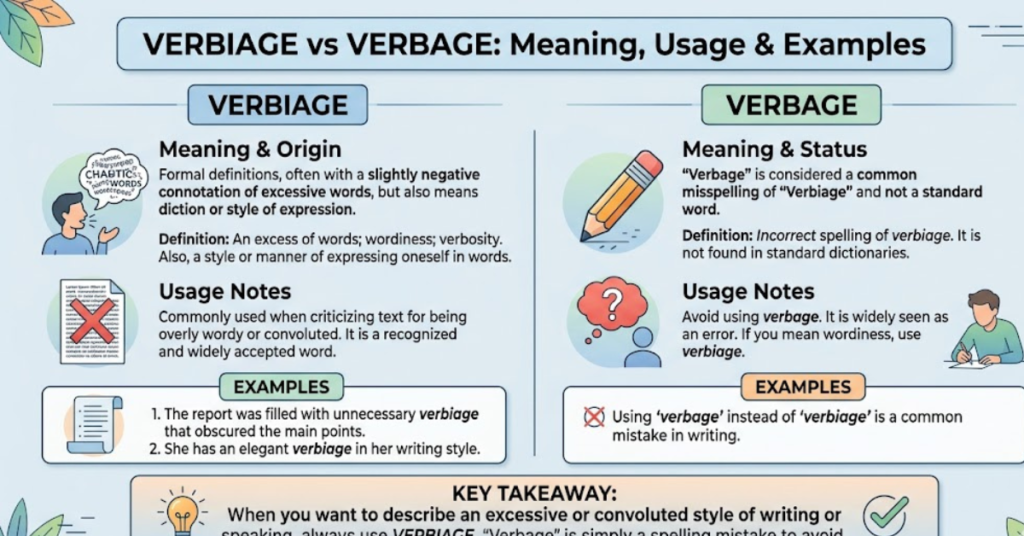
Verbiage Definition
Verbiage is a real English word. It refers to:
- Excessive or unnecessary words
- Overly complex or wordy language
- Sometimes, simply the wording of a text
In many cases, verbiage carries a slightly negative tone, suggesting that something could be said more clearly or concisely.
Example Sentences
- The contract was filled with confusing verbiage.
- Try to reduce unnecessary verbiage in your writing.
- The speech had too much verbiage and not enough substance.
What Is “Verbage”? (And Is It Correct?)
Verbage Definition
Here’s the truth: verbage is not considered a standard word in formal English.
It’s a common misspelling of verbiage. While you might see it used informally online, it’s generally viewed as incorrect in:
- Academic writing
- Professional documents
- Published content
Why Do People Use “Verbage”?
There are a few reasons:
- It sounds simpler and more intuitive
- It follows patterns like coverage or storage
- It’s often used mistakenly without realizing the correct spelling
Verbiage vs Verbage Meaning: Side-by-Side
Let’s make it crystal clear:
| Term | Status | Meaning |
| Verbiage | Correct | Excessive or unnecessary wording |
| Verbage | Incorrect | Misspelling of verbiage |
When comparing verbiage vs verbage definition, only verbiage holds real linguistic value.
Verbiage vs Verbage Pronunciation
Pronunciation is another area where confusion creeps in.
- Verbiage → VUR-bee-ij
- Verbage → Often pronounced the same, which adds to the confusion
Because they sound alike, many people assume both are valid—but spelling matters, especially in writing.
Verbiage vs Verbage Examples in Real Context
Let’s look at practical usage to understand this better.
Correct Usage (Verbiage)
- The legal document contains too much verbiage.
- Clear writing avoids unnecessary verbiage.
Incorrect Usage (Verbage)
- The report has too much verbage.
- Please reduce the verbage in this paragraph.
Even though readers may understand what you mean, using verbage can make your writing look less polished.
Why Using the Right Word Matters
Choosing between verbiage vs verbage isn’t just about grammar—it’s about credibility.
Using the correct form:
- Builds trust with your audience
- Improves readability
- Enhances SEO performance
- Reflects professionalism
In digital content, small mistakes can impact how your writing is perceived—and even ranked.
Tips to Avoid This Common Mistake
Here are a few simple tricks to remember:
- Think “bi” in verbiage → it’s part of the correct spelling
- Associate it with verbose (another word related to wordiness)
- Double-check when writing formal content
A quick mental check can save you from an easy-to-make error.
Verbiage vs Verbage vs Verbiage: Why the Confusion Persists
You might have seen phrases like verbiage vs verbage vs verbiage floating around online. This repetition usually reflects search behavior rather than actual differences.
In reality:
- There’s only one correct word: verbiage
- The rest is just variation or misspelling
Search engines pick up these patterns because people often type what they think is correct.
FAQs About Verbiage vs Verbage
1. Is “verbage” ever acceptable?
No, verbage is considered a misspelling in standard English. Always use verbiage.
2. What is the correct meaning of verbiage?
It refers to excessive, unnecessary, or overly complex wording.
3. Why do people confuse verbiage and verbage?
Because they sound the same and follow similar spelling patterns found in other English words.
4. How do you pronounce verbiage?
It’s pronounced VUR-bee-ij.
5. Can verbiage ever be neutral or positive?
Yes, in some contexts it simply refers to wording, but it often carries a negative tone.
Conclusion: Keep It Clear, Keep It Correct
When it comes to verbiage vs verbage, the verdict is simple: verbiage is correct, and verbage is not.
Understanding the difference helps you write more clearly, communicate more effectively, and present yourself as a careful, confident writer.
If you’re aiming to improve your writing, start by trimming unnecessary verbiage—and spelling it right while you’re at it.
Want to sharpen your language skills even more? Explore other commonly confused words and take your writing to the next level.