
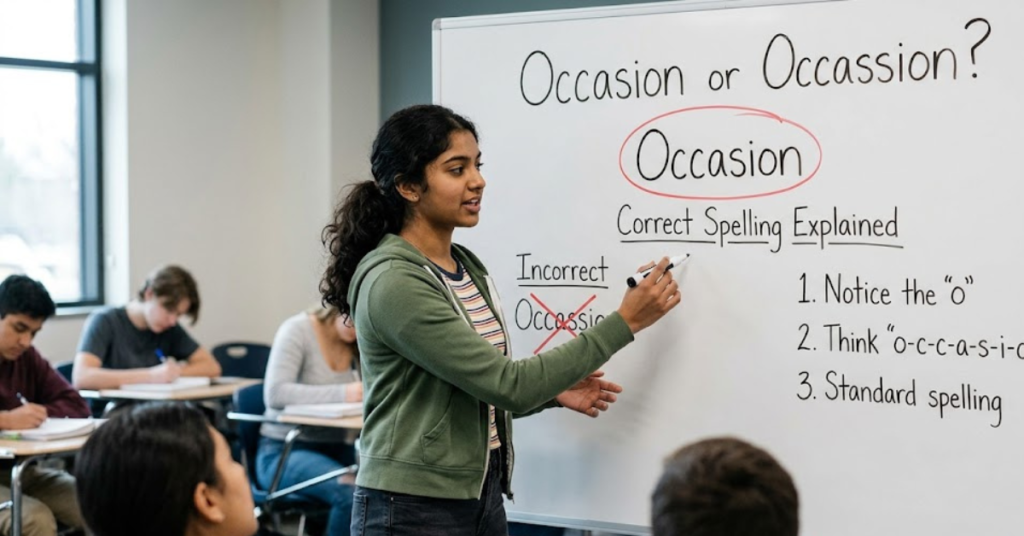

Have you ever paused while typing and wondered whether to write “occasion” or “occassion”? You’re definitely not alone. This is one of the most commonly misspelled words in English because of its double letters and pronunciation. Many people accidentally add an extra “s,” resulting in “occassion,” but only one version is correct.
In this guide, you’ll learn the correct spelling, why the mistake happens, how to remember the right version, and how to use the word naturally in sentences. If you’ve searched for “occassion or occasion is correct” or “which is correct occassion or occasion?” this article will clear up the confusion once and for all.
What Is the Correct Spelling?
The correct spelling is occasion.
The word “occassion” is incorrect and is considered a spelling mistake in standard English.
Correct:
- Occasion
Incorrect:
- Occassion
The confusion usually comes from the pronunciation. Since the word sounds like it has an extra “s” when spoken quickly, many writers unintentionally spell it with “ss.”
What Does “Occasion” Mean?
The word “occasion” has a few related meanings depending on how it’s used in a sentence. Most commonly, it refers to a special event, a particular time, or a reason for something happening.
Common meanings of “occasion”:
- A special event or celebration
- A particular time or instance
- A cause or reason
Examples:
- We dressed formally for the occasion.
- On one occasion, she forgot her passport.
- His comments gave no occasion for concern.
Because it’s such a versatile word, you’ll see it often in both formal and casual English.
Why Do People Misspell Occasion?
The spelling mistake happens for a few simple reasons.
1. Pronunciation Confusion
When spoken aloud, “occasion” can sound like it contains a double “s.” English pronunciation doesn’t always match spelling perfectly, which leads to errors.
2. Double-Letter Patterns
English contains many words with double consonants:
- Permission
- Discussion
- Occasionally
Because of these patterns, writers sometimes assume “occasion” follows the same structure.
3. Typing Habits
Fast typing and autocorrect mistakes also contribute to the popularity of the misspelling.
Easy Trick to Remember the Correct Spelling
A simple way to remember the spelling is this:
Occasion has one “s” and two “c” letters.
Break it down:
- oc + ca + sion
Another helpful memory trick:
Think of the word “occasionally.” The root word remains “occasion,” not “occassion.”
How to Use “Occasion” in Sentences
Seeing the word in context makes it easier to remember and use correctly.
Everyday Examples
- Birthdays are special occasions.
- I only drink coffee on rare occasions.
- The wedding was a joyful occasion for the whole family.
- On one occasion, we got lost during the trip.
Formal Examples
- The ceremony marked an important occasion in history.
- There is no occasion for panic at this stage.
Using the word naturally in conversation and writing helps reinforce the correct spelling over time.
Occasion as Different Parts of Speech
One interesting thing about “occasion” is that it can function as both a noun and a verb.
As a Noun
This is the most common use.
Example:
- The award ceremony was a memorable occasion.
As a Verb
Less commonly, it means “to cause something.”
Example:
- The policy change occasioned widespread debate.
Although the verb form exists, most people mainly use “occasion” as a noun.
Common Phrases With “Occasion”
Here are some expressions that frequently use the word:
On Occasion
Meaning: Sometimes
Example:
- We eat out on occasion.
Special Occasion
Meaning: An important or memorable event
Example:
- She bought the dress for a special occasion.
Rise to the Occasion
Meaning: Perform well during a challenge
Example:
- The team rose to the occasion during the finals.
Learning these phrases can improve both your vocabulary and confidence in writing.
Occasion vs Similar Words
Sometimes people confuse “occasion” with related terms. Here’s how they differ.
Occasion vs Event
- Occasion often implies significance or emotion.
- Event is broader and more neutral.
Example:
- A wedding is both an event and a special occasion.
Occasion vs Opportunity
- Occasion refers to a moment or event.
- Opportunity refers to a favorable chance.
Example:
- Graduation is an occasion.
- A job interview is an opportunity.
Which Is Correct: Occassion or Occasion?
To settle it clearly:
- “Occasion” is the correct spelling.
- “Occassion” is incorrect in English grammar and spelling.
If you’re writing professionally, academically, or even casually online, using the correct spelling matters because it improves clarity and credibility.
How Spellcheck Handles the Word
Most spellcheck tools automatically flag “occassion” as incorrect and suggest “occasion.” However, relying completely on autocorrect isn’t always ideal because typos can still slip through.
Developing familiarity with commonly misspelled words strengthens your overall writing skills.
Frequently Misspelled Words Similar to Occasion
If you often struggle with “occasion,” you may also find these words tricky:
- Accommodation
- Embarrass
- Necessary
- Separate
- Recommendation
These words share similar spelling challenges involving repeated consonants.
Tips to Avoid Spelling Mistakes
Improving spelling doesn’t require memorizing endless rules. A few simple habits can make a big difference.
Helpful Strategies
- Read more regularly
- Slow down while typing
- Use spellcheck carefully
- Practice commonly misspelled words
- Break words into syllables
Consistency is more important than perfection.
FAQs
Is “occassion” ever correct?
No. “Occassion” is always considered a misspelling. The correct version is “occasion.”
Why is “occasion” spelled with one “s”?
The word comes from Latin and evolved through French into English. Its accepted spelling uses only one “s.”
How do you remember the spelling of “occasion”?
Remember this pattern: two “c” letters and one “s.”
What does “special occasion” mean?
It refers to an important or memorable event, such as a wedding, anniversary, or graduation.
Is “occasion” a noun or a verb?
It can be both, though it is most commonly used as a noun.
How common is the misspelling “occassion”?
Very common. Many people accidentally add an extra “s” because of pronunciation patterns.
Conclusion
The confusion between occassion or occasion is extremely common, but the rule is simple once you know it. The correct spelling is always “occasion,” with two “c” letters and only one “s.” The version “occassion” is a spelling error that should be avoided in formal and everyday writing.
Understanding why the mistake happens, practicing the correct spelling, and using memory tricks can help you avoid repeating it in the future. Whether you’re writing emails, essays, captions, or professional documents, mastering commonly confused words like “occasion” improves your communication and confidence.
If you enjoy learning about tricky English words and spelling differences, exploring similar language guides can sharpen your writing even further.