
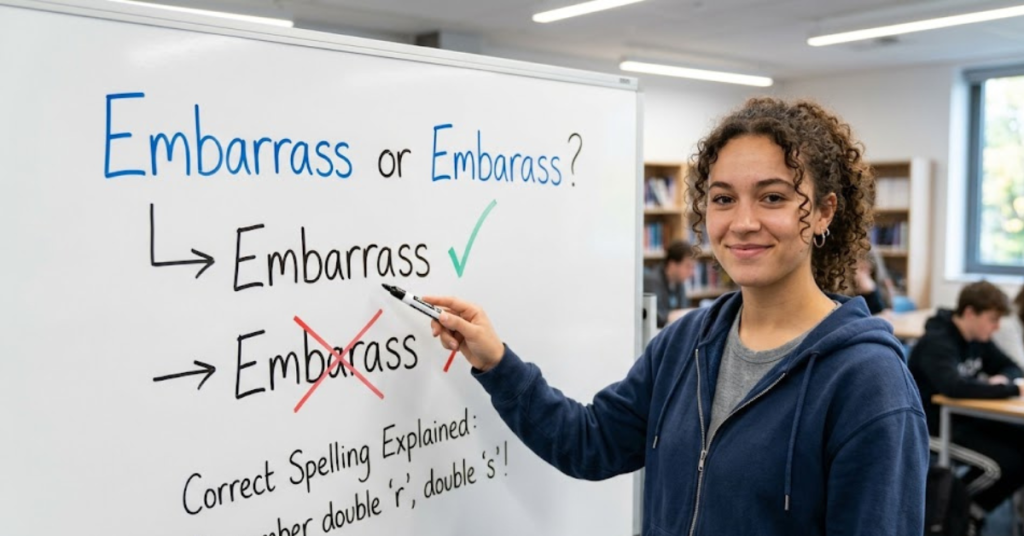

Have you ever paused mid-sentence while typing because you suddenly forgot whether it’s embarass or embarrass? You’re not alone. This is one of the most commonly misspelled words in English, and even confident writers second-guess themselves.
The correct spelling is embarrass — with two “r” letters and two “s” letters.
The version embarass is incorrect, although many people accidentally type it because the pronunciation can make the spelling confusing. In this guide, you’ll learn why the mistake happens, how to remember the correct spelling, and how to use the word naturally in everyday writing and conversation.
Why People Confuse “Embarrass” and “Embarass”
English spelling isn’t always logical. Some words sound simpler than they look, and this is one of them.
When spoken aloud, “embarrass” sounds smooth enough that the double letters are easy to miss. Many writers assume there’s only one “r,” leading to the common typo.
Here are a few reasons this spelling mistake happens so often:
- Double consonants can be hard to remember
- The pronunciation doesn’t strongly emphasize both “r” letters
- Fast typing increases spelling errors
- Spellcheck may not always catch mistakes immediately
Because of these factors, many people search online to verify the correct form before sending emails, writing essays, or posting on social media.
The Correct Spelling Is “Embarrass”
The proper spelling is:
Embarrass
Spelling breakdown:
- Em
- Bar
- Rass
Notice the pattern:
- Two “r” letters
- Two “s” letters
A quick memory trick is:
“An embarrassing mistake deserves extra letters.”
That little reminder helps many people remember the double “r” and double “s.”
What Does “Embarrass” Mean?
The word “embarrass” means to make someone feel awkward, self-conscious, uncomfortable, or ashamed.
It can refer to small social moments or more serious situations.
Examples of Correct Usage
- I didn’t mean to embarrass you in front of everyone.
- Forgetting her name was embarrassing.
- He gets embarrassed easily during presentations.
- Loud parents can embarrass teenagers quickly.
The word can function in different forms:
- Embarrass (verb)
- Embarrassed (adjective/past tense)
- Embarrassing (adjective)
- Embarrassment (noun)
Common Misspellings of “Embarrass”
Besides embarass, several other incorrect versions appear frequently online.
Incorrect Variations
- Embarass
- Embarres
- Embarras
- Embarassed
- Embarrasment
Correct Variations
- Embarrass
- Embarrassed
- Embarrassing
- Embarrassment
The noun “embarrassment” is especially tricky because it keeps the double “r” and double “s.”
Easy Ways to Remember the Correct Spelling
Spelling becomes easier when you use memory techniques. Here are a few simple tricks that actually work.
1. Remember “Double R, Double S”
Think of the word as balanced:
- Two R’s
- Two S’s
This is the most reliable spelling shortcut.
2. Break the Word Into Parts
Instead of memorizing the entire word at once, divide it:
Em + barr + ass
Smaller chunks are easier for the brain to retain.
3. Read More Often
Frequent readers naturally recognize correct spelling patterns. Seeing the word repeatedly in books, articles, and messages helps reinforce memory.
4. Practice Writing It
Typing or handwriting difficult words a few times can improve long-term recall.
Is “Embarass” Ever Accepted?
No. Embarass is not considered a correct spelling in standard English.
Whether you’re writing:
- Academic papers
- Professional emails
- Blog posts
- Social media captions
- Text messages
…the accepted spelling is always “embarrass.”
Using the incorrect version may make your writing appear careless, especially in professional settings.
The Origin of the Word “Embarrass”
The word comes from French and Spanish roots connected to the idea of obstruction or difficulty. Over time, English adopted the modern meaning associated with social discomfort or awkwardness.
Its unusual spelling reflects its historical linguistic roots, which explains why it doesn’t follow simple English spelling rules.
Words People Commonly Misspell Alongside “Embarrass”
If you struggle with this word, you’re probably not alone with these too:
- Necessary
- Accommodation
- Occasion
- Maintenance
- Separate
- Definitely
- Questionnaire
Most of these contain repeated letters or unexpected spelling patterns.
Tips to Avoid Spelling Mistakes in Writing
Even experienced writers make spelling errors occasionally. Here are practical ways to reduce them.
Use Spellcheck Carefully
Spellcheck helps, but don’t rely on it completely. Sometimes autocorrect introduces new errors.
Proofread Slowly
Reading too quickly makes the brain skip mistakes because it recognizes the intended word instead of the actual spelling.
Read Your Text Out Loud
This helps catch awkward phrasing and spelling inconsistencies.
Build a Personal “Difficult Words” List
Keep track of words you commonly misspell and review them occasionally.
Why Correct Spelling Still Matters
Some people argue that minor spelling mistakes don’t matter online anymore. While casual texting may be forgiving, correct spelling still affects:
- Professional credibility
- Academic performance
- Search engine visibility
- Reader trust
- First impressions
Clear writing communicates confidence and attention to detail.
Frequently Asked Questions
Is it embarrass or embarass?
The correct spelling is “embarrass.” The spelling “embarass” is incorrect.
Why is “embarrass” hard to spell?
People often forget the double “r” because the pronunciation doesn’t strongly emphasize it.
How do you remember how to spell embarrass?
A helpful trick is to remember:
“Double R, double S.”
Is “embarrassed” spelled with two R’s?
Yes. “Embarrassed” also contains two “r” letters and two “s” letters.
Is embarass in the dictionary?
No reputable English dictionary lists embarass as the standard spelling.
What part of speech is “embarrass”?
“Embarrass” is a verb.
Conclusion
The confusion between embarrass or embarass is extremely common, but the correct spelling is always embarrass with two “r” letters and two “s” letters. Once you understand the spelling pattern and use a few memory tricks, it becomes much easier to remember.
Spelling mistakes happen to everyone, especially with tricky English words. The important thing is learning the correct form and using it confidently in your writing. If you frequently mix up similar words, practicing them in context can improve both your spelling and overall communication skills.