


Do you ever look at your guitar neck and feel a little lost? You are not alone! Many players just strum chords without knowing where the notes actually live. Learning the Guitar Fretboard Notes is the secret key that unlocks the whole instrument. When you know your way around the fretboard, playing gets way more fun. You can build your own chords, play cool melodies, and jam with your friends easily.
The best part is that you do not need a music degree to figure this out. We are going to break it down into tiny, simple pieces. By the end of this guide, finding those sneaky guitar fretboard notes will feel like second nature. Grab your favorite axe, tune it up, and let us start mapping out your fretboard step by step!
Meet the Musical Alphabet
Before we touch the strings, let us talk about the musical alphabet. It is super short and easy to remember. It only has seven letters: A, B, C, D, E, F, and G. After G, it just loops right back around to A.
Most of these letters have a little buddy called a sharp (marked with a # symbol) or a flat (marked with a b symbol). A sharp just means you go one fret higher, and a flat means you go one fret lower. There are two special pairs of notes that do not have a sharp or flat between them: B and C, and E and F. Knowing this rule makes memorizing your guitar fretboard notes much faster!
Tuning Your Open Strings
Your guitar has six strings, and each one starts with a specific note when you play it open (without pressing down any frets). From the thickest string to the thinnest string, the standard tuning is E, A, D, G, B, and E. A fun way to remember this is the silly phrase: “Elephants And Donkeys Grow Big Ears.”
When you pluck a string without pressing a fret, that open sound gives you your starting point for all the other guitar fretboard notes on that string. Let us say your thick E string is open. If you press the first fret, you move up one letter in our musical alphabet to an F. It is like climbing a little musical ladder!
The Magic of the Octave Shape
An octave is just the same note, but higher or lower in pitch. For example, a low E and a high E sound like cousins. On the guitar, finding octaves is like playing a fun visual game.
If you want to find the exact same note as your low E string on the A string, you just move up two frets and across one string. This cool shape helps you find guitar fretboard notes all over the neck without counting every single fret one by one. Once you spot your first octave shape, the whole fretboard starts looking smaller and way less scary.
Memorizing the E and A Strings First
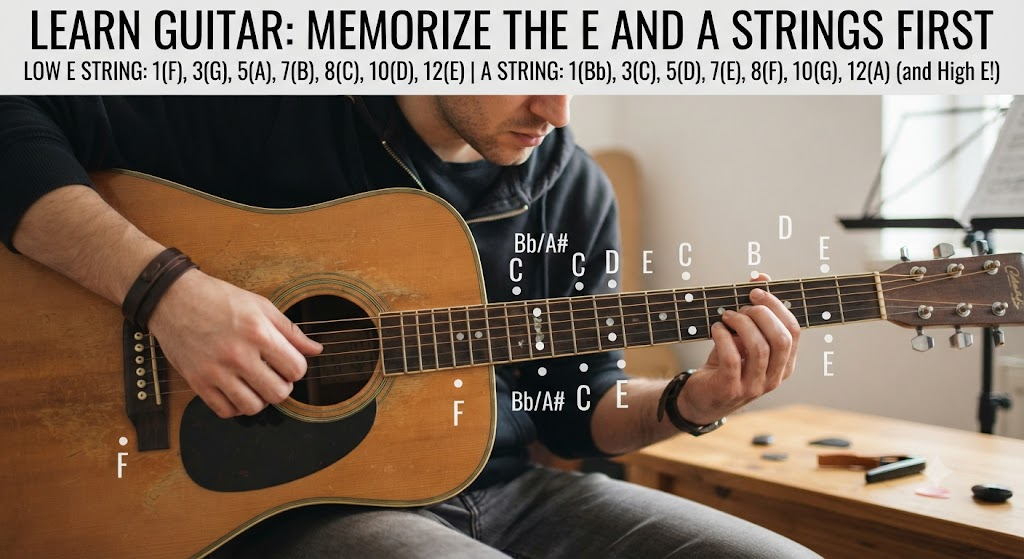
You do not need to memorize every single fret on day one. That would make your brain feel super tired! Instead, start by learning the natural notes on your thickest low E string and your A string.
On the low E string, the notes are on frets 1, 3, 5, 7, 8, 10, and 12. Once you know these, you already know the guitar fretboard notes for your high E string too, because they use the exact same names! Spend just five minutes a day naming the notes on these two big strings, and you will see amazing progress by next week.
Using Fret Markers as Road Signs
Look down at the edge of your guitar neck. Do you see those little dots? Those are your fret markers! They usually sit on the third, fifth, seventh, and ninth frets, with a double dot right on the twelfth fret.
Think of these dots as street signs on your musical road trip. Instead of guessing where you are, use the dots to anchor your memory for the surrounding guitar fretboard notes. For example, the fifth fret on the low E string is always an A note. Whenever your finger lands on that fifth dot, you instantly know your location!
The Half-Step and Whole-Step Rule
In music, a half-step is the distance from one fret right next to it, like fret one to fret two. A whole-step is skipping one fret, like going from fret one to fret three. Natural notes with sharps or flats take up a whole step, while B-C and E-F only take a half step.
Understanding this stepping rule helps you figure out any missing guitar fretboard notes on the fly. If you know fret three is a G, you know fret four must be a G sharp or A flat. You are basically solving a fun little math puzzle right on your guitar neck every time you play.
The 12th Fret Reset Button
The twelfth fret is a magical place on your guitar. It is right in the middle of the string length, and it marks the exact point where all the guitar fretboard notes repeat themselves from the very beginning.
If your open string is an E, the twelfth fret is also an E, just one octave higher. Anything you play past the twelfth fret is just a mirror image of the first eleven frets. Knowing this reset button makes the upper half of the neck feel totally familiar instead of like a total mystery zone.
Daily Fretboard Warm-Up Games
Learning notes does not have to be boring homework. You can turn it into a quick daily game before you practice your favorite songs. Pick one single note name, like the letter C, and try to find every single C on the entire guitar neck.
Set a little timer on your phone for three minutes and see how fast you can touch them all. Playing this game daily burns those guitar fretboard notes straight into your muscle memory. Soon, your fingers will just glide to the right spots without your brain needing to do any heavy lifting at all.
Connecting Notes to Major Scales
Scales are just organized families of notes that sound great together. The major scale follows a specific recipe of whole steps and half steps. When you play a scale, you are literally walking through a specific set of guitar fretboard notes in a pleasing order.
When you practice your scales, always say the letter names out loud as you play them. This links your ear, your voice, and your fingers together into one superpower team. You will stop seeing random metal bars and start seeing musical pathways everywhere you look.
Real-World Song Application
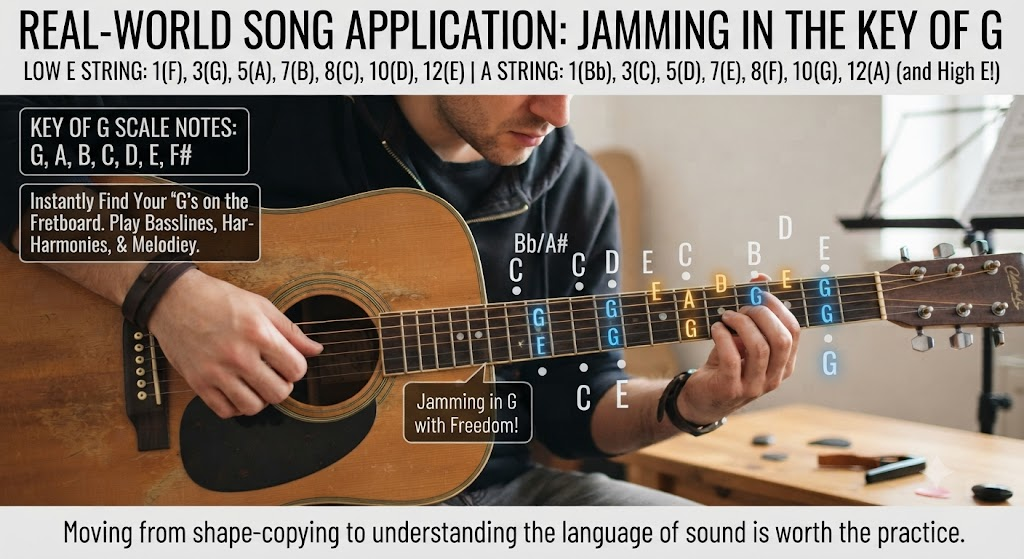
The real magic happens when you take what you learned and use it in a real song. When a friend says, “Let us jam in the key of G,” you won’t panic. You will instantly know where your G guitar fretboard notes are hiding.
You can play a bassline, find a harmony, or create your own little melody right on the spot. It turns you from someone who just copies shapes into a real musician who actually understands the language of sound. That freedom is totally worth the little bit of practice it takes to get there!
Complete Fretboard Reference Table
| String Name | Open Fret | 3rd Fret | 5th Fret | 7th Fret | 10th Fret | 12th Fret |
| High E String | E | G | A | B | D | E |
| B String | B | D | E | F# | A | B |
| G String | G | A# | C | D | F | G |
| D String | D | F | G | A | C | D |
| A String | A | C | D | E | G | A |
| Low E String | E | G | A | B | D | E |
Frequently Asked Questions
How long does it take to learn guitar fretboard notes?
It usually takes a few weeks of consistent daily practice to get comfortable with the basics. You do not need to memorize everything at once. Focus on one string at a time, and the patterns will stick in your memory naturally before you know it.
Do I need to memorize every single fret right away?
No way! Start with the low E and A strings, and use your fret dots as helpful landmarks. Learning these core guitar fretboard notes gives you a solid foundation without overwhelming your brain with too much data all at once.
What is the easiest way to practice finding notes?
Play a quick finding game before your normal practice routine. Pick a random letter like D, and find every D on the neck within two minutes. Making it a fun challenge helps your brain remember the layouts much faster than boring drills.
Why do some notes not have sharps or flats?
Between B and C, and between E and F, there is only a natural half step in standard Western music theory. Remembering this special rule makes counting out the rest of the guitar fretboard notes much simpler and keeps you from getting confused.
How do fret markers help me find notes?
Fret markers act like visual street signs on your guitar neck. The third, fifth, seventh, and ninth dots tell you your exact position so you don’t get lost while moving your hands up and down the fretboard during a song or solo.
Can knowing these notes help me write better music?
Yes, absolutely! When you know the exact names of the guitar fretboard notes, you can easily build your own chords, create sweet melodies, and communicate smoothly with other musicians when you are jamming together.
Conclusion
Learning your way around the guitar neck is one of the best investments you can make in your musical journey. By taking it slow and practicing a little bit each day, those guitar fretboard notes will transform from a confusing puzzle into your favorite creative playground.
Pick up your guitar right now and try finding just three notes on your low E string. You have got this! Keep having fun, keep playing every single day, and watch how much your confidence grows on the instrument.