
If you’ve ever paused mid-sentence wondering whether to write check in or check-in, you’re not alone. This small grammar detail often confuses even experienced writers.
The good news? Once you understand how each form works in a sentence, the choice becomes simple.
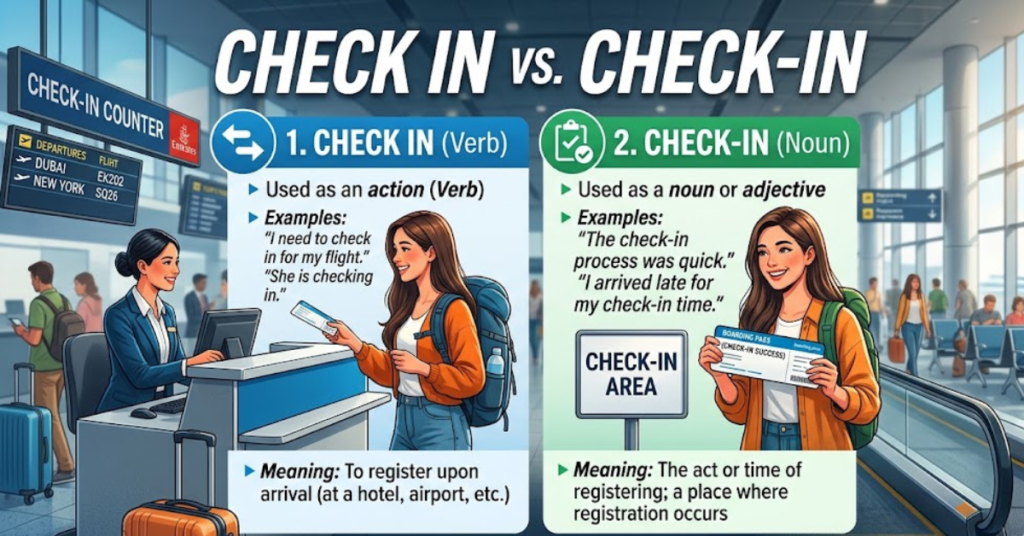
The Simple Rule
At its core, the difference comes down to usage:
- “Check in” (two words) → a verb (an action)
- “Check-in” (hyphenated) → a noun or adjective (a thing or description)
Quick tip:
If it’s something you do, use the verb form.
If it’s something you can name, use the hyphenated form.
When to Use the Verb Form
This version describes an action.
Examples:
- I’ll check in with you later about the project.
- Please check in at reception when you arrive.
- Let’s follow up tomorrow to review progress.
Common situations:
- Following up with someone
- Arriving at a location
- Casual communication
When to Use the Hyphenated Form
The hyphenated version refers to a thing, event, or scheduled interaction.
Examples:
- We have a weekly team meeting.
- Hotel check-in starts at 2 PM.
- Let’s schedule a quick call.
Where it appears:
- Workplace communication
- Travel processes
- Planned updates
Meetings: Which Form Is Correct?
Both forms appear, depending on usage:
- Check-in meeting (noun)
- We have a check-in meeting every Monday.
- Verb usage
- Please check in before the meeting starts.
Travel Example: Hotels & Flights
A common real-life situation:
- Action:
- I will checkin at the hotel at 3 PM.
- Process:
- Arrival begins at 3 PM.
What About “Checkin”?
- Checkin → incorrect
- Two words → action
- Hyphenated → noun/adjective
Avoid combining it into one word.
Quick Grammar Guide
- Action → use the verb
- Event or thing → use the hyphenated version
- Description → use the hyphenated version
Weekly Usage
- Weekly check-in → correct
- Our weekly meeting keeps the team aligned.
- Verb usage → also correct
- Please check’s in weekly with your manager.
Everyday Examples
Work:
- Let’s do a quick meeting before the deadline.
- I’ll follow up with the team later today.
Travel:
- Don’t forget to check in online before your flight.
- Boarding starts at noon.
Casual:
- Just reaching out to see how you’re doing.
- We had a great catch-up yesterday.
Common Mistakes to Avoid
- Using the hyphenated form as an action
- Writing it as one word
- Mixing both forms incorrectly
Pro Tip
If you can replace the phrase with “arrive” or “follow up,” you’re using the verb.
Read also <<< Phenix vs Phoenix: Meaning, Usage & Key Differences
FAQs
1. Which form is correct?
Both are correct—it depends on how they’re used.
2. Is the one-word version ever correct?
No, it’s not standard English.
3. How do I use them in a sentence?
- Verb: I’ll check in later.
- Noun: We had a quick check-in.
4. What about meetings?
Use the hyphenated version for the meeting itself, and the verb for the action.
5. Can I say “I wanted to check-in”?
No. The correct form uses two words.
Conclusion
Once you understand the difference between an action and a thing, this rule becomes easy to apply.
Use the verb form for actions and the hyphenated version for events or descriptions. Keep it simple, and your writing will feel natural and professional.