
You’ve probably written it at least once and paused, is it “time flies” or “time flys”? This tiny spelling dilemma trips up a surprising number of people. The phrase is common, but the grammar behind it isn’t always obvious.
In this article, we’ll break down in a clear and friendly way so you can use it confidently. You’ll learn which form is correct, why it works, and how to avoid similar mistakes in everyday writing.
Which Is Correct?
Let’s settle it right away:
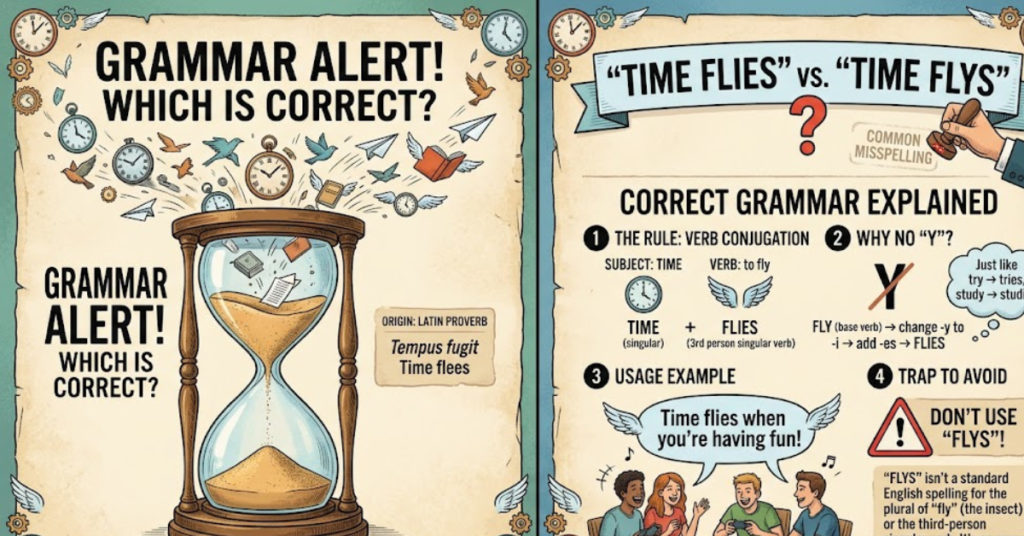
Correct: Time flies
Incorrect: Time flys
If you’ve ever wondered, “is it time flies or time flys?”, the answer is straightforward—“time flies” is grammatically correct.
Why “Time Flies” Is Correct
Understanding the Grammar
The phrase time flies uses:
- “Time” as a singular noun
- “Flies” as the present tense verb
In English, when the subject is singular (like time), the verb usually takes an -s in the present simple tense.
Examples:
- Time flies when you’re having fun
- She runs every morning
- He writes daily
So when people ask, “which is correct time flies or time flys?”, the rule is simply subject-verb agreement.
Why “Time Flys” Is Incorrect
The Confusion Explained
The spelling flys often appears because:
- People confuse it with plural nouns like boys or toys
- They assume verbs follow the same pattern
But here’s the key difference:
- “Flies” = correct verb form (from fly)
- “Flys” = incorrect spelling in this context
Interestingly, flys can appear in very limited technical contexts (like proper names), but it’s not correct in standard grammar.
What Does “Time Flies” Mean?
If you’re searching for time flies or time flys meaning, here’s a simple explanation:
“Time flies” means that time seems to pass very quickly.
Common Usage Examples
- Time flies when you’re enjoying yourself
- I can’t believe it’s already Friday—time flies!
- The kids have grown up so fast; time really flies
This phrase is often used in both casual conversations and writing.
Do You Say Time Flies or Time Flys?
If you’re wondering, “do you say time flies or time flys?”, the answer is:
Always say “time flies.”
It’s the standard, accepted form in:
- Spoken English
- Academic writing
- Professional communication
Grammar Rules
To avoid this mistake in the future, remember these quick grammar tips:
1. Singular Subject Rule
- Singular subject → verb ends in -s
- Example: Time flies, not fly
2. Verb vs Noun Forms
- Verb: flies (correct)
- Incorrect variation: flys
3. Similar Examples
- He tries (not trys)
- She studies (not studys)
These patterns help reinforce the correct structure behind time flies or time flys grammar.
Common Mistakes to Avoid
Here are a few errors people often make:
- Writing “time flys” in emails or essays
- Assuming “flys” is just a modern variation
- Mixing up verb and plural noun rules
Quick Tip
If you’re unsure, say the sentence out loud.
“Time flies” will always sound natural—“time flys” won’t.
Why This Mistake Is So Common
You might see searches like time flies or time flys yahoo because people frequently double-check this phrase online.
The confusion usually comes from:
- English spelling inconsistencies
- Similar-looking plural forms
- Overthinking simple grammar rules
The good news? Once you understand the rule, it’s easy to remember.
FAQs
1. Is it time flies or time flys?
It’s time flies. This is the correct grammatical form.
2. Why is “time flys” incorrect?
Because flys is not the correct verb form. The proper present tense is flies.
3. What does “time flies” mean?
It means time passes quickly, especially when you’re enjoying something.
4. Do you say time flies or time flys in formal writing?
Always use time flies in both formal and informal writing.
5. Which is correct: time flies or time flys grammar-wise?
Grammatically, time flies is correct due to subject-verb agreement.
Conclusion
So, next time you hesitate over time flies or time flys, you’ll know exactly what to write. The correct phrase is “time flies”, and it follows a simple grammar rule: singular subjects take verbs ending in -s.
It’s a small detail, but getting it right makes your writing clearer and more polished. Keep this rule in mind, and you’ll avoid similar mistakes in the future.
If you found this helpful, consider exploring other common grammar questions—you’ll be surprised how many quick wins are out there.