
Ever written a sentence, paused, and wondered whether to use passed or past? You’re not alone. The confusion around passed vs past is one of the most common grammar slip-ups in English—and it can trip up even confident writers.
In this guide, we’ll break down the passed vs past meaning, explain when to use each word, and give you practical examples you can actually remember. By the end, you’ll never second-guess this pair again.
Passed vs Past Meaning (Quick Overview)
Let’s keep it simple:
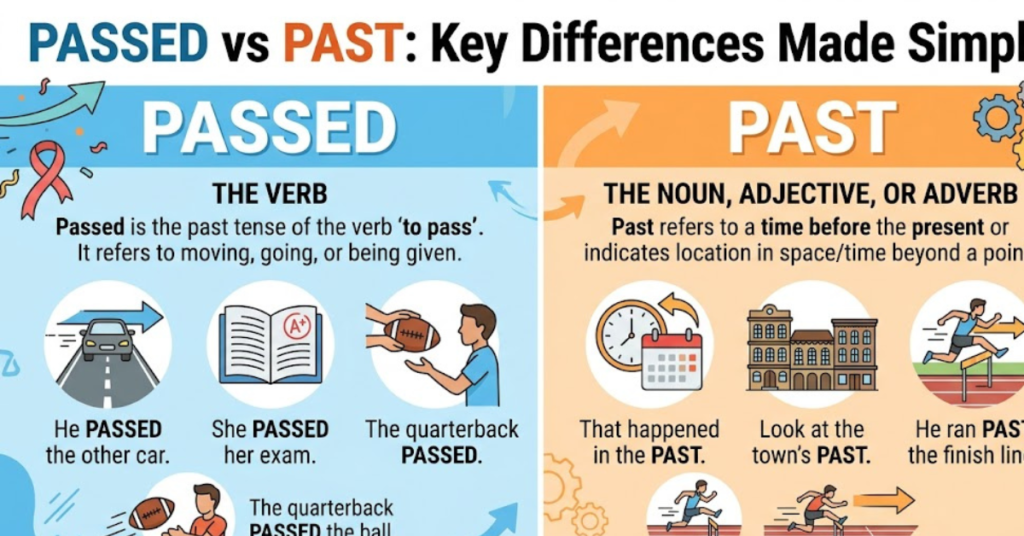
- Passed = a verb (action)
- Past = a noun, adjective, adverb, or preposition (time, direction, or position)
If you remember just one thing, make it this:
If an action happened, you probably need “passed.”
What Does “Passed” Mean?
“Passed” is the past tense of the verb “pass.” It always describes an action that has already happened.
Common Uses of “Passed”
- Moving by something
- Completing something
- Transferring or giving something
- Time going by
Passed vs Past Examples
- She passed the exam.
- The car passed us.
- He passed the ball to his teammate.
- Time has passed quickly this year.
Passed vs Past Away
This is a special case:
- “Passed away” is a polite way to say someone died.
Correct: He passed away peacefully.
Incorrect: He past away peacefully.
What Does “Past” Mean?
“Past” is not a verb. It relates to time, position, or direction.
Common Uses of “Past”
- Referring to time before now
- Showing movement beyond something
- Describing a previous period
Passed vs Past in a Sentence
- That’s all in the past now.
- It’s half past five.
- She walked past the store.
- In past years, things were different.
Passed vs Past Difference (Grammar Made Easy)
Here’s a quick breakdown:
| Word | Part of Speech | Meaning | Example |
| Passed | Verb | Something happened (action) | He passed the test. |
| Past | Noun/Adj/etc. | Time or position | Leave the past behind. |
When to Use Passed vs Past
If you’re unsure, ask yourself:
- Is there an action happening?
→ Use passed - Is it about time, direction, or position?
→ Use past
Quick Test Trick
Try replacing the word with “went”:
- If it works → use passed
- If it doesn’t → use past
Example:
- He went the shop → So: He walked past the shop
- He went the exam → So: He passed the exam
Common Mistakes to Avoid
1. Walked Passed vs Past
Correct: She walked past me.
Incorrect: She walked passed me.
2. Get Passed vs Past
Correct: I couldn’t get past the guard.
Correct: The ball got passed to him.
3. Look Passed vs Past
Correct: Look past your fears.
Incorrect: Look passed your fears.
4. Years Passed vs Past
Correct: Years have passed since we met.
Correct: In past years, things were cheaper.
5. Passed vs Past Deadline
Correct: The deadline has passed.
Correct: We are past the deadline.
Passed vs Past Grammar Examples
Here are more examples to lock it in:
- The train passed the station.
- It’s now past midnight.
- He passed his driving test.
- That belongs to the past.
- She passed me on the road.
- We walked past the park.
Pass vs Passed vs Past
Let’s quickly compare all three:
- Pass → present tense (I pass the ball)
- Passed → past tense (I passed the ball)
- Past → time/place (It’s in the past)
Passed vs Past Time (Special Case)
When talking about time:
- Half past six (correct)
- Half passed six (incorrect)
But:
- Time has passed (correct)
Quick Practice (Mini Quiz)
Choose the correct word:
- She walked ___ me without saying hello.
- The time has ___ quickly.
- That’s all in the ___.
- He ___ the ball to me.
Answers:
- past
- passed
- past
- passed
FAQs
What is the difference between passed vs past?
“Passed” is a verb showing action, while “past” refers to time, direction, or position.
When should I use passed vs past?
Use “passed” for actions and “past” for time or location.
Is it walked past or walked passed?
The correct phrase is walked past.
What does passed vs past away mean?
“Passed away” is correct and means someone has died. “Past away” is incorrect.
How do I remember the difference easily?
Think: passed = action, past = time/place.
Conclusion
Mastering passed vs past doesn’t have to be complicated. Once you remember that passed is an action and past relates to time or position, the confusion fades quickly.
The next time you’re writing, take a second to check:
Are you describing something happening—or something already behind you?
Keep practicing with real sentences, and soon this grammar rule will feel completely natural.