
Ever paused while typing and wondered whether it should be catchup or catch up? You’re not alone. This is one of those English language doubts that trips up even fluent speakers.
The phrase catch up is commonly used in everyday conversation, work emails, and social media. But the spelling and usage can change depending on context, which creates confusion. In this guide, we’ll break everything down in a simple, practical way so you’ll never second-guess it again.
What Does “Catch Up” Mean?
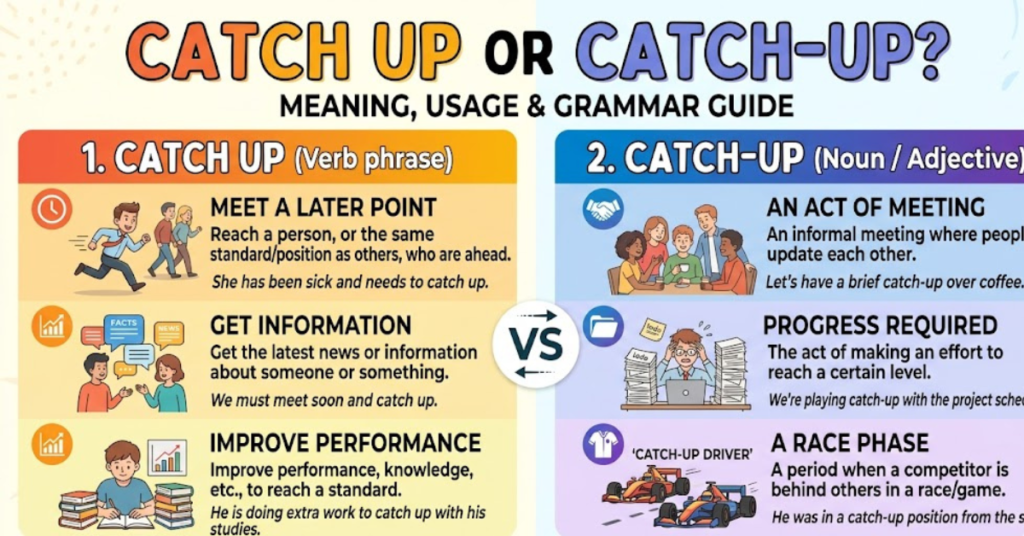
At its core, catch up is a phrasal verb. It means to reach the same level, status, or position as someone or something.
Common meanings include:
- Reaching someone ahead of you
- Updating yourself with news or information
- Returning to a previous level or progress
Example:
- I need to catch up on sleep.
- Let’s catch up after work.
Catch Up or Catchup – Which Is Correct?
This is where most confusion starts.
Correct form: catch up
Incorrect (in formal writing): catchup
“Catch up” (two words) is the standard grammatical form. However, “catchup” is sometimes used informally or in branding.
So if you’re writing professionally or academically, always go with catch up.
Catchup or Catch Up Meeting – What Does It Mean?
A catch up or catch up meeting refers to an informal meeting where people update each other on progress, life events, or work tasks.
In workplace context:
- Quick status updates
- Team alignment discussions
- One-on-one check-ins
Example:
- Let’s schedule a catch up meeting next week to review progress.
In professional writing, it is still more correct to say catch up meeting rather than “catchup meeting.”
Is It Catchup or Catch Up? Grammar Rule Explained
If you’re asking is it catchup or catch up, the answer depends on usage:
Use “catch up” when:
- It is a verb phrase
- You are describing an action
Example:
- I need to catch up with my emails.
“Catchup” is used when:
- Informally in branding or casual speech
- Sometimes as a noun in relaxed contexts
However, this is not standard grammar in formal English.
Catchup or Catch Up UK Usage
In the UK, both forms are seen in casual writing, but:
- Catch up is preferred in formal British English
- Catchup may appear in informal texts or messaging apps
So when in doubt, especially in academic or professional UK writing, stick to catch up.
Catchup or Catch Up or Catch-up – What’s the Difference?
You may also see catch-up with a hyphen.
Here’s the breakdown:
- Catch up → verb (most common)
- Catch-up → noun or adjective
- Catchup → informal or branding use
Example:
- We had a catch-up session yesterday.
- Let’s catch up tomorrow.
So technically, all three exist—but their usage depends on grammar role.
Catchup or Catch Up with Someone
When you meet someone after a long time, you often say catch up with someone.
Meaning:
To talk and exchange updates after not seeing each other for a while.
Examples:
- I’m going to catch up with my old friend.
- We should catch up with each other soon.
This is one of the most natural and widely used forms in everyday English.
Quick Summary (Easy Rules to Remember)
- Use catch up for verbs
- Use catch-up for nouns/adjectives
- Avoid catchup in formal writing
- “Catch up with someone” is the most common phrase in conversation
FAQs About Catch Up or Catchup
1. Is catchup or catch up correct?
“Catch up” is correct in formal English. “Catchup” is informal and not grammatically standard.
2. What is a catch up meeting?
A catch up meeting is an informal session where people update each other on progress or personal matters.
3. Is it catchup or catch up UK English?
In UK English, “catch up” is preferred in formal writing, while “catchup” appears informally.
4. Can I use catch-up instead of catch up?
Yes, but “catch-up” is usually a noun or adjective, not a verb.
5. What does catch up with someone mean?
It means meeting someone after a gap to talk and share updates.
Conclusion
Understanding catch up or catchup is actually simpler than it looks once you break it down. The key rule is: use catch up when writing formally, especially in emails, assignments, or professional communication.
Whether it’s a catch up meeting, a friendly chat, or catching up with someone, the correct form helps you sound clear and confident in English.
If you want to improve your grammar further, start noticing how native speakers use phrasal verbs in real conversations—it makes a huge difference over time.