
Ever stumbled across uncurable vs incurable and wondered which one is actually correct? You’re not alone. These two words look similar and seem to mean the same thing—but only one of them is considered proper English.
In this guide, we’ll break down the difference between uncurable vs incurable, explain why one form is preferred, and show you exactly how to use the correct term with confidence. Whether you’re writing professionally or just trying to improve your vocabulary, this article will clear things up in a simple, no-nonsense way.
What Does “Incurable” Mean?
Incurable is a standard English adjective that describes something that cannot be cured, healed, or remedied.
Common Uses:
- Medical conditions
- Habits or traits
- Situations that cannot be fixed
Examples:
- The disease is considered incurable.
- He’s an incurable optimist.
- Some conditions are manageable but incurable.
In everyday language, incurable is widely accepted and used across formal writing, healthcare, and general conversation.
What About “Uncurable”?
Here’s the straightforward truth: “uncurable” is not standard English.
While it might seem logical—since many words use the prefix un-—this particular form is rare, nonstandard, and generally considered incorrect in modern usage.
Why It Sounds Wrong:
English doesn’t always follow predictable rules when forming negatives. In this case:
- “Incurable” comes from Latin roots
- The prefix “in-” is the historically correct negative form
So even though “uncurable” might make sense structurally, it’s not recognized as proper usage in dictionaries or formal writing.
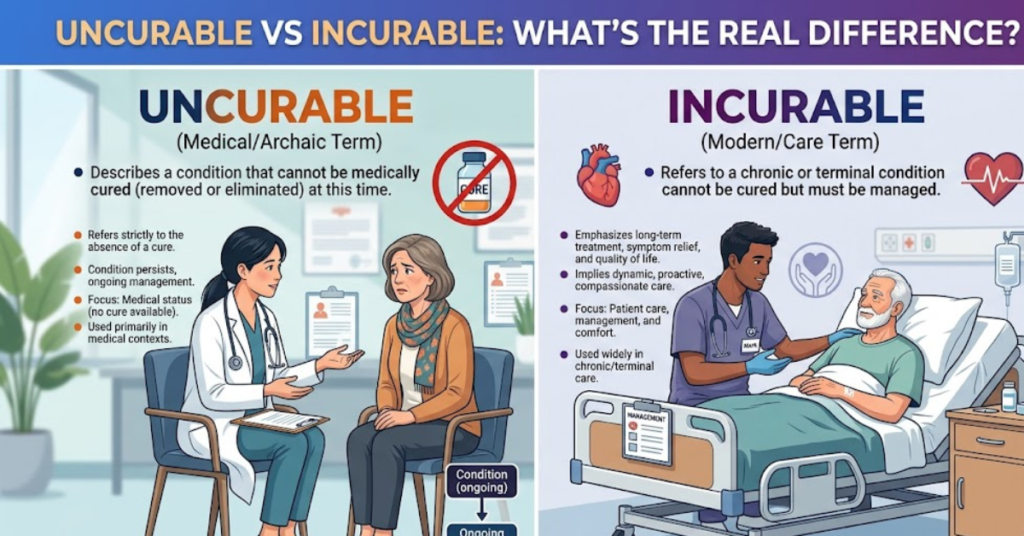
Uncurable vs Incurable: Key Differences
Let’s simplify the comparison:
| Feature | Incurable | Uncurable |
| Correct usage | Yes | No |
| Common in writing | Widely used | Rare |
| Accepted in dictionaries | Yes | No |
| Professional contexts | Appropriate | Avoid |
Bottom line:
If you’re choosing between uncurable vs incurable, always go with “incurable.”
Why “Incurable” Is the Standard Term
English borrows heavily from Latin, especially in medical and academic vocabulary. The word “incurable” follows this pattern:
- “in-” = not
- “curable” = able to be cured
Together, they form a grammatically and historically correct word.
Similar Examples:
- Incomplete (not complete)
- Inaccurate (not accurate)
- Invisible (not visible)
This pattern explains why “incurable” fits naturally, while “uncurable” feels off.
When Should You Use “Incurable”?
You can use incurable in several contexts:
1. Medical Context
- Describing diseases with no known cure
- Example: “Certain genetic disorders are incurable.”
2. Figurative Use
- Talking about personality traits
- Example: “She’s an incurable romantic.”
3. Everyday Language
- Expressing permanence
- Example: “His love for music is incurable.”
Common Mistakes to Avoid
When thinking about uncurable vs incurable, here are a few pitfalls to watch out for:
- Using “uncurable” in formal writing
- Assuming all negatives use “un-”
- Mixing informal logic with standard grammar
Quick Tip:
If you’re unsure, stick with “incurable”—it’s always the safe and correct choice.
Related Words and Synonyms
To expand your vocabulary, here are some alternatives depending on context:
- Untreatable
- Irreversible
- Chronic
- Terminal (in medical contexts)
Each has a slightly different nuance, so choose carefully based on what you want to convey.
FAQs
1. Is “uncurable” ever correct?
Not in standard English. While it may appear occasionally, it’s generally considered incorrect and should be avoided.
2. Why do people use “uncurable”?
Mostly due to confusion. Since many English words use “un-” as a negative prefix, people assume it works here too.
3. Is “incurable” only used for diseases?
No. It can also describe habits, traits, or situations that cannot be changed.
4. Can “incurable” have a positive meaning?
Yes, in a figurative sense. For example, “incurable optimist” suggests a strong, lasting positive trait.
5. What’s the easiest way to remember the difference?
Just remember: “incurable” is the correct word—“uncurable” isn’t.
Conclusion
When it comes to uncurable vs incurable, the answer is clear: “incurable” is the only correct and widely accepted term. While “uncurable” might seem logical, it doesn’t hold up in standard English usage.
Understanding this difference helps you write more clearly, sound more professional, and avoid common language mistakes. If you’re ever in doubt, stick with “incurable”—it’s accurate, recognized, and always appropriate.
Want to sharpen your English even further? Keep exploring commonly confused words—you’ll be surprised how much clarity it brings to your writing.