
Have you ever paused mid-sentence wondering, is it puddy or putty? You’re not alone. This common spelling confusion pops up in everything from DIY guides to casual conversations. The truth is simple—but often misunderstood.
In this guide, we’ll break down puddy or putty meaning, explain which one is correct, and show you how to use it confidently in everyday writing.
Which One Is Correct?
Let’s clear this up right away:
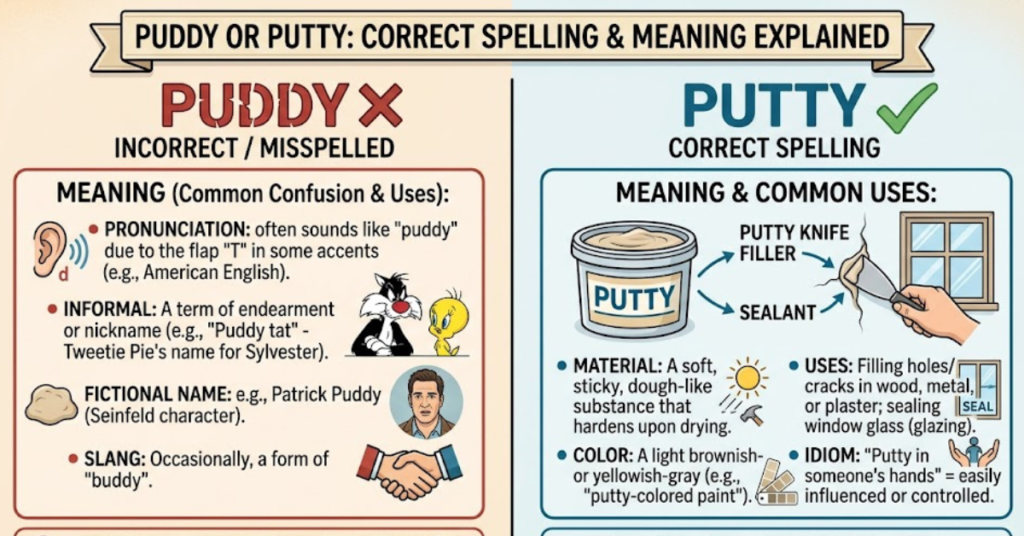
- Putty is the correct spelling
- Puddy is a common misspelling
“Putty” is a real English word with a specific meaning, while “puddy” doesn’t exist in standard dictionaries. Most of the time, when people write “puddy,” they actually mean “putty.”
What Does “Putty” Mean?
Putty Meaning in Simple Terms
Putty refers to a soft, moldable material often used in construction and repairs. It’s especially common in:
- Sealing window panes
- Filling small cracks or holes
- Woodworking and glazing
Think of it as a flexible filler that hardens over time.
Everyday Uses of Putty
Here are some common ways “putty” is used:
- Home repairs – sealing gaps around windows
- Painting prep – smoothing surfaces before painting
- Crafts – modeling or shaping objects
You might also hear phrases like “silly putty,” which refers to a stretchy, toy-like version.
Why Do People Say “Puddy”?
The Reason Behind the Confusion
The mix-up between puddy or putty usually happens because of pronunciation. In casual speech, “putty” can sound like “puddy,” especially in certain accents.
Other reasons include:
- Typing errors or autocorrect mistakes
- Lack of familiarity with the correct spelling
- Hearing the word more often than seeing it written
How to Remember the Correct Spelling
Simple Tricks to Avoid Mistakes
If you’re still unsure about is it puddy or putty, these tips can help:
- Think of “put” – you “put” putty into cracks
- Double “t” rule – “putty” always has two T’s
- Visual memory – picture a repair job involving putty
The more you see and use the correct spelling, the more natural it becomes.
Common Phrases Using “Putty”
Real-Life Examples
To make things clearer, here are a few common expressions:
- “He filled the hole with putty before painting.”
- “The window frame needs fresh putty.”
- “She molded the material like soft putty.”
Notice how “puddy” doesn’t fit in any of these sentences.
Meaning in Context
Understanding Usage Through Context
When people search for puddy or putty meaning, they’re usually trying to confirm the right word. In context:
- Correct: “Apply putty to seal the glass.”
- Incorrect: “Apply puddy to seal the glass.”
Only one version makes sense—and it’s always “putty.”
FAQs
1. Is it puddy or putty?
It’s putty. “Puddy” is a misspelling and not recognized as a standard English word.
2. What does putty mean?
Putty is a soft, moldable material used for sealing, filling, and repairing surfaces, especially in construction.
3. Why do people write puddy instead of putty?
Mostly due to pronunciation differences, typing mistakes, or unfamiliarity with the correct spelling.
4. Is “puddy” ever correct?
No, “puddy” is not correct in standard English usage.
5. How can I remember the correct spelling?
Associate it with the word “put” and remember it always has two “t” letters.
Conclusion
So, when it comes to puddy or putty, the answer is clear: putty is the correct spelling, and “puddy” is simply a common mistake. Understanding the difference not only improves your writing but also helps you communicate more clearly—especially in practical contexts like home repairs or DIY projects.
Next time you’re unsure, just remember: you put putty where it’s needed.