
Ever typed “I payed the bill” and wondered if it looked… off? You’re not alone. The confusion around payed vs paid is surprisingly common, even among fluent English speakers. At first glance, both words seem like valid past tense forms of “pay,” but only one is correct in most situations.
In this guide, we’ll break down the payed vs paid meaning, explain when each word is appropriate, and give you real-life examples so you can use them confidently. By the end, you’ll never second-guess your grammar again.
Payed vs Paid: What’s the Difference?
Let’s clear this up right away:
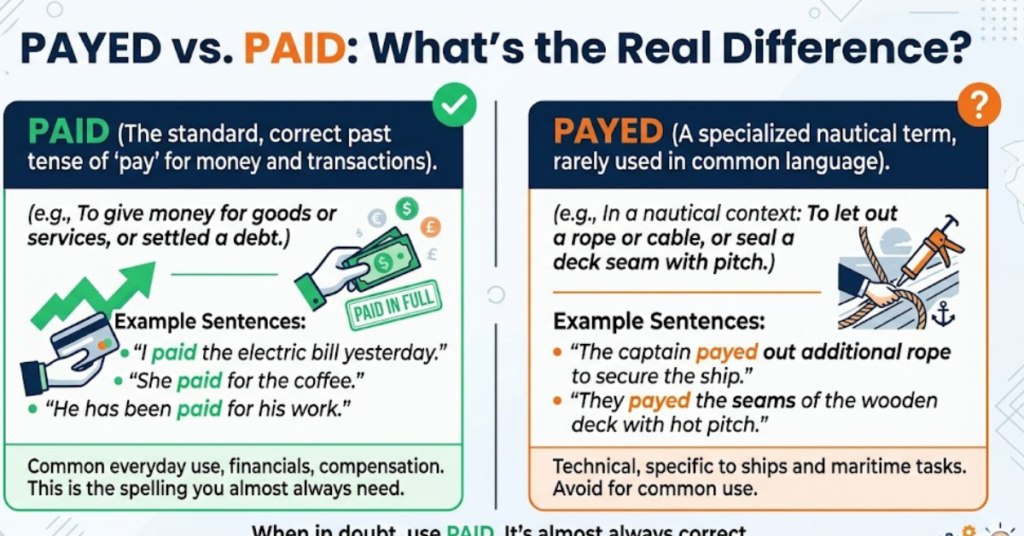
- Paid is the correct past tense and past participle of pay in almost all contexts.
- Payed is a rare, specialized term used mainly in nautical contexts.
Quick Rule:
If you’re talking about money, effort, attention, or anything similar — use “paid.”
What Does “Paid” Mean?
Paid is the standard form used in everyday English. It applies whenever you’re referring to giving money, completing a transaction, or even figurative expressions.
Common Uses of “Paid”:
- Financial transactions
- Rewards or consequences
- Idiomatic phrases
Examples:
- She paid the rent on time.
- He finally paid off his student loans.
- The hard work really paid off.
- I paid attention during the lecture.
This covers most situations related to payed vs paid money, payed vs paid attention, and payed vs paid off.
What Does “Payed” Mean?
Here’s where things get interesting.
Payed is not incorrect—but it’s extremely rare. It’s used in maritime (sailing) terminology.
Definition of “Payed”:
- To seal the deck or seams of a ship with tar or pitch
- To let out rope or cable in a controlled way
Examples:
- The crew payed the deck to prevent leaks.
- The sailor carefully payed out the rope.
Unless you’re writing about ships or sailing, you’ll almost never need this word.
Payed vs Paid in Grammar
Understanding payed vs paid grammar comes down to recognizing irregular verbs.
- “Pay” is an irregular verb
- Correct past tense: paid (not “payed”)
Why the Confusion Happens:
Many English verbs form the past tense by adding “-ed”:
- Walk → walked
- Jump → jumped
But “pay” is an exception:
- Pay → paid (not payed)
Payed vs Paid Examples
Let’s compare both forms side by side:
| Sentence | Correct? | Explanation |
| I payed the bill yesterday. | Incorrect | Should be “paid” |
| I paid the bill yesterday. | Correct | Standard usage |
| The sailor payed out the rope. | Correct | Nautical context |
| She paid attention in class. | Correct | Common expression |
These examples clarify the payed vs paid difference grammar in real-world usage.
Common Mistakes to Avoid
Here are a few errors people often make:
Incorrect:
- I payed him back.
- She payed attention to the details.
- They payed off their debt.
Correct:
- I paid him back.
- She paid attention to the details.
- They paid off their debt.
This applies across regions, including payed vs paid UK usage—there’s no difference. “Paid” is correct globally.
When to Use Payed vs Paid
To simplify:
Use Paid when:
- Talking about money
- Referring to effort or results
- Using common phrases (paid off, paid attention)
Use Payed when:
- Writing about ships, ropes, or sealing decks
- Discussing maritime activities
If you’re unsure, default to paid—you’ll be right almost every time.
Which Is Correct?
The correct phrase is:
- I paid
- I payed
Even though “payed” looks logical, it’s not grammatically correct in everyday English. This is one of the most searched forms in the payed vs paid difference debate.
Why This Matters
Using the wrong word might not seem like a big deal, but it can affect:
- Professional writing
- Academic work
- SEO content quality
- Credibility and clarity
Mastering small distinctions like this improves your overall communication.
FAQs
1. Is “payed” ever correct?
Yes, but only in nautical contexts like sailing or ship maintenance.
2. Why is “paid” spelled differently?
Because “pay” is an irregular verb, and its past tense doesn’t follow the usual “-ed” rule.
3. Can I use “payed” instead of “paid” casually?
No. Outside of maritime usage, it’s considered incorrect.
4. Is there a difference in American and British English?
No. Both use “paid” in standard situations.
5. How can I remember the correct form?
Think: Money = Paid. Ships = Payed.
Conclusion
The confusion is easy to fix once you know the rule. In nearly every situation, “paid” is the correct choice—whether you’re talking about money, effort, or attention. “Payed,” on the other hand, belongs to a very specific nautical niche.
If you take away one thing, let it be this: when in doubt, go with paid. It’s the safe, correct, and widely accepted option.
Want to sharpen your grammar even further? Keep exploring common word confusions—you’ll be surprised how much clarity they can bring to your writing.