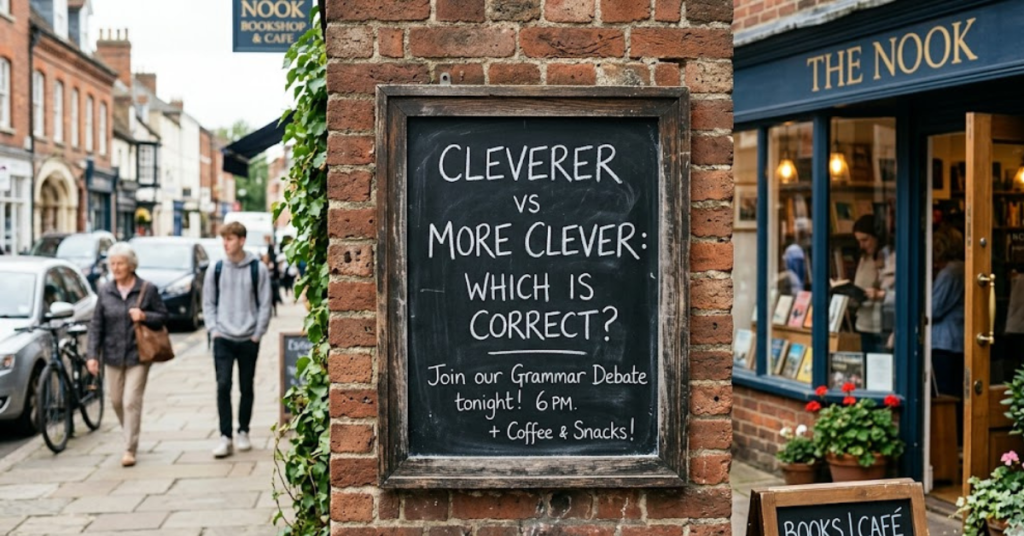

Ever paused mid-sentence and wondered whether to say cleverer or more clever? You’re not alone. The debate around cleverer vs more clever is a common grammar puzzle that trips up even confident English speakers.
In this guide, we’ll break down both forms, explain when each is appropriate, and help you sound natural in both writing and conversation. By the end, you’ll know exactly which one to use—and why.
Understanding Comparative Adjectives
Before diving into the specifics, it helps to understand how English forms comparisons.
Comparative adjectives are used when comparing two things. Typically, English follows two main patterns:
- Short adjectives (one syllable): add -er
- fast → faster
- tall → taller
- Longer adjectives (two or more syllables): use more
- beautiful → more beautiful
- interesting → more interesting
So where does clever fit? That’s where things get interesting.
Cleverer vs More Clever: What’s the Difference?
The word clever sits in a gray area. It has two syllables, which means it can follow both rules.
- Cleverer = formed by adding -er
- More clever = formed by adding more
Here’s the key point:
Both forms are grammatically correct.
Examples:
- She is cleverer than her brother.
- She is more clever than her brother.
Both sentences mean the same thing, and neither is wrong.
Which One Should You Use?
Even though both are correct, usage often depends on style, tone, and regional preference.
1. Use “Cleverer” for Simplicity
Cleverer tends to sound more natural in everyday speech, especially in informal contexts.
- This solution is cleverer than the last one.
- He’s getting cleverer with age.
It’s shorter, smoother, and often preferred in casual writing.
2. Use “More Clever” for Emphasis or Formal Tone
More clever can feel slightly more formal or deliberate. It’s also useful when you want to emphasize the comparison.
- That strategy is more clever than it looks.
- Her response was more clever than expected.
In some cases, it simply sounds better depending on rhythm and sentence flow.
Regional and Stylistic Preferences
Usage can vary depending on where and how English is spoken.
- British English: often favors cleverer
- American English: uses both, but may lean toward more clever in formal writing
That said, neither version is restricted to one region. Both are widely understood and accepted globally.
Why Does This Confusion Exist?
The confusion around cleverer vs more clever comes from how English handles two-syllable adjectives. Some words strictly follow one rule, while others—like clever, simple, and narrow—can go either way.
This flexibility isn’t a mistake. It’s part of how English evolves and adapts over time.
Common Mistakes to Avoid
Even though both forms are correct, there are still a few pitfalls to watch out for:
- Don’t use both forms together:
- Incorrect: more cleverer
- Correct: choose one form only
- Avoid overthinking:
- If one version sounds natural, it’s likely fine
- Stay consistent in tone:
- Mixing styles in formal writing can feel uneven
Quick Tips for Choosing the Right Form
If you’re unsure which one to use, these simple tips can help:
- Go with cleverer for casual, everyday use
- Choose more clever for formal or polished writing
- Read your sentence aloud—pick what sounds smoother
- When in doubt, either option is acceptable
FAQs
Is “cleverer” a real word?
Yes, cleverer is a valid comparative form of clever and is widely used in English.
Is “more clever” incorrect?
No, it’s also correct. Both forms are grammatically acceptable.
Which is more common: cleverer or more clever?
It depends on context. Cleverer is common in speech, while more clever may appear more in formal writing.
Can I use both in the same sentence?
No. You should use only one comparative form at a time.
Why does “clever” allow both forms?
Because it’s a two-syllable adjective that fits into a flexible category in English grammar.
Conclusion
When it comes to cleverer vs more clever, the good news is that you don’t have to stress over being “right.” Both forms are correct, and your choice mainly depends on tone, style, and what sounds natural in context.
If you prefer something concise and conversational, cleverer is a great pick. If you want a slightly more formal feel, more clever works just as well.
The key takeaway? Focus on clarity and flow. Once you do that, your writing will always come across as—well—clever.