
Ever paused mid-sentence and wondered: in-person or in person—which one is correct? You’re not alone. This small but tricky distinction shows up everywhere, from emails about meetings to job interview invitations. Getting it right matters, especially in professional communication.
In this guide, we’ll break down is it in-person or in person, explain the grammar rules in plain English, and show real-world examples so you can use each form confidently.
What’s the Difference?
At first glance, the only difference is a hyphen—but that tiny mark changes how the phrase functions in a sentence.
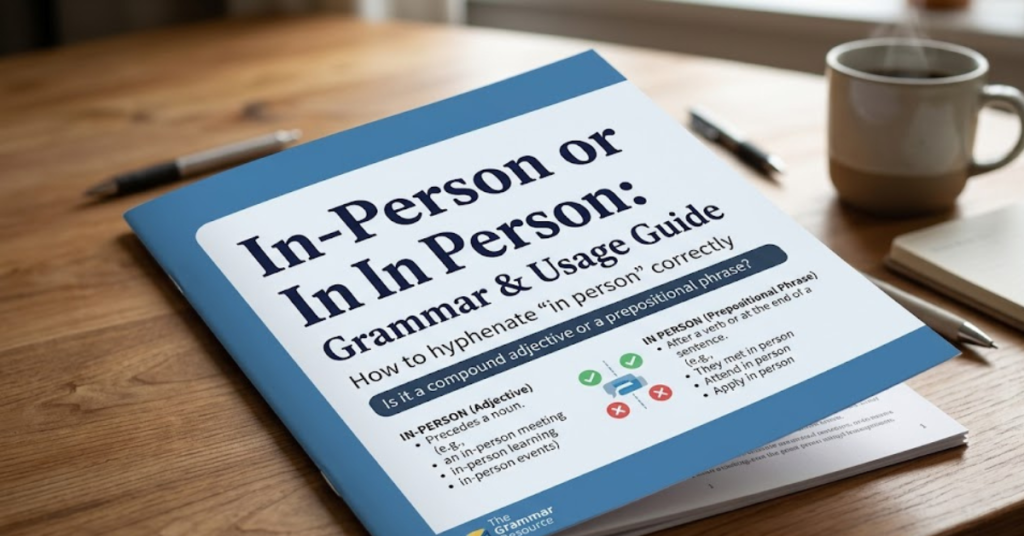
- “In person” (no hyphen) is a prepositional phrase
- “In-person” (hyphenated) is a compound adjective
Quick Rule to Remember
- Use “in person” when it stands alone
- Use “in-person” when it describes a noun
When to Use “In Person”
“In person” works as an adverbial phrase, meaning physically present rather than online or remotely.
Examples of “In Person”
- I prefer to meet clients in person.
- She handled the issue in person instead of over email.
- The manager will speak to you in person tomorrow.
In these cases, the phrase doesn’t directly describe a noun—it describes how something happens.
Common Situations
You’ll typically use “in person” when talking about:
- Meetings
- Conversations
- Interactions
- Appearances
When to Use “In-Person”
“In-person” acts as an adjective. That means it comes before a noun and describes it.
Examples of “In-Person”
- We scheduled an in-person meeting.
- The company prefers in-person interviews.
- They offer in-person training sessions.
Here, the phrase directly modifies a noun (meeting, interview, training), which is why the hyphen is needed.
Which Is Correct?
This is one of the most searched questions—and for good reason.
Correct: in-person meeting
Incorrect: in person meeting
Why? Because the phrase is describing the type of meeting, so it functions as an adjective.
What’s Right?
When using the phrase after a verb, go with “in person.”
Correct: Let’s meet in person
Incorrect: Let’s meet in-person
The phrase isn’t describing a noun—it’s describing the action.
Interview: Proper Usage
Just like “meeting,” the word “interview” needs a descriptive adjective.
Correct: in-person interview
Incorrect: in person interview
Think of it as answering the question: What kind of interview? → An in-person one.
In-Person or In Person AP Style Guidelines
If you follow AP Style, the rule is straightforward:
- Hyphenate “in-person” when it’s used as a modifier before a noun
- Do not hyphenate when it stands alone
AP Style Examples
- The company held an in-person event.
- The CEO attended the meeting in person.
This aligns with general grammar rules, so it’s easy to remember.
Grammar Explained
Let’s simplify the grammar behind it:
- Compound adjectives (like “in-person”) need hyphens when placed before nouns
- Prepositional phrases (like “in person”) don’t need hyphens
Test Yourself
Ask: Is this phrase describing a noun directly?
- Yes → Use in-person
- No → Use in person
Examples in Everyday Use
Here are some practical examples to make things crystal clear:
Correct Usage
- We had an in-person meeting yesterday.
- I’d rather discuss this in person.
- The company is shifting back to in-person work.
- She completed an in-person interview last week.
Incorrect Usage
- We had an in person meeting.
- Let’s talk in-person tomorrow.
Spot the pattern? It always comes down to whether you’re modifying a noun.
Spelling Matters
You might also see variations like:
- inperson (one word)
- in- person (with a space after hyphen)
Both are incorrect.
Correct Forms Only
- ✔ in person
- ✔ in-person
Stick to these, and you’ll avoid common spelling mistakes.
Common Mistakes to Avoid
Even experienced writers slip up here. Watch out for these:
- Using in person before a noun
- Forgetting the hyphen in compound adjectives
- Writing “inperson” as one word
- Mixing both forms in the same sentence incorrectly
Consistency is key, especially in professional writing.
FAQs
Is it in-person or in person?
Both are correct, but they serve different purposes. Use “in person” as a phrase and “in-person” as an adjective before a noun.
Which is correct: meeting in-person or in person?
Use “in person” after the verb:
Correct: We will meet in person
How do you write in-person or in person interview?
Use “in-person interview” because it describes the type of interview.
Is “inperson” ever correct?
No, “inperson” is not a standard spelling in modern English.
What does AP style say about in-person or in person?
AP style follows the same rule: hyphenate when used as an adjective, and don’t hyphenate when used as a phrase.
Conclusion
The difference between in-person or in person isn’t complicated once you see the pattern. One describes a noun, the other describes an action. That’s it.
- Use in-person before a noun
- Use in person after a verb or on its own
Mastering this small detail can make your writing look sharper and more professional—especially in emails, resumes, and business communication.
If you’re working on improving your grammar skills, keep practicing with real examples. Over time, the correct choice will feel natural without a second thought.