
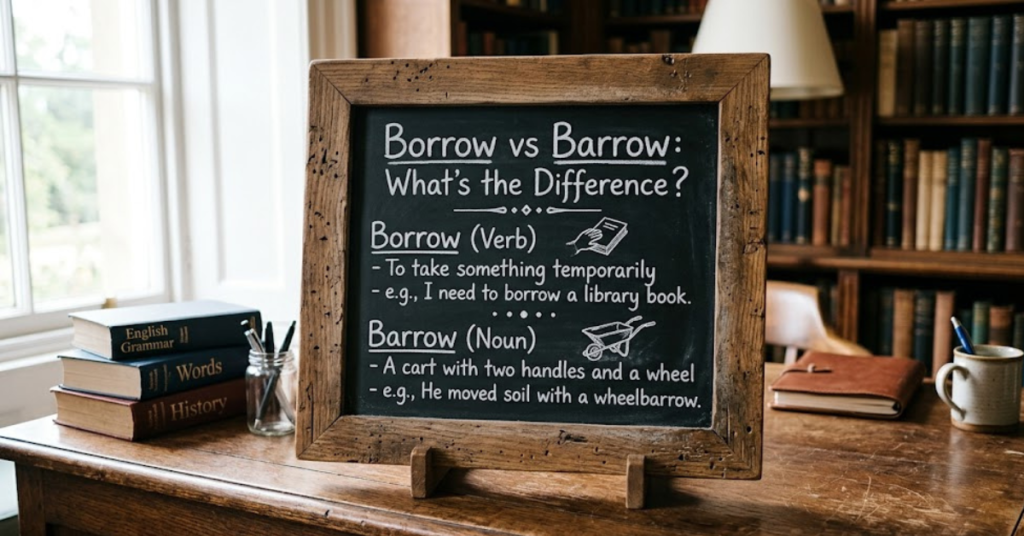

Have you ever paused mid-sentence wondering whether to use borrow or barrow? You’re not alone. The confusion around borrow vs barrow is surprisingly common because the words sound similar—but their meanings couldn’t be more different.
In this guide, we’ll break everything down in a clear, conversational way. You’ll learn what each word means, how to use them correctly, and how to avoid common mistakes. By the end, you’ll feel confident choosing the right word every time.
Borrow vs Barrow: The Core Difference
At its simplest, the distinction comes down to meaning and usage:
- Borrow = to take something with the intention of returning it
- Barrow = a type of cart, mound, or specific term depending on context
These words are not interchangeable, even though they may sound alike.
What Does “Borrow” Mean?
Definition of Borrow
The word borrow is a verb. It means to take something from someone temporarily, with the intention of giving it back.
Common Uses of Borrow
You’ll see borrow used in everyday situations like:
- Borrowing money from a friend
- Borrowing a book from the library
- Borrowing someone’s phone charger
Example Sentences
- Can I borrow your pen for a minute?
- She needed to borrow some cash until payday.
- He forgot his notes and had to borrow from a classmate.
Quick Tip
If the action involves taking and returning, you almost always need borrow.
What Does “Barrow” Mean?
Definition of Barrow
The word barrow is typically a noun, and it has a few different meanings depending on context.
Common Meanings of Barrow
- Wheelbarrow (short form)
A small hand-propelled cart used for carrying loads. - Burial mound
In archaeology, a barrow refers to an ancient grave mound. - Market cart (less common)
A cart used by street vendors.
Example Sentences
- He pushed a barrow full of soil across the garden.
- The archaeologists discovered a burial barrow nearby.
- The vendor loaded fruits onto his barrow.
Quick Tip
If you’re talking about a physical object, especially a cart or mound, you likely mean barrow.
Borrow vs Barrow: Side-by-Side Comparison
Understanding the contrast helps lock it in your memory:
- Borrow
- Part of speech: Verb
- Meaning: Take temporarily
- Context: Everyday actions
- Barrow
- Part of speech: Noun
- Meaning: Cart or mound
- Context: Physical objects or historical references
Common Mistakes and How to Avoid Them
Even experienced writers mix these up occasionally. Here are some frequent errors:
1. Using “Barrow” Instead of “Borrow”
Incorrect: Can I barrow your book?
Correct: Can I borrow your book?
2. Confusing Sound with Meaning
Because both words sound similar, people often rely on pronunciation rather than meaning. This leads to errors in writing.
3. Overthinking the Context
If the sentence involves an action (taking something), it’s almost always borrow. If it’s an object, it’s barrow.
Easy Memory Trick
- Borrow = “Bring back” (both start with “b”)
- Barrow = “Big cart”
When Do People Confuse Borrow vs Barrow?
The confusion usually happens because:
- Both words are pronounced similarly in some accents
- Spell-check tools don’t always catch the mistake
- “Barrow” is less commonly used, so people default to guessing
This is especially true in informal writing, where speed often matters more than accuracy.
Practical Tips to Get It Right Every Time
Here are some simple ways to avoid mixing them up:
- Pause and ask: Am I taking something or describing an object?
- Replace the word with a synonym:
- Borrow → take temporarily
- Barrow → cart or mound
- Read your sentence out loud and check if it makes logical sense
With practice, the correct choice will become automatic.
FAQs About Borrow vs Barrow
What is the main difference between borrow and barrow?
The main difference is meaning. Borrow means to take something temporarily, while barrow refers to a cart, mound, or similar object.
Can “barrow” ever be used as a verb?
In modern English, barrow is almost always used as a noun. It rarely appears as a verb.
Why do people confuse these words?
They sound alike, especially in certain accents, which leads to spelling mistakes in writing.
Is “borrow” always about returning something?
Yes, the idea of returning is central to the meaning of borrow. If there’s no intention to return, a different word like “take” or “keep” is more appropriate.
What is a wheelbarrow?
A wheelbarrow is a small cart with one wheel, commonly used for carrying soil, tools, or heavy materials.
Conclusion
Understanding borrow vs barrow doesn’t have to be complicated. Once you remember that borrow is about taking something temporarily and barrow refers to a physical object like a cart or mound, the confusion quickly disappears.
The key is to focus on context. Ask yourself what the sentence is really about—an action or an object. With that simple check, you’ll avoid mistakes and write with more confidence.
If you found this helpful, consider exploring similar word pairs to sharpen your writing even further. Clear language always makes a stronger impression.