
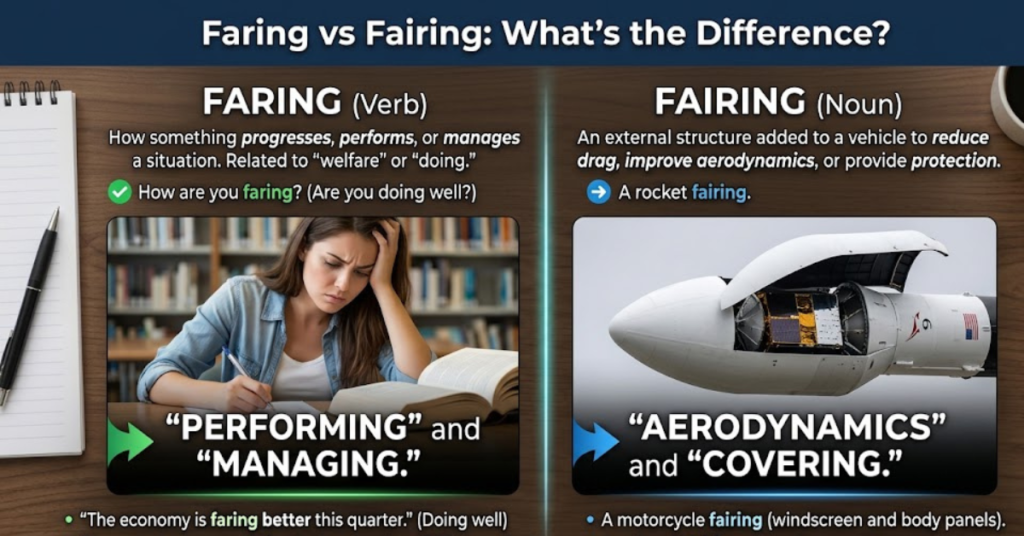

Have you ever typed faring when you actually meant fairing? You’re not alone. These two words sound identical, but they mean completely different things. Because they’re homophones, many writers mix them up in emails, articles, school papers, and even professional documents.
Understanding faring vs fairing is important if you want your writing to sound polished and accurate. One word relates to how someone is doing, while the other belongs mostly to engineering and transportation. In this guide, we’ll break down the meanings, origins, examples, and common mistakes so you’ll never confuse them again.
Why People Confuse Faring and Fairing
The confusion happens because both words are pronounced the same way: FAIR-ing. English is full of homophones, and these are particularly tricky because they look similar too.
Here’s the key distinction:
- Faring = related to getting along or performing
- Fairing = a structure designed to improve airflow or reduce drag
A single letter changes the meaning entirely.
What Does Faring Mean?
The word faring comes from the verb fare, which means “to get along,” “to perform,” or “to experience a situation.”
It’s commonly used when talking about someone’s condition, progress, or success.
Examples of Faring in Sentences
- How are you faring after the storm?
- The company is faring well this year.
- Students are faring better with online learning tools.
- She asked how her brother was faring overseas.
In each example, the word relates to someone’s situation or performance.
Common Expressions Using Faring
You’ll often see the word in phrases like:
- “How are you faring?”
- “Faring well”
- “Faring badly”
- “Economic faring”
These expressions usually describe emotional, financial, academic, or physical conditions.
What Does Fairing Mean?
Fairing is a technical noun used mainly in engineering, aviation, cycling, motorcycles, and boating. It refers to a smooth covering or structure added to reduce air resistance or improve appearance.
You’ll frequently hear this term in transportation industries.
Examples of Fairing in Sentences
- The motorcycle fairing reduced wind resistance.
- Aircraft fairings improve aerodynamic performance.
- The damaged fairing needed replacement after the crash.
- Cyclists sometimes add a front fairing for speed efficiency.
Unlike faring, this word has nothing to do with personal success or wellbeing.
Types of Fairings
Fairings appear in several industries. Here are the most common types:
Motorcycle Fairings
These are plastic or fiberglass panels attached to motorcycles. They help with:
- Wind protection
- Fuel efficiency
- Aerodynamics
- Rider comfort
Aircraft Fairings
Airplanes use fairings to smooth intersections between parts, reducing drag and improving fuel performance.
Rocket Fairings
Spacecraft use nose fairings to protect cargo during launch.
Bicycle Fairings
Some racing bicycles use lightweight fairings to increase speed by minimizing air resistance.
Faring vs Fairing: Quick Comparison
Although they sound alike, their meanings are unrelated.
Use “Faring” When Talking About:
- Progress
- Performance
- Wellbeing
- Success or failure
Use “Fairing” When Talking About:
- Vehicles
- Aerodynamics
- Engineering
- Protective coverings
A simple trick is this:
- If it’s about a person or situation, choose faring.
- If it’s about machinery or airflow, choose fairing.
Origin and History of Both Words
Learning where these words came from can make them easier to remember.
Origin of Faring
The word traces back to Old English faran, meaning “to travel” or “to go.” Over time, it evolved into the modern meaning of managing or progressing in life.
Origin of Fairing
This word comes from the adjective fair, meaning smooth or pleasing in appearance. Engineers later adapted it to describe streamlined structures.
Their histories are completely separate, despite their similar pronunciation.
Common Mistakes Writers Make
Many people accidentally substitute one word for the other because spellcheck may not catch the error.
Incorrect Examples
- How is your motorcycle faring?
- She asked how the airplane was fairing.
Correct Versions
- How is your motorcycle fairing?
- She asked how the airplane was faring financially.
Context matters more than pronunciation.
Tips to Remember the Difference
Here are a few memory tricks that actually work:
Remember “Fare” Means Journey or Condition
Think of phrases like:
- Farewell
- Bus fare
- Fare better
These all connect to movement, condition, or progress.
Think of “Fairing” as a Physical Part
The double “i” in fairing can remind you of “industrial” or “engineering.”
It’s a real object attached to something mechanical.
When to Use Faring in Professional Writing
You’ll often encounter faring in:
- News articles
- Economic reports
- Healthcare updates
- Educational studies
- Workplace evaluations
Example:
- Small businesses are faring better this quarter.
This usage sounds natural in formal and conversational English alike.
When to Use Fairing in Technical Writing
The term appears frequently in:
- Automotive manuals
- Aviation documents
- Mechanical engineering
- Product specifications
- Motorsport discussions
Example:
- Carbon-fiber fairings reduced aerodynamic drag.
In technical fields, precision matters, so using the correct spelling is essential.
British vs American English Usage
Interestingly, both words are spelled the same way in British and American English. There’s no regional spelling variation here.
The only challenge is choosing the correct word based on context.
Similar Homophones That Cause Confusion
English contains many word pairs similar to these:
- Brake vs break
- Principal vs principle
- Compliment vs complement
- Stationary vs stationery
Like faring and fairing, these words sound identical but carry different meanings.
FAQs About Faring vs Fairing
Is fairing a real word?
Yes. A fairing is a structural component used to improve aerodynamics or appearance, especially on vehicles and aircraft.
What does faring mean in a sentence?
It means how someone is doing or progressing. Example: “She is faring well in her new job.”
Are faring and fairing interchangeable?
No. They have completely different meanings despite sounding alike.
Which word is used for motorcycles?
Fairing is the correct term for motorcycle body panels that reduce wind resistance.
Why do people confuse these words?
Because they are homophones with similar spellings and pronunciations.
Is “How are you fairing?” wrong?
Yes. The correct phrase is “How are you faring?”
Conclusion
The difference between faring vs fairing becomes simple once you understand their meanings. Faring relates to how someone is doing or progressing, while fairing refers to a streamlined structure used in engineering and transportation.
Even though the words sound identical, using the wrong one can confuse readers and weaken your writing credibility. The next time you’re unsure, just remember:
- People and performance = faring
- Vehicles and aerodynamics = fairing
Mastering small distinctions like this can make your writing clearer, more professional, and easier to understand.