
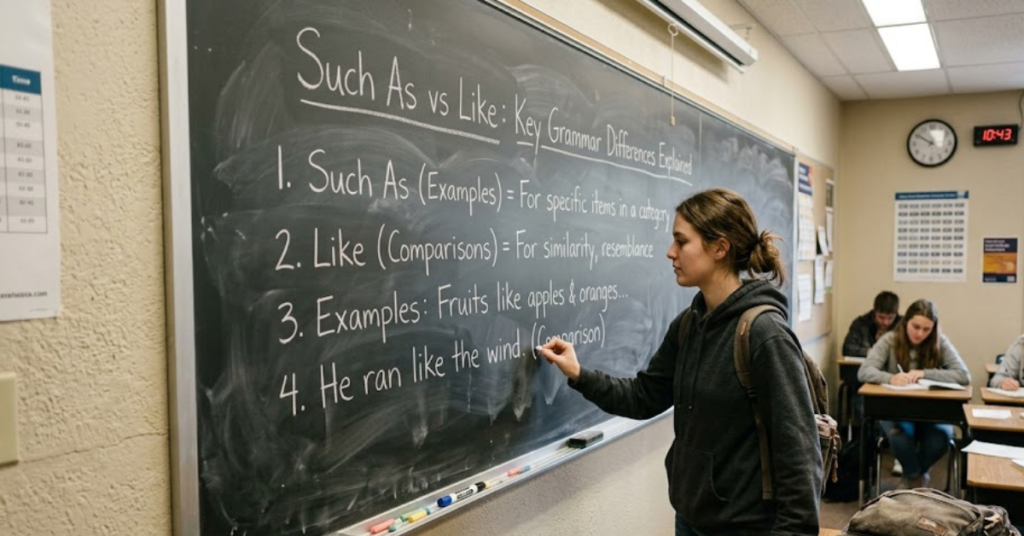

Many English learners—and even native speakers—struggle with such as vs like. At first glance, these two expressions seem interchangeable because both introduce examples or comparisons. However, they serve different grammatical purposes and using the wrong one can make your writing sound awkward or even incorrect.
Understanding the distinction is especially important in academic writing, professional communication, standardized tests, and everyday conversations. In this guide, you’ll learn the rules, examples, common mistakes, and practical exercises that make the difference crystal clear.
Understanding Such As vs Like
The confusion between such as vs like usually comes from the fact that both phrases appear before examples. However, their meanings are not identical.
- Such as introduces specific examples from a larger group.
- Like introduces similarities or comparisons.
A simple way to remember it is:
- Such as = for example
- Like = similar to
Examples
Such as:
- I enjoy outdoor activities such as hiking, camping, and fishing.
- Several countries, such as Canada and Australia, have large natural reserves.
Like:
- She sings like a professional musician.
- The clouds looked like giant cotton balls.
In the first set of examples, actual examples are listed. In the second set, comparisons are being made.
Such As vs Like Grammar Rules
Understanding the grammar behind these expressions helps eliminate confusion.
When to Use “Such As”
Use such as when introducing one or more examples that belong to a category already mentioned.
Formula:
Category + such as + examples
Examples:
- Tropical fruits such as mangoes and pineapples grow well in warm climates.
- Many social media platforms, such as Instagram and TikTok, attract younger audiences.
The examples are actual members of the category being discussed.
When to Use “Like”
Use like to show resemblance, similarity, or comparison.
Formula:
Subject + like + similar thing
Examples:
- He runs like an athlete.
- This fabric feels like silk.
The comparison suggests similarity rather than identifying exact examples.
Such As vs Like Usage in Everyday Writing
Choosing the correct phrase can improve clarity and professionalism.
Correct Use of Such As
- Renewable energy sources such as solar and wind power are becoming more popular.
- Healthy snacks such as nuts and fruit can help maintain energy levels.
Correct Use of Like
- The baby slept like a log.
- The new employee works like a machine.
In these sentences, no actual examples are listed. Instead, the speaker compares one thing to another.
Common Mistakes People Make
Many writers mistakenly use like when they should use such as.
Incorrect
- European countries like France and Germany have strong economies.
Technically Better
- European countries such as France and Germany have strong economies.
Why? France and Germany are actual examples of European countries, not things that merely resemble European countries.
Another common mistake is replacing comparisons with examples.
Incorrect
- He enjoys sports such as a professional athlete.
Correct
- He enjoys sports like a professional athlete.
The sentence compares his behavior to that of a professional athlete.
Such As vs Like in Formal Writing
Formal and academic writing generally prefers precision.
When providing examples:
- Use such as.
When making comparisons:
- Use like.
Examples:
- Effective leadership skills, such as communication and decision-making, are essential for managers.
- Her leadership style is like that of a seasoned executive.
Using the correct expression improves credibility and readability.
Such As vs Like GMAT Tips
The such as vs like GMAT distinction appears frequently in sentence correction questions.
Test writers often check whether candidates can distinguish examples from comparisons.
GMAT Rule
Use such as for examples.
Example:
- Cities such as Tokyo and Seoul have highly developed transportation systems.
Use like for comparisons.
Example:
- Tokyo’s transportation system operates like a well-designed machine.
Quick GMAT Test
Ask yourself:
“Are these actual examples?”
- If yes, use such as.
- If no, use like.
This simple question can help eliminate incorrect answer choices quickly.
Such As vs Like Examples
Here are more examples to reinforce the difference.
Examples with Such As
- Several programming languages, such as Python and JavaScript, are beginner-friendly.
- Marine animals such as dolphins and whales are highly intelligent.
- Classic novels such as Pride and Prejudice remain popular today.
Examples with Like
- He thinks like a strategist.
- The lake was smooth like glass.
- The child danced like a star performer.
Notice how one group provides actual examples while the other creates comparisons.
Such As vs Like Exercises
Try these practice questions and check your answers afterward.
Exercise 1
Choose the correct option.
- Birds _____ eagles and hawks have excellent vision.
- She performs _____ an experienced actress.
- Countries _____ Japan and South Korea are known for technological innovation.
- The fabric feels _____ velvet.
- Healthy foods _____ vegetables and whole grains support overall wellness.
Answers
- such as
- like
- such as
- like
- such as
Exercise 2
Identify whether the sentence needs “such as” or “like.”
- Animals _____ lions and tigers are carnivores.
- He swims _____ an Olympic champion.
- Technologies _____ artificial intelligence and machine learning are transforming industries.
- The sky looked _____ a painting.
Answers
- such as
- like
- such as
- like
Practicing regularly helps build confidence and accuracy.
Easy Memory Trick
If you can replace the phrase with for example, use such as.
Example:
- Many vegetables, such as carrots and spinach, are rich in nutrients.
- Many vegetables, for example carrots and spinach, are rich in nutrients.
The sentence still makes sense.
If you can replace it with similar to, use like.
Example:
- The material feels like leather.
- The material feels similar to leather.
Again, the meaning remains intact.
Why the Difference Matters
While native speakers often use these expressions loosely in conversation, formal writing values precision.
Using the correct phrase helps:
- Improve grammar accuracy
- Strengthen academic writing
- Enhance professional communication
- Perform better on exams
- Avoid ambiguity
Small grammar choices can significantly impact how polished and credible your writing appears.
Frequently Asked Questions
What is the difference between such as and like?
Such as introduces actual examples, while like shows similarity or comparison.
Can I use like instead of such as?
In casual speech, people often do. However, in formal writing and exams, it’s better to use such as when listing examples.
Is “such as” more formal than “like”?
Yes. Such as is generally considered more precise and formal when presenting examples.
How does the GMAT test such as and like?
The GMAT often checks whether examples are introduced with such as and comparisons are introduced with like.
Is this sentence correct: “Countries like France and Germany”?
Many people use it conversationally, but in formal writing, “Countries such as France and Germany” is typically preferred because France and Germany are actual examples of countries.
How can I remember the rule?
Think of:
- Such as = for example
- Like = similar to
This memory trick works in most situations.
Conclusion
Understanding such as vs like is one of the simplest ways to improve your grammar and writing precision. Remember that such as introduces real examples, while like creates comparisons. Although the two expressions sometimes appear similar, their functions are different, especially in formal writing and standardized tests.
By mastering these grammar rules, practicing exercises, and applying the “for example” versus “similar to” test, you’ll avoid common mistakes and communicate more clearly. Continue practicing with your own sentences, and you’ll quickly develop a natural instinct for choosing the right expression every time.