
Ever typed puting and wondered if it’s correct—or if it should be putting instead? You’re not alone. The confusion around puting or putting is surprisingly common, especially for learners of English and even native speakers in a rush.
In this guide, we’ll clear things up in plain, simple language. You’ll learn the correct spelling, understand the meaning, and see how the word is used in everyday English—and even in golf. By the end, you won’t hesitate again when deciding which one to use.
Is It Puting or Putting?
Let’s settle it right away:
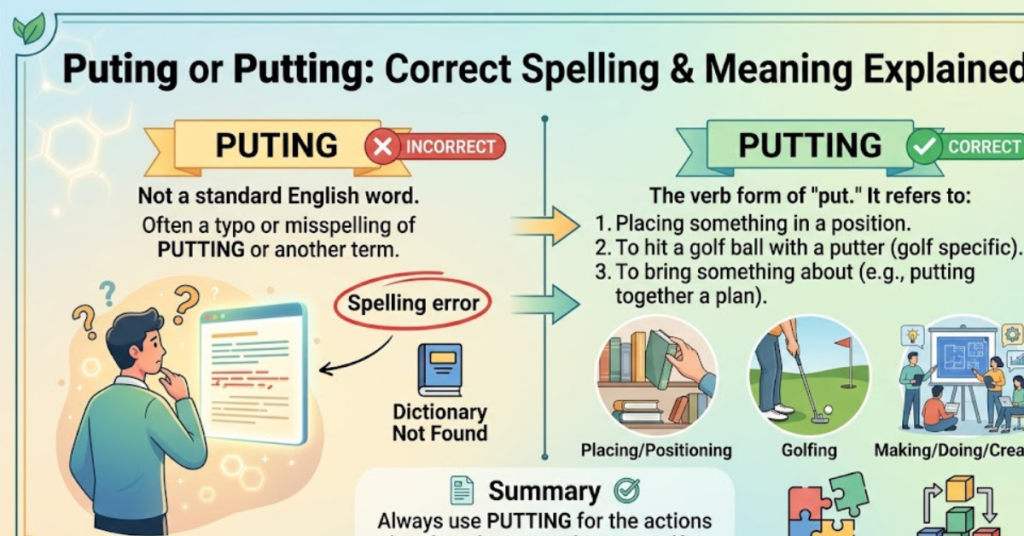
“Putting” is correct
“Puting” is incorrect
The confusion comes from how English handles verbs ending in consonants when adding “-ing.” In the case of put, the final consonant “t” is doubled, forming putting.
Puting or Putting Meaning Explained
What Does “Putting” Mean?
The word putting comes from the verb “put,” which means to place something somewhere.
Examples:
- She is putting the book on the table.
- He is putting effort into his work.
It can also refer to a specific action in sports.
Puting or Putting Golf Usage
In golf, putting has a specialized meaning. It refers to hitting the ball gently across the green toward the hole using a putter.
Example:
- His putting skills improved after practice.
So whether in daily conversation or sports, putting is always the correct form.
Why “Puting” Is Incorrect
English spelling rules can be tricky, but here’s a simple explanation:
When a verb:
- Has one syllable
- Ends in a consonant
- Has a short vowel sound
You usually double the final consonant before adding -ing
Examples:
- Run → Running
- Sit → Sitting
- Put → Putting
That’s why puting is not accepted in standard English.
Puting or Putting in English Grammar
Understanding this pattern helps avoid similar mistakes. Here’s a quick breakdown:
Basic Rule
- Verb + ing → double consonant if needed
When NOT to Double
- If the word ends in two consonants (help → helping)
- If the stress isn’t on the final syllable (open → opening)
This makes putting grammatically consistent and correct.
Spell Puting or Putting Correctly Every Time
Here are a few quick tips to remember:
- Think: “short word, double letter”
- Say it out loud: put-ting (you’ll hear the double “t”)
- Compare with similar words like sitting
Quick Memory Trick
If it sounds stronger or emphasized at the end, double the letter.
Puting or Putting Synonym and Alternatives
Depending on context, putting can be replaced with:
General use:
- Placing
- Setting
- Positioning
In golf:
- Stroking (less common but context-specific)
Using synonyms can improve your writing and avoid repetition.
Which Is Correct Puting or Putting? Final Answer
To make it crystal clear:
Correct: Putting
Incorrect: Puting
Whenever you’re unsure, remember the doubling rule—it works in most similar cases.
FAQs
What is the correct spelling: puting or putting?
The correct spelling is putting with a double “t.”
Why do we double the “t” in putting?
Because put is a short, one-syllable verb ending in a consonant, so the final letter is doubled before adding “-ing.”
Is “puting” ever correct in English?
No, puting is not a correct spelling in standard English.
What does putting mean in golf?
In golf, putting means gently hitting the ball on the green toward the hole using a putter.
How can I remember the correct spelling?
Use the rule: short verb + “-ing” = double the last consonant (put → putting).
Conclusion
Understanding the difference between puting or putting is simpler than it seems once you know the rules. Putting is the only correct spelling, whether you’re talking about placing something or playing golf.
The key takeaway? English often doubles the final consonant in short verbs before adding “-ing.” Once you get used to this pattern, you’ll avoid similar mistakes effortlessly.
If you’re working on improving your English writing, keep practicing these small rules—they make a big difference over time.