
Ever paused mid-sentence wondering whether it’s lying or lieing? You’re not alone. This is one of those deceptively simple spelling questions that trips up even confident writers. The confusion often comes from how English verbs change form—especially irregular ones like “lie.”
In this guide, we’ll break down the lieing or lying meaning, explain which spelling is correct, and show you how to use it naturally in everyday situations. By the end, you’ll never second-guess yourself again.
Which Is Correct?
Let’s clear this up right away:
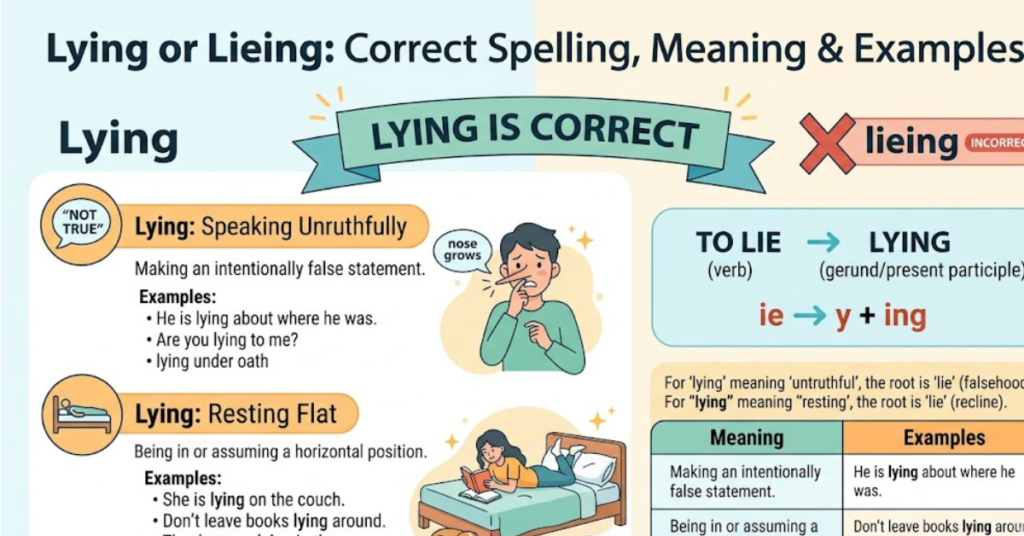
“Lying” is correct
“Lieing” is incorrect
So if you’re asking “is it lieing or lying?” — the answer is always lying.
Why is “lieing” wrong?
English spelling rules can be tricky, but here’s the key:
- When a verb ends in -ie, we usually change it to -y before adding -ing
- Example:
- lie → lying (not lieing)
- die → dying (not dieing)
This explains the correct spelling of lieing or lying and clears up one of the most common mistakes.
What Does “Lying” Mean?
The word “lying” has two main meanings, which is why it can be confusing.
1. Lying (Not telling the truth)
This refers to being dishonest.
This usage connects directly to the keyword idea of lieing or lying not telling the truth.
2. Lying (Resting or reclining)
This means being in a horizontal position.
Don’t Mix Them Up
Another common confusion appears alongside lieing or lying?—and that’s laying.
Here’s a quick breakdown:
- Lie (lying) = to rest or recline
- Lay (laying) = to put something down
Examples:
- I am lying on the couch.
- I am laying the book on the table.
How to Spell Lying (Easy Trick)
If you’ve ever wondered “how do you spell lieing or lying?”, here’s a simple memory trick:
Think: “IE becomes Y before ING”
So:
- Lie → Lying
- Die → Dying
This helps you remember the correct spelling every time.
Common Mistakes People Make
Let’s look at typical errors and corrections:
He is lieing on the floor
He is lying on the floor
She keeps lieing to me
She keeps lying to me
Is it lieing or lying?
It is always lying
Lying in British vs. American English
Good news: whether you’re in the UK or elsewhere, the spelling doesn’t change.
- Lying is correct in both British and American English
- There is no regional variation for this word
So if you’re searching for lieing or lying UK, the answer remains the same.
Quick Summary (For Fast Learners)
- Correct spelling: lying
- Incorrect spelling: lieing
- Two meanings:
- Not telling the truth
- Resting or reclining
- Rule: -ie → -y + ing
Read also <<< Who vs Whom: Rules, Examples & Easy Trick
FAQs
1. Is it lieing or lying?
It is always lying. “Lieing” is a spelling mistake.
2. What is the meaning of lying?
“Lying” can mean:
- Not telling the truth
- Being in a resting position
3. How do you spell lieing or lying correctly?
The correct spelling is lying, formed by changing “ie” to “y” and adding “ing.”
4. Why do people write “lieing”?
Because they assume adding “-ing” directly works. However, English spelling rules require changing “ie” to “y.”
5. Is “lying in bed” correct?
Yes, lying in bed is grammatically correct and widely used.
6. What is the difference between lying and laying?
- Lying = resting
- Laying = placing something down
Conclusion
The debate over lieing or lying is simpler than it seems once you understand the rule. The correct spelling is always lying, whether you’re talking about honesty or resting. Remember the small but powerful rule—“ie becomes y”—and you’ll avoid this mistake for good.
If you found this helpful, keep exploring similar grammar topics to sharpen your writing skills and communicate more confidently every day.