
If you’ve ever paused mid-sentence wondering whether to write protestors or protesters, you’re not alone. This small spelling choice trips up writers, journalists, and students alike. The confusion is understandable—both forms exist, but only one is widely accepted in modern usage. In this article, we’ll break down the difference, explore style guidelines like AP style, and explain how usage varies in the UK and beyond.
Protestors or Protesters: What’s the Difference?
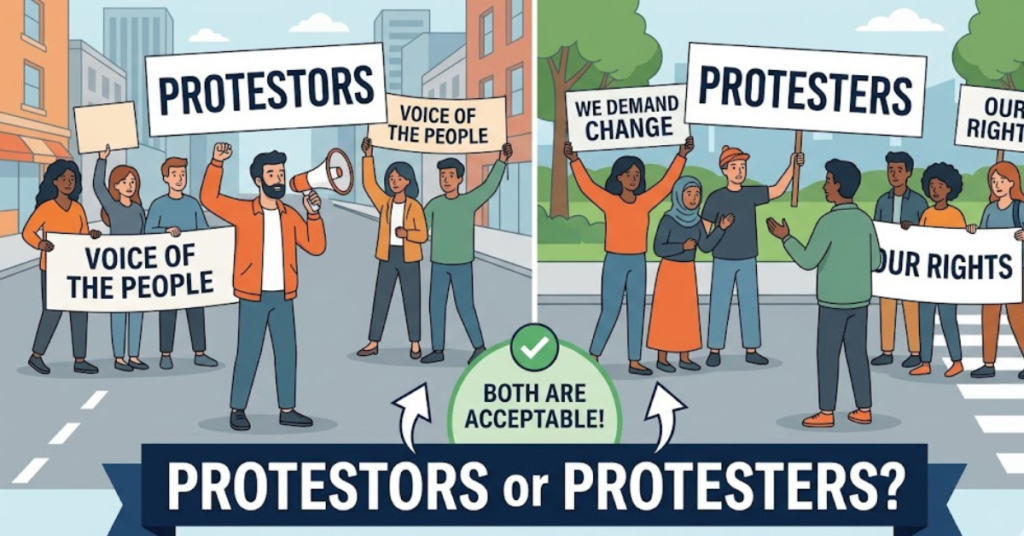
At first glance, protestors and protesters look like interchangeable variations. However, there’s a clear distinction in standard English usage.
- Protesters: The correct and preferred spelling in most contexts
- Protestors: Considered a less common or outdated variant
The word comes from the verb “protest,” and when forming a noun for someone who performs the action, English typically uses the -er ending. That’s why protester aligns with patterns like teacher, runner, or speaker.
Why “Protesters” Is the Standard Spelling
Linguistic Consistency
English tends to favor -er endings for people performing actions. This makes protesters more consistent with everyday language rules.
Dictionary Preference
Most major dictionaries list “protester” as the primary form, while “protestor” is often marked as a variant or less common spelling.
Modern Usage Trends
In news articles, academic writing, and online content, protesters overwhelmingly dominates. It’s the form you’ll encounter in reputable publications.
Protestors or Protesters AP Style
If you follow journalistic standards, the answer becomes even clearer.
- AP Style recommends “protester”
- It avoids “protestor” entirely in standard usage
So if you’re writing for media, blogs, or news-style content, sticking with protesters is the safest choice.
Protestors or Protesters UK Usage
In British English, the situation is similar:
- “Protesters” is still the preferred spelling
- “Protestors” may appear occasionally but is rare and not standard
Even in the UK, where spelling variations are more common (like colour vs color), this particular word doesn’t follow that pattern. The -er ending remains dominant.
Is It Protestors or Protesters Spelling? A Simple Rule
If you’re still unsure, here’s an easy way to remember:
When in doubt, choose protesters—it’s correct almost every time.
Quick Checklist:
- Writing an essay? → Use protesters
- Posting online? → Use protesters
- Following AP style? → Definitely protesters
Common Mistakes to Avoid
Here are a few pitfalls people run into:
- Using protestors in formal writing
- Mixing both spellings in the same document
- Assuming UK English prefers -or endings in this case
Keeping your spelling consistent boosts clarity and professionalism.
FAQs
1. Is it protestors or protesters?
The correct and widely accepted spelling is protesters.
2. Why do some people use “protestors”?
“Protestors” is an older or less common variant that still appears occasionally but isn’t standard.
3. What does AP style recommend?
AP style clearly recommends protester and avoids “protestor.”
4. Is there a difference in UK English?
No significant difference—protesters is still the preferred spelling in the UK.
5. Can I ever use “protestors”?
You might see it in older texts or informal contexts, but it’s best avoided in modern writing.
Conclusion
So, when it comes to protestors or protesters, the answer is straightforward: “protesters” is the correct and preferred spelling in nearly all cases. Whether you’re writing for an academic paper, a blog, or a news article, sticking with the standard form ensures clarity, credibility, and consistency.
If you’re aiming to improve your writing further, pay attention to small details like this—they add up. Keep learning, stay curious, and explore more language tips to sharpen your skills.