
If you’ve ever paused mid-sentence wondering “take effect or take affect?”, you’re definitely not alone. This is one of those tricky English phrases that can trip up even confident writers. The confusion usually comes down to the words effect and affect, which sound similar but have very different meanings.
In this article, we’ll break down take effect or take affect in a simple, conversational way. By the end, you’ll not only know the correct form but also feel confident using it in real-life sentences.
What Does “Take Effect” Mean?
Let’s start with the correct phrase: take effect.
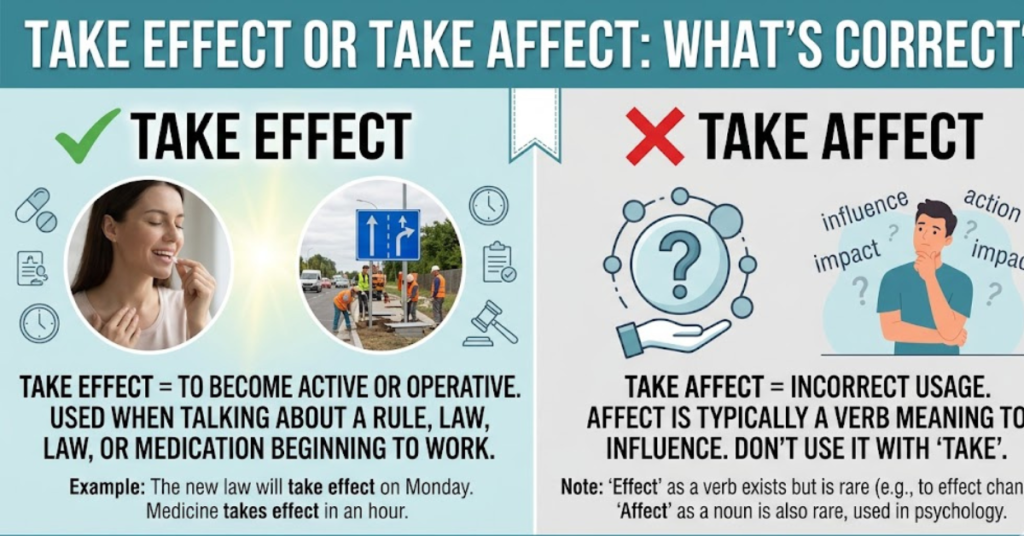
“Take effect” means:
- To begin to work
- To become active or operational
Examples:
- The new law will take effect next month.
- The medicine should take effect within an hour.
- The policy changes take effect immediately.
In all these cases, something is starting to work or become active.
Is “Take Affect” Ever Correct?
Short answer: No.
If you’re asking “is it take effect or take affect?”, the correct answer is always take effect.
Here’s why:
- Affect is usually a verb (an action word), meaning “to influence something.”
- Effect is usually a noun, meaning “a result” or “an outcome.”
The phrase “take effect” uses effect as a noun, which makes grammatical sense.
“Take affect” doesn’t fit standard English usage and is considered incorrect.
Affect vs. Effect: The Key Difference
Understanding this distinction will help you avoid confusion in the future.
Affect (Verb)
- Means to influence something
- Example: Lack of sleep can affect your mood.
Effect (Noun)
- Means a result or outcome
- Example: The new rule had a positive effect.
Quick Memory Trick:
- Affect = Action (both start with “A”)
- Effect = End result
How to Use “Take Effect” in a Sentence
If you’re searching for “take effect or take affect in a sentence”, here are some clear examples:
- The agreement will take effect on January 1st.
- The changes won’t take effect until approved.
- The treatment began to take effect after a few days.
These examples show how the phrase is commonly used in formal, academic, and everyday contexts.
Common Variations You Might See
Let’s clear up some frequently searched phrases:
To Take Effect or Take Affect
The correct phrase is always to take effect.
Will Take Effect or Take Affect
Again, the correct usage is will take effect.
Example:
- The new pricing structure will take effect next week.
Why Do People Confuse These Terms?
There are a few reasons this mistake is so common:
- Similar pronunciation: Affect and effect sound alike.
- Grammar complexity: One is usually a verb, the other a noun.
- Fast writing habits: People type what sounds right, not what is correct.
The good news? Once you understand the difference, it becomes second nature.
Quick Tips to Remember
Here’s a simple checklist to avoid mistakes:
- Use take effect when something begins or starts working
- Remember affect = influence, not “start”
- If unsure, replace with “begin” — if it fits, use “take effect”
FAQs
1. Is it “take effect or take affect”?
The correct phrase is take effect. “Take affect” is incorrect.
2. What does “take effect” mean?
It means something has started working or become active.
3. Can “affect” ever be used in this phrase?
No, “affect” does not work in this context because it’s typically a verb.
4. How do I remember the difference between affect and effect?
Think: Affect = Action, Effect = End result.
5. Which is correct: “will take effect or take affect”?
The correct version is will take effect.
Conclusion
So, when it comes to take effect or take affect, the answer is clear: “take effect” is always correct. It’s the proper way to describe something starting or becoming active, whether it’s a law, a policy, or even medication.
The confusion between affect and effect is common, but with a little practice, you’ll spot the difference instantly. Next time you write or speak, you’ll know exactly which phrase to use—and why it’s correct.
If you want to sharpen your grammar even further, keep exploring similar word pairs. Small improvements like this can make a big difference in how clearly and confidently you communicate.