
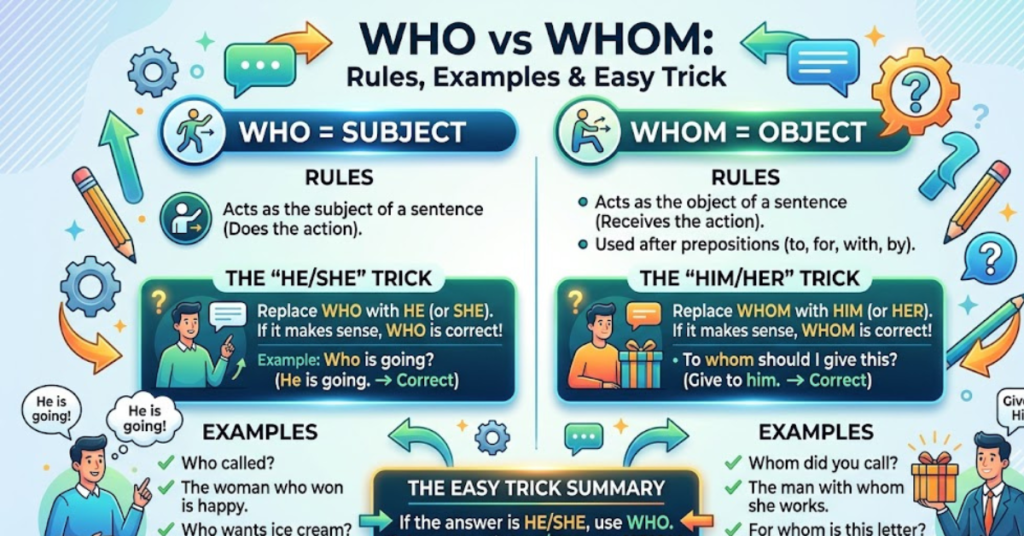

Ever paused mid-sentence wondering whether to write who or whom? You’re not alone. The confusion around who vs whom is one of the most common grammar struggles—even for fluent English speakers.
The good news? Once you understand a few simple rules and a reliable trick, choosing between them becomes much easier. In this guide, we’ll break down who vs whom grammar, share practical examples, and give you a quick method you can use every time.
Who vs Whom: What’s the Difference?
At its core, the difference comes down to subject vs object in a sentence.
- Who = subject (the one doing the action)
- Whom = object (the one receiving the action)
Simple Breakdown
- Use who when the person is performing the action
- Use whom when the person is affected by the action
The Easiest Who vs Whom Trick
If grammar rules feel abstract, this who vs whom trick will save you every time:
Replace the word with he/she or him/her
- If he/she fits → use who
- If him/her fits → use whom
Example:
- ___ is calling?
→ He is calling ✔ → Who is calling? - To ___ should I speak?
→ I should speak to him ✔ → To whom should I speak?
This quick test is the most reliable shortcut for everyday writing.
When to Use Who vs Whom (With Examples)
Understanding when to use who vs whom becomes easier with real examples.
Using “Who” (Subject)
Use who when the person is doing the action:
- Who wrote this article?
- Who is at the door?
- Who wants coffee?
In all these sentences, who performs the action.
Using “Whom” (Object)
Use whom when the person receives the action:
- Whom did you invite?
- To whom are you speaking?
- Whom should we contact?
Here, whom is on the receiving end.
Who vs Whom Rules You Should Remember
To simplify who vs whom rules, keep these points in mind:
- Look at the verb – Who performs it?
- Check sentence structure – Is the word a subject or object?
- Watch prepositions – Words like to, for, with often signal “whom”
- Use the he/him trick – Your fastest check
Who vs Whom Usage in Sentences
Let’s look at more who vs whom usage examples:
- Who is leading the team?
- Whom did they choose as captain?
- Who called you yesterday?
- With whom are you traveling?
Quick Tip:
In casual conversation, people often use who instead of whom. While that’s acceptable informally, formal writing still prefers correct usage.
Common Mistakes (And How to Avoid Them)
Here are typical errors when using who vs whom:
Whom is coming to the party?
Who is coming to the party?
Who did you give the book to? (acceptable informally)
Whom did you give the book to? (formal)
Who vs Whom Practice (Quick Quiz)
Test your understanding with this mini who vs whom quiz:
- ___ is responsible for this?
- To ___ did you send the email?
- ___ wants to join us?
Answers:
- Who
- Whom
- Who
Why “Whom” Is Becoming Less Common
Modern English is shifting. In everyday speech, whom is often replaced by who. However:
- Formal writing (academic, professional) still values correct usage
- Knowing the rule helps you sound more polished
So even if you don’t use whom daily, understanding who vs whom usage is still important.
FAQs
1. When do you use who vs whom?
Use who as the subject and whom as the object of a verb or preposition.
2. What is the easiest who vs whom trick?
Replace with he/she or him/her. If him/her fits, use whom.
3. Is it okay to always use “who”?
In casual conversation, yes. But in formal writing, using whom correctly is recommended.
4. How can I check who vs whom quickly?
Use a who vs whom checker method: rephrase the sentence and test with he/him.
5. Do native speakers use “whom”?
Less often in speech, but it’s still used in formal contexts and writing.
Conclusion
Mastering who vs whom doesn’t have to be complicated. Once you understand the subject-object difference and use the he/him trick, the confusion disappears quickly.