
Ever paused mid-sentence wondering whether to write farther or further? You’re not alone. The confusion around farther vs further trips up even experienced writers because the words seem interchangeable at first glance.
Here’s the good news: once you understand the subtle difference, choosing the right one becomes surprisingly easy. In this guide, we’ll break down the farther vs further meaning, explore grammar rules, and walk through real-world examples so you can use both words with confidence.
Farther vs Further Meaning: What’s the Difference?
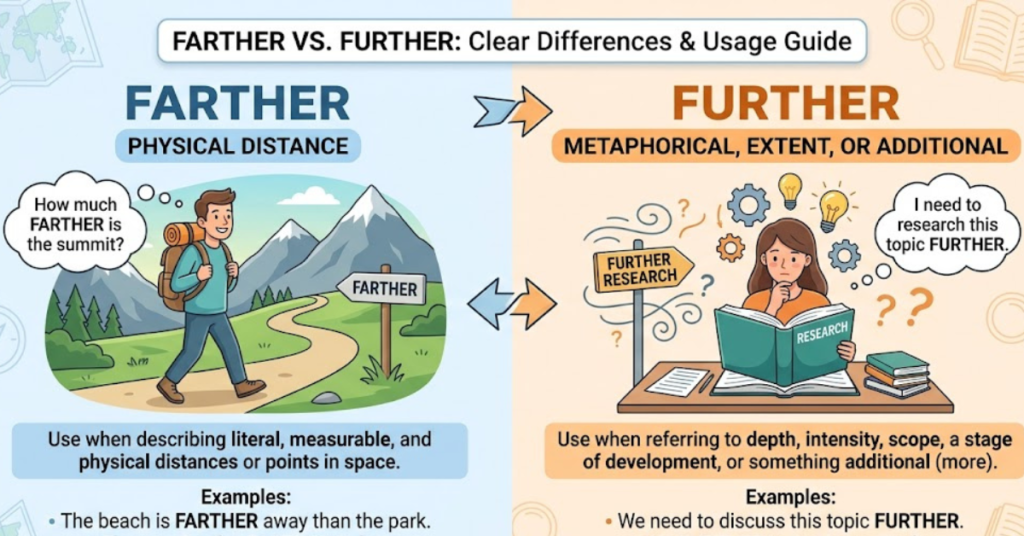
At its core, the farther vs further difference comes down to distance—literal vs figurative.
- Farther → refers to physical distance
- Further → refers to figurative distance, time, or degree
Quick Rule to Remember
If you can measure it (in miles, meters, etc.), use farther.
If it’s abstract (ideas, progress, time), use further.
When to Use Farther vs Further
Use Farther for Physical Distance
Think of farther as something you can physically measure.
Examples:
- She ran farther than anyone else in the race.
- The shop is farther down the road.
- We walked farther than planned.
These sentences all involve actual, measurable space.
Use Further for Figurative Distance or Time
Further works when you’re talking about concepts, progress, or time.
Examples:
- Let’s discuss this further tomorrow.
- He took the idea further than expected.
- We need further information before deciding.
This is why farther vs further for time leans strongly toward further.
Farther vs Further Usage Examples
Here’s a side-by-side comparison to make things crystal clear:
| Context | Correct Word | Example Sentence |
| Physical distance | Farther | The park is farther away than I thought. |
| Abstract idea | Further | She wants to explore the topic further. |
| Time | Further | We’ll talk further next week. |
| Progress | Further | The research went further than expected. |
Farther vs Further Grammar Rules
Let’s simplify the farther vs further grammar rules into something easy to remember:
- Use farther for measurable distance
- Use further for metaphorical or abstract concepts
- When unsure, “further” is often acceptable in modern usage
Interestingly, many style guides—including references like Merriam-Webster—note that further is increasingly used in both contexts, especially in informal writing.
Farther vs Further in UK vs US English
The farther vs further UK distinction is less strict than in American English.
- In American English, the distinction is clearer:
- Farther = physical
- Further = abstract
- In British English, further is often used for both meanings
So, if you’re writing for a global audience, further is usually the safer choice.
Farther vs Further Pronunciation
Both words sound similar but have slight differences:
- Farther → /ˈfɑːrðər/
- Further → /ˈfɜːrðər/
The vowel sound changes, but in fast speech, they can sound almost identical—another reason they’re often confused.
Common Mistakes to Avoid
Here are a few pitfalls people run into with farther vs further usage:
- “We need farther discussion”
“We need further discussion” - “The store is further away” (technically acceptable, but less precise)
“The store is farther away” - Mixing both randomly in the same context
Consistency matters—pick the correct one based on meaning.
Farther vs Further Quiz (Quick Test)
Try this quick check:
- The hotel is ______ down the road.
- Let’s not go any ______ with this argument.
- He pushed the project ______ than expected.
Answers:
- Farther
- Further
- Further
FAQs
1. What is the main difference between farther vs further?
The main difference is that farther refers to physical distance, while further refers to abstract or figurative distance.
2. Can farther and further be used interchangeably?
Sometimes, yes—especially in informal contexts. However, using them correctly improves clarity and precision.
3. Is “further” correct for distance?
It’s increasingly accepted, especially in British English, but farther is still more precise for physical distance.
4. When to use farther vs further in writing?
Use farther for measurable distance and further for ideas, time, or progress.
5. Which is more common in modern usage?
Further is more commonly used overall and often replaces farther in casual writing.
Conclusion
Understanding farther vs further difference usage doesn’t have to be complicated. Just remember:
- Farther = physical distance
- Further = abstract ideas, time, or progress
Once you get the hang of it, your writing becomes clearer and more polished. If you want to sharpen your grammar even more, keep practicing with real-life examples and revisit tricky word pairs like this one.
Ready to take it a step further? Explore more grammar guides and keep building your writing confidence.