
Ever found yourself hesitating between tweek or tweak while writing? You’re not alone. This small spelling confusion trips up a lot of people because both versions look like they could be right. But here’s the truth: only one of them is correct in standard English.
In this guide, we’ll break down tweek or tweak in a simple, practical way. You’ll learn the correct spelling, meaning, usage, and how to avoid this common mistake for good.
Tweek or Tweak: What’s the Correct Spelling?
Let’s settle it right away:
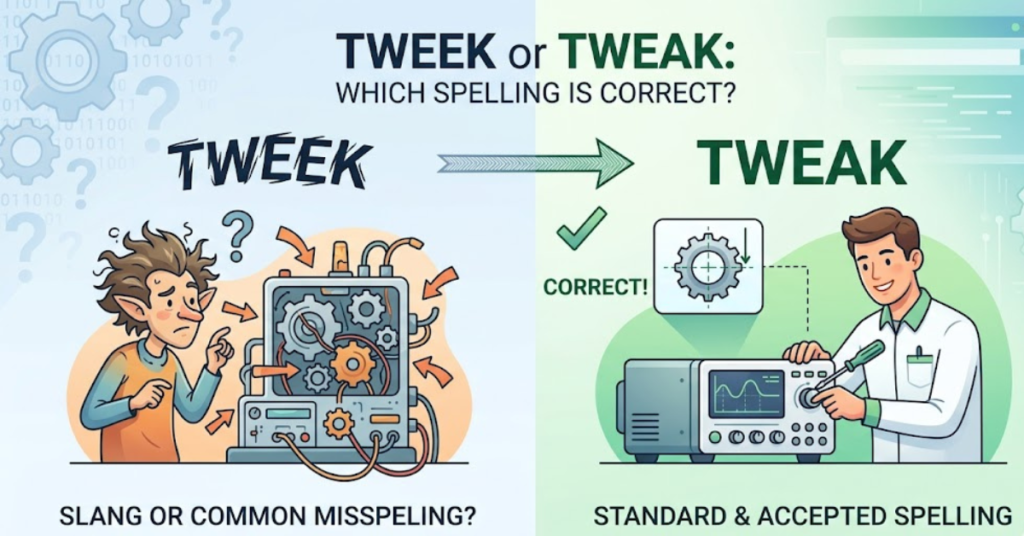
The correct spelling is “tweak.”
“Tweek” is a misspelling.
If you’ve been wondering is it tweek or tweak, the answer is clear—“tweak” is the only accepted form in modern English.
What Does “Tweak” Mean?
Understanding the meaning helps lock in the correct spelling.
Tweak (verb):
To make small adjustments or fine-tune something.
Tweak (noun):
A slight modification or improvement.
Examples:
- “I need to tweak this design before publishing.”
- “The recipe only needs a small tweak.”
So when people search for tweek or tweak meaning, they’re really looking for the definition of “tweak.”
Why Do People Confuse?
The confusion usually comes down to pronunciation and spelling patterns.
Common reasons:
- The long “ee” sound in tweek feels natural.
- English spelling rules can be inconsistent.
- Autocorrect doesn’t always catch informal writing errors.
But when it comes to tweek or tweak spelling, remember this:
“Tweak” follows standard English usage.
“Tweek” doesn’t appear in dictionaries.
How to Remember the Correct Spelling
If you tend to mix up tweek or tweak, try these simple tricks:
1. Think of “weak”
- Both tweak and weak share the “ea” pattern.
2. Associate it with “adjust”
- “Tweak” = adjust → both are real words you already know.
3. Visual memory
- “Tweak” just looks more like a polished English word.
When to Use “Tweak” in Sentences
Here are some everyday situations where “tweak” fits naturally:
Work & Productivity
- “Let’s tweak the presentation before the meeting.”
Technology
- “You can tweak the settings for better performance.”
Writing & Creativity
- “I’ll tweak this paragraph to make it clearer.”
Daily Life
- “Just a small tweak can improve the flavor.”
If you’re thinking about tweek or tweak to change, “tweak” is exactly the word you want—it literally means making small changes.
Common Mistakes to Avoid
When dealing with tweek or tweak?, here are a few pitfalls:
- Writing “tweek” in formal documents
- Assuming both spellings are acceptable
- Ignoring spell-check suggestions
Quick rule:
If you’re unsure how to spell tweek or tweak, always go with tweak.
Tweak vs Similar Words
To better understand usage, here’s how “tweak” compares:
| Word | Meaning | Usage Example |
| Tweak | Small adjustment | “Tweak the settings.” |
| Adjust | Modify for improvement | “Adjust the volume.” |
| Modify | Change partially | “Modify the design.” |
| Revise | Edit or improve | “Revise the document.” |
“Tweak” is usually more casual and implies minor changes, not major ones.
FAQs About Tweek or Tweak
1. Is it tweek or tweak?
It is tweak. “Tweek” is incorrect.
2. What is the correct tweek or tweak definition?
“Tweak” means to make small changes or adjustments to improve something.
3. Why do people write “tweek”?
Mostly due to pronunciation and confusion with similar-looking words.
4. Can “tweek” ever be correct?
No, “tweek” is not recognized in standard English.
5. How do I remember the correct spelling?
Think of “weak” or “peak”—they share the same “ea” pattern as “tweak.”
Conclusion
The debate over tweek or tweak is simpler than it seems. “Tweak” is the correct spelling, and it refers to making small, precise changes. “Tweek,” on the other hand, is just a common mistake.
Once you understand the meaning and see how often “tweak” is used in everyday language, the confusion fades quickly. Keep practicing, stay mindful while writing, and you’ll never second-guess it again.
If you’re looking to sharpen your writing further, explore other commonly confused words—you’ll be surprised how many quick “tweaks” can improve your clarity and confidence.