

Ever stopped mid-sentence wondering whether to write orientated or oriented? You’re not alone. The debate around orientated vs oriented is surprisingly common, even among experienced writers. While both words look similar and are often used interchangeably, there are subtle differences in usage, tone, and regional preference.
In this guide, we’ll break down the meaning, explain when to use each form, and give you practical examples so you can write with confidence—no second-guessing required.
Orientated vs Oriented Meaning
At their core, both orientated and oriented come from the verb “orient,” which means:
- To align or position something
- To familiarize someone with a situation
- To direct attention or focus toward something
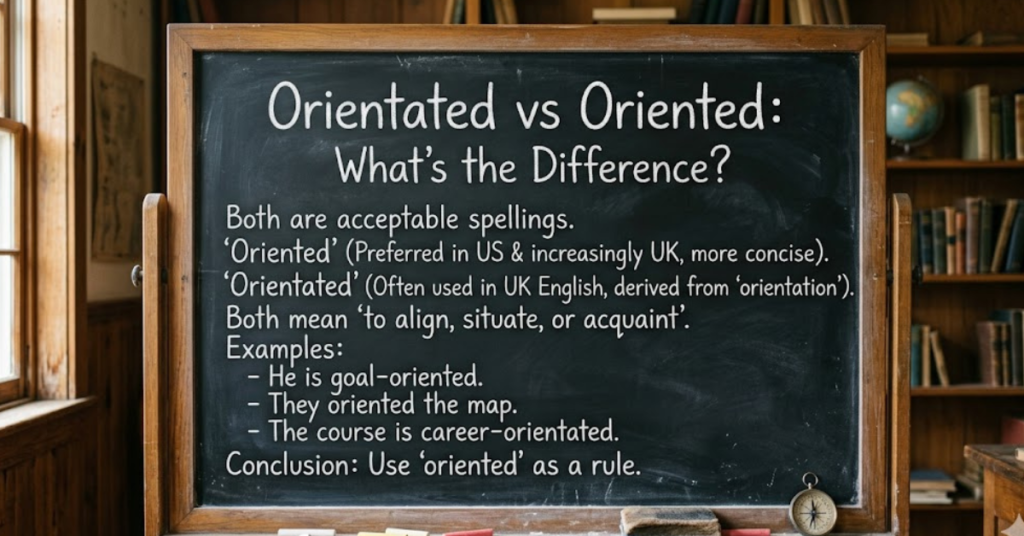
So in terms of orientated vs oriented meaning, there is no major difference. Both words carry the same definition and can technically be used in similar contexts.
However, how they’re perceived varies depending on where you are and the style of English you’re using.
Is Orientated vs Oriented Correct?
Here’s the straightforward answer: both are correct, but one is more widely accepted.
- Oriented is the preferred and standard form in most English-speaking regions
- Orientated is considered a variant, more common in British English
If you’re writing for a global or professional audience, oriented is usually the safer choice.
Orientated vs Oriented UK Usage
When it comes to orientated vs oriented UK preferences:
- In the UK, both forms are used
- Orientated appears more frequently in informal or conversational contexts
- Oriented is still widely accepted, especially in formal writing
So if you’re writing in British English, you have flexibility—but consistency matters.
Orientated vs Oriented Canada and US
In North America, the difference is clearer:
- In the United States and Canada, oriented dominates
- Orientated is rarely used and may sound slightly awkward or outdated
For anyone targeting North American readers, sticking with oriented is the best approach.
Family Orientated vs Oriented: Which One Sounds Better?
This is one of the most searched phrases: family orientated vs oriented.
Both are technically correct:
- Family-oriented (preferred, especially in US/Canada)
- Family-orientated (acceptable in UK, less common elsewhere)
Example usage:
- “It’s a family-oriented neighborhood with great schools.”
- “The company promotes a family-orientated work culture.”
If you want your writing to sound modern and widely understood, go with family-oriented.
Orientated vs Oriented Examples
Seeing the words in context makes the difference clearer. Here are some natural orientated vs oriented examples:
Using “oriented”:
- “The training session is designed to help new employees get oriented.”
- “She’s very career-oriented and focused on growth.”
- “This course is student-oriented and interactive.”
Using “orientated”:
- “The team is goal-orientated and driven.”
- “He works in a customer-orientated role.”
Notice how both work similarly, but oriented tends to feel cleaner and more standard.
Define Orientated vs Oriented (Simple Explanation)
If you’re looking to define orientated vs oriented in the simplest terms:
- Oriented: The standard, widely accepted past form of “orient”
- Orientated: A less common variant, mainly used in British English
In terms of orientated vs oriented definition, they mean the same thing—but differ in frequency and preference.
When Should You Use Each One?
Here’s a quick guide to help you decide:
Use “oriented” when:
- Writing for a global or international audience
- Creating professional, academic, or business content
- Targeting US or Canadian readers
Use “orientated” when:
- Writing in British English with a conversational tone
- Matching a specific regional style or audience
Consistency is key. Don’t mix both forms in the same piece unless there’s a clear reason.
Common Mistakes to Avoid
Even though the difference is subtle, a few mistakes can stand out:
- Mixing both forms in one article
- Assuming orientated is incorrect (it’s not—it’s just less common)
- Using orientated in formal US writing
Keeping your audience in mind will help you avoid these pitfalls.
FAQs
1. Is orientated vs oriented the same?
Yes, both words have the same meaning. The difference lies in regional usage and preference.
2. Which is correct: orientated or oriented?
Both are correct, but oriented is more widely accepted, especially in formal writing.
3. Is orientated British English?
Yes, orientated is more commonly used in British English, though oriented is also accepted.
4. What is better: family orientated or family oriented?
Family-oriented is generally preferred, especially in North America and professional contexts.
5. Should I avoid using orientated?
Not necessarily. You can use it if you’re writing for a UK audience, but oriented is safer for broader readability.
Conclusion
The debate around orientated vs oriented isn’t about right or wrong—it’s about preference and context. While both forms share the same meaning, oriented stands out as the clearer, more universally accepted option.
If you’re aiming for polished, professional writing that works across regions, oriented is your best bet. Still, understanding both forms gives you flexibility and confidence in your writing.
Want to sharpen your grammar even further? Keep exploring similar word pairs and you’ll notice your writing becoming more precise and natural with every step.