
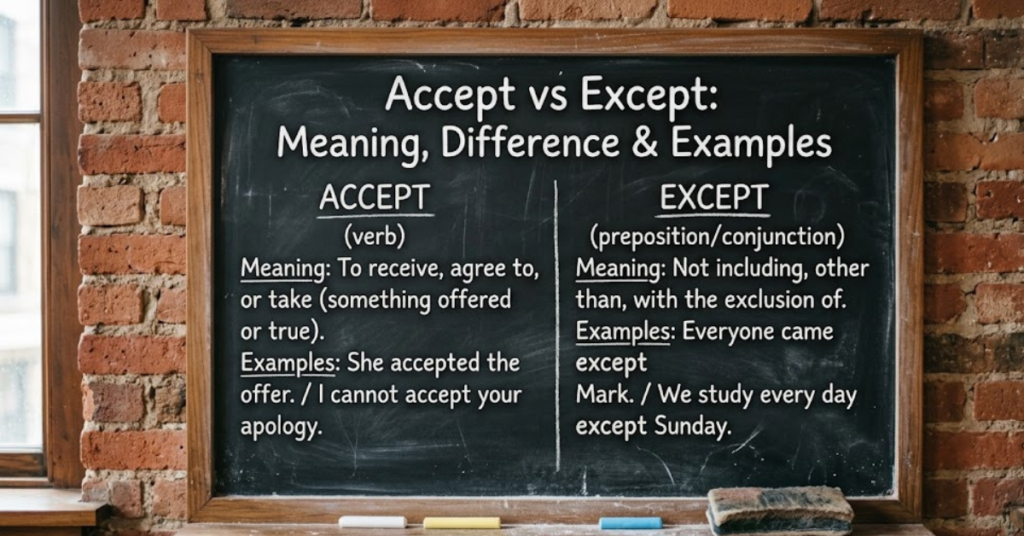

Have you ever paused mid-sentence wondering whether to write accept or except? You’re not alone. The confusion around accept vs except is one of the most common grammar slip-ups in English. These two words sound similar, but their meanings couldn’t be more different.
In this guide, we’ll break down the accept vs except meaning, show real-life examples, and give you simple tricks to never mix them up again. By the end, you’ll confidently know when to use each word in any context.
What Is Accept vs Except?
Let’s start with the basics.
Accept – Definition and Usage
Accept is a verb. It means to receive something willingly or to agree to something.
Common meanings include:
- To receive (a gift, offer, or invitation)
- To agree or approve
- To believe something is true
Examples:
- I happily accept your invitation.
- She didn’t accept the job offer.
- He finally accepted the truth.
Except – Definition and Usage
Except is usually a preposition or conjunction. It means to exclude something or someone.
Common meanings include:
- Leaving something out
- Not including a particular item or person
Examples:
- Everyone came to the party except Ali.
- I like all fruits except bananas.
- The store is open every day except Sunday.
Accept vs Except Difference Explained
Understanding the accept vs except difference is easier when you focus on their roles:
- Accept = Receive or agree (action word / verb)
- Except = Exclude or leave out (preposition/conjunction)
A quick trick:
- If you can replace the word with receive, use accept
- If you can replace it with excluding, use except
Example:
- I accept your apology (I receive it)
- Everyone came except him (excluding him)
Accept vs Except Usage in Sentences
Here are some clear accept or except sentences to reinforce the difference:
- She will accept the award tonight.
- All students passed except one.
- I can’t accept this excuse.
- We work every day except Sunday.
Practicing these kinds of accept or except usage examples helps build confidence quickly.
Accept vs Except vs Expect
Another layer of confusion comes with expect.
- Accept = receive
- Except = exclude
- Expect = anticipate or think something will happen
Examples:
- I expect a call tomorrow.
- I accept your decision.
- Everyone is here except Sara.
When to Use Accept vs Except
Here’s a simple guide for when to use accept vs except:
Use accept when:
- You’re talking about agreeing or receiving
- An action is being performed
Use except when:
- You’re excluding something
- You’re making an exception
Accept vs Except Grammar Tips
To master accept vs except grammar, remember:
- Accept is always a verb
- Except is never a verb in standard usage
- Sentence meaning changes completely if you mix them up
Incorrect: I except your apology
Correct: I accept your apology
Accept vs Except Pronunciation
Although they look similar, pronunciation differs slightly:
- Accept: ak-SEPT
- Except: ik-SEPT
The difference is subtle, which is why confusion happens, especially in spoken English.
Commonly Confused Words: Accept vs Except
In the world of commonly confused words accept vs except, these two top the list. Why?
- Similar spelling
- Similar pronunciation
- Completely different meanings
The key is context. Always ask yourself: Am I receiving something or excluding something?
Practice: Accept vs Except Exercises
Try these quick accept vs except practice sentences:
- I will ___ your offer.
- Everyone left ___ John.
- She refused to ___ the gift.
- All rules apply ___ this one.
Answers:
- accept
- except
- accept
- except
If you’re creating an accept vs except worksheet, these fill-in-the-blank exercises work perfectly for learners.
Accept vs Except Quiz
Test yourself with a mini accept vs except quiz:
Which sentence is correct?
A. I except your invitation
B. I accept your invitation
Correct answer: B
Accept vs Except Meme (Learning Trick)
A fun way to remember:
- “I accept gifts”
- “Everyone came except me”
Even simple mental images like this can make a big difference in recall.
FAQs
What is accept vs except?
It refers to two commonly confused words in English where accept means to receive and except means to exclude.
How do I remember the difference?
Think:
- Accept = Action (receive)
- Except = Exclusion (leave out)
Can except ever be a verb?
In rare formal cases, yes, but it’s extremely uncommon. In everyday use, it functions as a preposition or conjunction.
Why do people confuse accept vs except?
Because they sound very similar and are only one letter apart in spelling.
Where can I find an accept vs except worksheet PDF?
You can create your own practice sheets using fill-in-the-blank exercises or quizzes like the ones above.
Conclusion
Mastering accept vs except doesn’t have to be complicated. Once you understand that accept means to receive and except means to exclude, everything falls into place.
Keep practicing with real sentences, test yourself regularly, and pay attention to context. With a little consistency, this once-confusing pair will become second nature.
If you found this guide helpful, consider exploring other commonly confused words to sharpen your grammar even further.