
Ever paused mid-sentence wondering whether to write exception or acception? You’re not alone. The confusion around exception vs acception is surprisingly common, especially because one is a standard English word while the other… well, not quite.
In this guide, we’ll break down the exception vs acception meaning, explain why the mix-up happens, and show you exactly how to use the correct term with confidence. By the end, you’ll never second-guess yourself again.
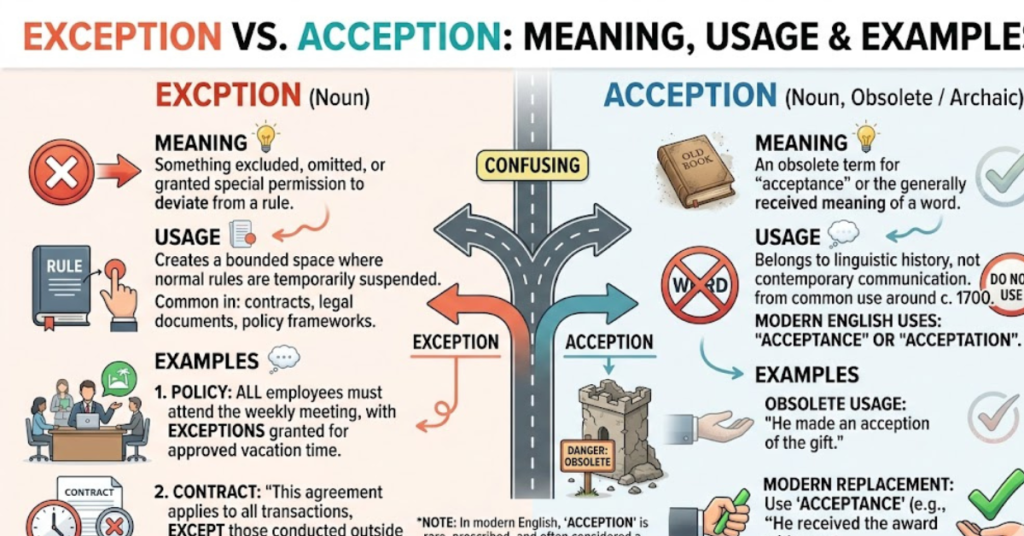
Exception vs Acception – What’s the Difference?
Let’s clear this up right away:
- Exception is a correct and widely used English word.
- Acception is extremely rare and considered outdated or incorrect in modern usage.
What Does “Exception” Mean?
An exception refers to something that does not follow a general rule or pattern.
Simple definition:
A person or thing that is excluded from a rule.
Examples:
- Everyone passed the test, with one exception.
- I like all fruits, with the exception of bananas.
- The rule applies to everyone—no exceptions allowed.
In everyday English, this is the word you almost always want.
What Does “Acception” Mean?
Technically, acception exists, but it’s:
- Obsolete or rarely used
- Found mostly in historical or linguistic contexts
Meaning:
It refers to the “accepted meaning of a word” in a specific context.
Example (rare usage):
- The word has a different acception in legal language.
That said, modern English speakers almost never use it. Instead, words like meaning, sense, or definition are preferred.
Why People Confuse Exception vs Acception
The confusion doesn’t come out of nowhere. Here’s why it happens:
- Similar spelling: Both words look alike at a glance
- Pronunciation overlap: In fast speech, they can sound similar
- Auto-correct errors: Typing quickly can lead to unintended word swaps
- Lack of exposure: Most people rarely encounter acception, so they assume it’s a variation of exception
Exception vs Acception Meaning in Real Context
To really lock this in, let’s compare how each works in context:
Correct Usage (Exception)
- There are no exceptions to this rule.
- She made an exception for her best friend.
Incorrect or Rare Usage (Acception)
- There are no acceptions to this rule.
- Better: There are no exceptions to this rule.
When “Acception” Might Appear
- Academic or linguistic texts
- Historical writings
- Discussions about word meanings in specialized contexts
Even then, it’s uncommon.
Easy Trick to Remember the Difference
Here’s a simple memory hack:
- Exception = Exclude → both start with “Ex”
- Acception = Accept (but don’t use it!)
If you’re writing about rules, limits, or special cases, you want exception—every time.
Common Mistakes to Avoid
When dealing with exception vs acception, watch out for these errors:
- Using acception in everyday writing
- Assuming both words are interchangeable
- Replacing exception in formal documents (this can look unprofessional)
Quick tip: If you’re unsure, stick with exception. It’s almost always correct.
Synonyms and Related Words
Expanding your vocabulary helps avoid confusion. Here are some alternatives:
For “Exception”
- Exclusion
- Special case
- Anomaly
- Deviation
Instead of “Acception”
- Meaning
- Definition
- Interpretation
- Sense
FAQs About Exception vs Acception
Is “acception” a real word?
Yes, but it’s outdated and rarely used in modern English.
Which is correct: exception or acception?
In almost all cases, exception is the correct word.
Can I use acception in formal writing?
It’s not recommended unless you’re writing in a highly specialized or historical context.
Why does acception sound correct?
Because it resembles accept and exception, making it feel familiar—even though it’s not commonly used.What’s the easiest way to avoid mistakes?
Remember: if you’re talking about rules or exclusions, use exception.
Conclusion
Understanding exception vs acception doesn’t have to be complicated. One word—exception—is a staple of everyday English, used to describe something that doesn’t follow the rule. The other—acception—is largely obsolete and rarely needed.
If you keep one takeaway in mind, let it be this: when in doubt, go with exception. It’s correct, clear, and widely accepted.
Want to sharpen your writing even further? Keep exploring commonly confused words—you’ll be surprised how quickly your confidence grows.