

Ever paused mid-sentence and wondered, “is it perfer or prefer?” You’re not alone. This small spelling mix-up is surprisingly common, especially because both versions sound similar when spoken quickly. But when it comes to writing, only one is correct—and knowing which one can instantly improve your credibility.
In this guide, we’ll break down the difference between perfer or prefer spelling, explain why the confusion happens, and give you easy ways to remember the correct form.
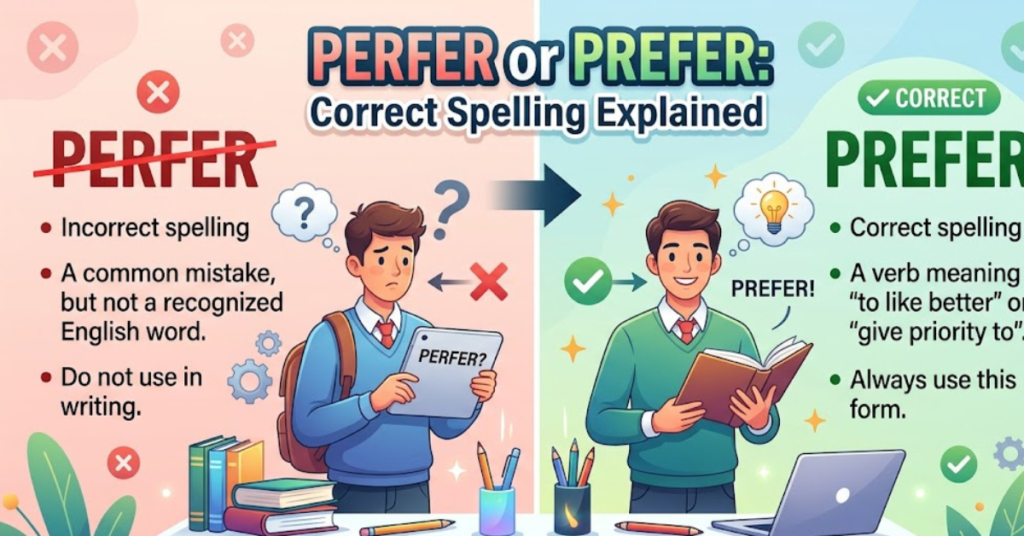
Perfer or Prefer: Which One Is Correct?
Let’s clear this up right away:
- Prefer = Correct spelling
- Perfer = Incorrect spelling
“Prefer” is a standard English verb that means to like one thing more than another. On the other hand, “perfer” is simply a misspelling and doesn’t exist in proper English usage.
What Does “Prefer” Mean?
“Prefer” is used when you choose or favor one option over another. It’s commonly used in both casual and formal conversations.
Examples:
- I prefer tea over coffee.
- She prefers working in the morning.
- We prefer quality over quantity.
Synonyms of “Prefer”:
- Favor
- Choose
- Like better
- Opt for
Why Do People Confuse “Perfer” and “Prefer”?
The confusion between perfer or prefer usually comes down to pronunciation and typing habits.
Common reasons include:
- Sound confusion: In fast speech, “prefer” may sound like “per-fer.”
- Typing errors: Fingers sometimes reverse letters while typing quickly.
- Lack of familiarity: Some learners haven’t seen the correct spelling often enough.
Easy Trick to Remember the Correct Spelling
Here’s a simple way to lock it in your memory:
“Pre” comes before “fer” — just like “prefer.”
Think of it like this:
- You prefer something before choosing it
- So the word starts with “pre”, not “per”
This small mental trick can save you from making the mistake again.
How to Use “Prefer” Correctly in Sentences
To fully understand the correct usage, here are some common sentence structures:
1. Prefer + noun
- I prefer pizza.
2. Prefer + A + to + B
- I prefer tea to coffee.
3. Prefer + verb (-ing)
- She prefers reading over watching TV.
4. Prefer + to + verb
- They prefer to travel by train.
Common Mistakes to Avoid
When thinking about is it perfer or prefer, watch out for these errors:
- Writing “perfer” in emails or assignments
- Mixing up “prefer” with unrelated words
- Forgetting subject-verb agreement (e.g., “She prefer” instead of “She prefers”)
Quick Fix:
Always double-check your spelling—especially in professional or academic writing.
Perfer or Prefer Spelling in Everyday Use
Understanding the correct form isn’t just about grammar—it impacts how others perceive your writing.
Why it matters:
- Professional communication: Correct spelling builds trust
- Academic writing: Helps avoid unnecessary mistakes
Using “prefer” correctly shows attention to detail and language confidence.
FAQs
1. Is “perfer” ever correct?
No, “perfer” is always incorrect. The correct spelling is “prefer.”
2. Why do I keep typing “perfer”?
It’s likely due to habit or muscle memory. Slowing down while typing and proofreading can help fix this.
3. How can I remember the correct spelling?
Use the “pre comes first” trick. Always start with pre- when writing “prefer.”
4. Is “prefer” a formal word?
Yes, it works in both formal and informal contexts, making it a versatile word.
5. Are there similar confusing words?
Yes, English has many commonly confused words like:
- Accept vs Except
- Affect vs Effect
- Lose vs Loose
Conclusion
So, next time you’re stuck wondering about perfer or prefer, remember this: “prefer” is the only correct spelling. It’s a simple fix, but one that can make a big difference in how polished your writing appears.
Mastering small details like this helps you communicate more clearly and confidently. If you want to sharpen your English even further, keep exploring commonly confused words—you’ll be surprised how much they elevate your writing skills.