
Ever paused mid-sentence wondering whether to write their or there? You’re not alone. The confusion around their vs there is one of the most common grammar slip-ups in English—and it doesn’t stop there. Add they’re into the mix, and things can get even trickier.
In this guide, we’ll break down their vs there vs they’re in a simple, conversational way. By the end, you’ll not only understand the differences but also feel confident using them in real-life writing.
Their vs There Meaning (Quick Overview)
Let’s start with the basics. Understanding the meaning of their vs there is the first step toward using them correctly.
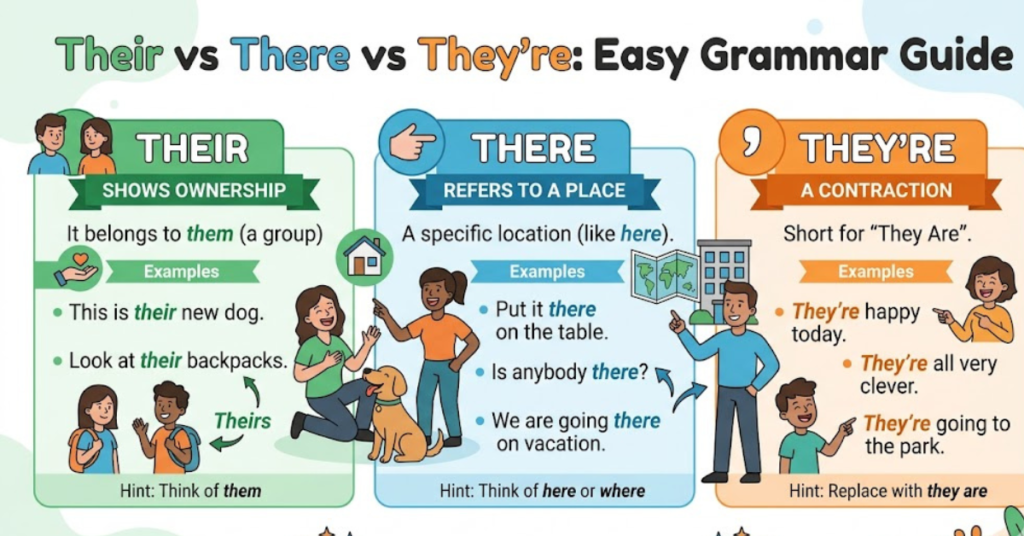
- Their → Shows possession (something belongs to them)
- There → Refers to a place or introduces a sentence
- They’re → A contraction of “they are”
These three words sound the same, but their meanings are completely different.
Their vs There vs They’re Difference Explained
1. What Does “Their” Mean?
Their is a possessive adjective. It shows ownership.
Examples:
- Their house is beautiful.
- The kids forgot their bags at school.
Think of their as similar to my, your, or our.
2. What Does “There” Mean?
There has two main uses:
a) Refers to a place
- The keys are over there.
- Let’s go there tomorrow.
b) Used to start sentences
- There is a problem with your order.
- There are many reasons to learn grammar.
3. What Does “They’re” Mean?
They’re is simply a contraction of they are.
Examples:
- They’re going to the market.
- I think they’re ready.
Quick test: Replace they’re with they are. If it still makes sense, you’re correct.
When to Use Their vs There (Simple Rules)
If you’re wondering when to use their vs there, follow these quick rules:
- Use their when showing ownership
- Use there when talking about a place or starting a sentence
- Use they’re when you mean they are
Their vs There Examples for Clarity
Here are side-by-side examples to make things clearer:
| Word | Example Sentence |
| Their | Their car is parked outside. |
| There | The car is over there. |
| They’re | They’re buying a new car. |
Their vs There Grammar Difference Made Easy
Understanding the their vs there grammar difference comes down to function:
- Their = Possession
- There = Location or sentence filler
- They’re = Action (they are doing something)
A helpful trick:
- If you can replace it with our, use their
- If it answers “where?”, use there
- If it expands to “they are,” use they’re
Common Mistakes to Avoid
Even confident writers mix these up. Here are a few pitfalls:
- There going to the party
They’re going to the party - Their is a problem here
There is a problem here - The students forgot there homework
The students forgot their homework
Their vs There vs They’re (Memory Tips)
Try these easy memory hacks:
- Their has “heir” → think ownership
- There has “here” → think location
- They’re has an apostrophe → means they are
Practice: Their vs There Quiz
Try this quick their vs there quiz:
Fill in the blanks:
- ______ going to finish the project today.
- The books are over ______.
- The team celebrated ______ victory.
Answers:
- They’re
- There
- Their
Their vs There Worksheet Idea
To practice further, create your own their vs there worksheet:
- Write 5 sentences using their
- Write 5 sentences using there
- Write 5 sentences using they’re
Then review and check for accuracy.
Read also >>> Words That Start With B: Complete A–Z Guide
FAQs
1. What is the difference between their vs there vs they’re?
The difference lies in meaning: their shows possession, there refers to a place or introduces a sentence, and they’re means they are.
2. When do you use their vs there?
Use their for ownership and there for location or sentence structure.
3. How to use their vs there correctly?
Focus on context—ask whether you’re showing possession or referring to a place.
4. Is “theyre” correct without an apostrophe?
No, theyre is incorrect. The correct form is they’re.
5. Why do people confuse their vs there?
Because they sound the same (homophones), but have different meanings and uses.
Conclusion
Mastering their vs there (and they’re) doesn’t require memorizing complicated rules—it just takes a bit of practice and awareness. Once you understand the core differences, spotting the correct word becomes second nature.
If you want to improve your writing further, keep practicing with real sentences, quizzes, and worksheets. Small improvements like this can make a big difference in how polished and professional your writing feels.