
Ever paused mid-sentence wondering whether to use hide or hid? You’re not alone. This small grammar choice trips up even confident English speakers. The confusion often shows up in phrases like “i have hide or hid”, leaving people unsure which form is correct.
In this guide, we’ll break down the meaning, explain when to use each form, and show you how to avoid common mistakes. By the end, you’ll feel confident using both words naturally in everyday writing and speech.
Understanding “Hide” and “Hid”
What Does “Hide” Mean?
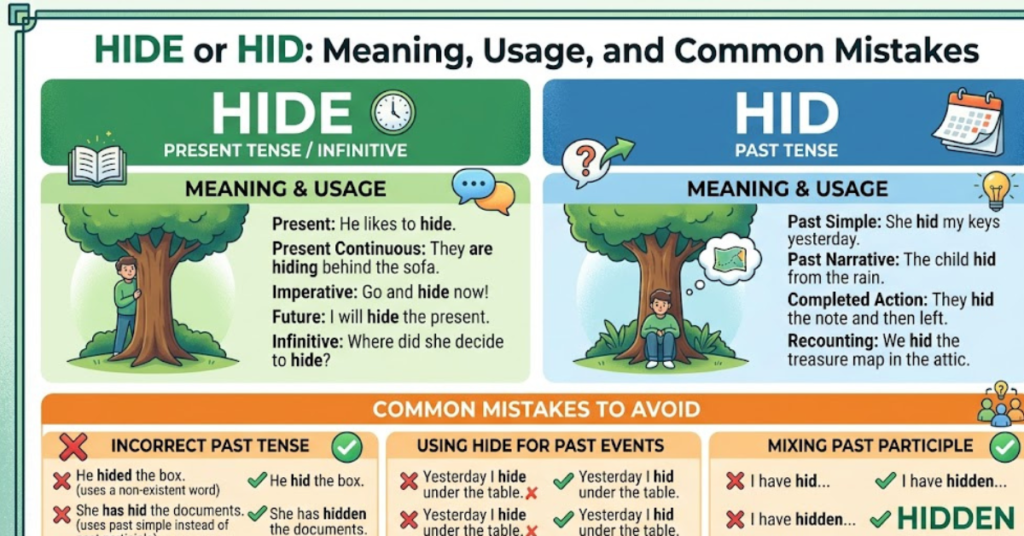
The word hide is the base (present tense) form of the verb. It means to put something or yourself in a place where it cannot be seen.
Examples:
- I always hide my keys in the same drawer.
- They hide surprises for special occasions.
It can also refer to concealing emotions or information.
What Does “Hid” Mean?
Hid is the simple past tense of hide. It describes an action that already happened.
Examples:
- She hid the gift before the party.
- He hid behind the door during the game.
So, when comparing hide or hid meaning, the difference mainly comes down to time: present vs past.
Key Differences
Here’s a quick breakdown to make things clearer:
- Hide → Present tense (happening now or regularly)
- Hid → Past tense (already happened)
Side-by-Side Examples
| Present (Hide) | Past (Hid) |
| I hide my phone at night. | I hid my phone last night. |
| They hide their mistakes. | They hid their mistakes yesterday. |
“I Have Hide or Hid”: Which Is Correct?
This is one of the most common questions. If you’ve ever typed “i have hide or hid”, here’s the rule:
The correct form is “I have hidden”, not hide or hid.
Why?
When using “have” (or has/had), you need the past participle, not the simple past.
- I have hid the book.
- I have hide the book.
- I have hidden the book.
Quick Tip
Think of it this way:
- Hide → present
- Hid → past
- Hidden → used with have/has/had
Common Mistakes and How to Avoid Them
Even experienced writers mix these up. Here are a few pitfalls:
1. Using “hid” with “have”
- Incorrect: I have hid the truth
- Correct: I have hidden the truth
2. Mixing tenses in one sentence
- Incorrect: Yesterday I hide the money
- Correct: Yesterday I hid the money
3. Overthinking simple sentences
Sometimes the simplest option is correct. If it already happened, go with hid.
Easy Memory Tricks
If grammar rules feel overwhelming, these quick tricks can help:
- Hide = Now (present action)
- Hid = Done (past action)
- Hidden = With “have”
You can also test your sentence by adding a time word:
- “Yesterday” → use hid
- “Every day” → use hide
Real-Life Usage Examples
Let’s look at how these forms appear in everyday conversations:
- I hide snacks so no one eats them.
- She hid the letter in her bag.
- We have hidden the documents safely.
These examples show how natural the shift is once you understand the tense.
FAQs
1. What is the difference between hide and hid?
The difference lies in tense. Hide is present tense, while hid is past tense.
2. Is “I have hid” correct?
No, it’s incorrect. The correct form is “I have hidden.”
3. Why do people confuse hide or hid?
They sound similar and are forms of the same verb, which makes them easy to mix up—especially in fast writing.
4. What is the past participle of hide?
The past participle is hidden, used with helping verbs like have, has, or had.
5. Can “hide” ever be used in past tense?
No. For past tense, you must use hid, not hide.
Conclusion
Understanding hide or hid doesn’t have to be complicated. Once you remember the basic tense rules—hide for present, hid for past, and hidden with “have”—you’ll avoid most common mistakes.
If you’ve ever hesitated over “i have hide or hid”, now you know the correct answer and why it works. Keep practicing with simple sentences, and soon it will feel completely natural.
Ready to sharpen your grammar even more? Keep exploring similar word pairs and build your confidence one step at a time.