
Ever paused mid-sentence wondering, “is it cancelled or canceled?” You’re definitely not alone. In fact, this tiny spelling difference trips up writers, students, and even professionals every day. Fortunately, both forms are correct—you just need to know when to use each one.
So, in this guide, we’ll break down cancelled or canceled, explain regional differences, clarify style rules, and show you exactly how to use each version with confidence.
Cancelled or Canceled: What’s the Difference?
At first glance, the only difference is one extra “L.” However, that small detail actually reflects a much bigger pattern in English spelling.
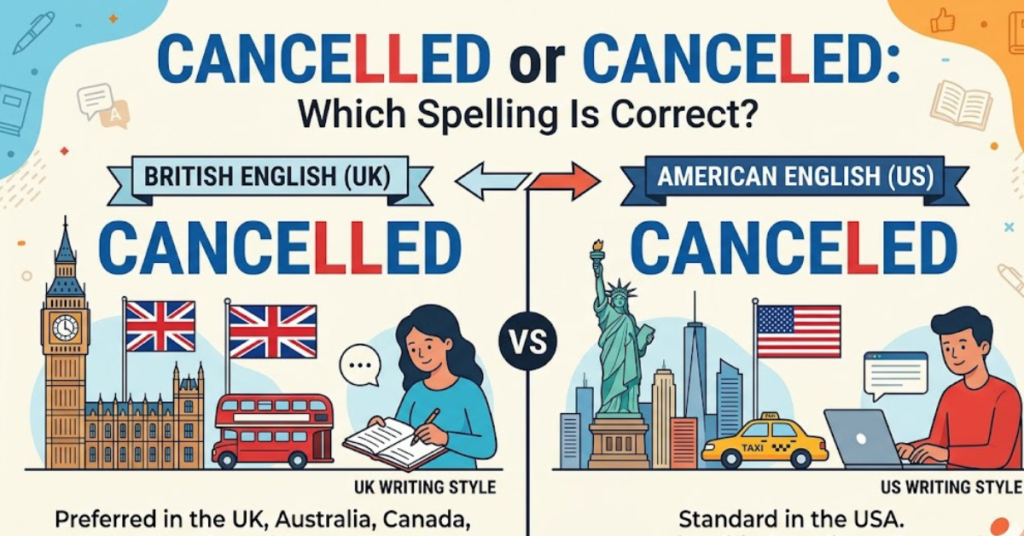
- Cancelled (double “L”) → Preferred in British English
- Canceled (single “L”) → Standard in American English
Therefore, if you’re asking “which is correct—cancelled or canceled?”, the answer ultimately depends on where your audience is.
Quick Rule of Thumb
To make things easier, here’s a simple guide:
- Writing for a US audience? → Canceled
- Writing for the UK, Canada, or Australia? → Cancelled
In other words, context matters more than correctness.
Why Do Two Spellings Exist?
So, why does this variation even exist? Essentially, English spelling evolved differently across regions. On the one hand, American English tends to simplify words. On the other hand, British English often preserves traditional forms.
As a result, you’ll notice this pattern in other words as well:
- Travelled (UK) vs. Traveled (US)
- Labelled (UK) vs. Labeled (US)
- Cancelled (UK) vs. Canceled (US)
Thus, when people search “cancelled or canceled spelling,” they’re really encountering a broader language trend.
Cancelled or Canceled in US English
If you’re writing in American English, the correct form is:
Canceled
This applies to several contexts, including:
- Business writing
- Academic papers
- Journalism (especially AP style)
- Everyday communication
AP Style Rule
Moreover, if you’re wondering about “cancelled or canceled AP style,” here’s the clear answer:
AP Style uses “canceled” (one L)
Consequently, this is especially important for journalists, bloggers, and content writers aiming for professional standards.
Cancelled or Canceled in British English
In contrast, British English prefers:
Cancelled
This spelling is commonly used in:
- UK publications
- International English contexts
- Formal writing outside the US
So, once again, if you’re asking “is cancelled or canceled correct?”, the answer is both—just region-specific.
Meaning
Thankfully, there’s no confusion when it comes to meaning.
Both versions mean:
To decide that something planned will not happen.
For example:
- The meeting was canceled due to rain. (US)
- The concert was cancelled at the last minute. (UK)
Therefore, whether you’re checking the spelling or the definition, the meaning stays exactly the same.
Common Mistakes to Avoid
Even though both spellings are correct, mixing them can look unprofessional. Therefore, it’s important to stay consistent.
Avoid these errors:
- Switching between canceled and cancelled in one piece
- Using British spelling in US-focused content (and vice versa)
- Ignoring style guides like AP or academic standards
In short, consistency is key.
How to Spell Correctly
If you’re still unsure how to choose, simply follow this checklist:
- First, identify your audience (US or international)
- Next, check relevant style guidelines (AP, academic, etc.)
- Finally, stay consistent throughout your document
By following these steps, you can avoid confusion entirely.
Real-World Usage Examples
To make things clearer, here’s how both forms appear in everyday writing:
American English:
- The flight was canceled due to bad weather.
- She canceled her subscription.
British English:
- The match was cancelled after heavy rain.
- They cancelled the event unexpectedly.
Cancelled or Canceled in Pop Culture
Interestingly, even pop culture follows these rules. For instance, you might see searches like “cancelled or canceled Taylor Swift.”
In general:
- US media outlets use canceled
- International outlets often use cancelled
Therefore, regional spelling applies across all types of content—even entertainment.
FAQs
1. Is it cancelled or canceled?
Both are correct. However, canceled is American English, while cancelled is British English.
2. Is cancelled or canceled correct in the US?
In the United States, canceled (one “L”) is correct.
3. How do you spell cancelled or canceled properly?
Simply choose based on your audience:
- US → canceled
- UK/International → cancelled
4. Which is correct: cancelled or canceled?
Both are correct; however, usage depends on regional conventions.
5. What is correct in AP style?
AP style uses canceled (single “L”).
6. Do they have different meanings?
No, both words mean exactly the same thing.
Conclusion
So, “cancelled or canceled?” The answer isn’t about right or wrong—instead, it’s about context.
- Use canceled for American English and AP style
- Use cancelled for British and international English
Ultimately, the key takeaway is simple: stay consistent and write for your audience. By doing so, you’ll not only avoid mistakes but also improve your clarity and credibility.