
Ever paused mid-sentence wondering whether to write halfday or half day? You’re not alone. The confusion around halfday or half day meaning shows up in emails, leave applications, and even professional documents. While the difference may seem minor, using the correct form can make your writing look polished and accurate.
In this guide, we’ll break down the correct usage, explain when each form applies (if at all), and give you practical examples you can start using right away.
Halfday or Half Day: What’s the Correct Form?
Let’s clear this up first:
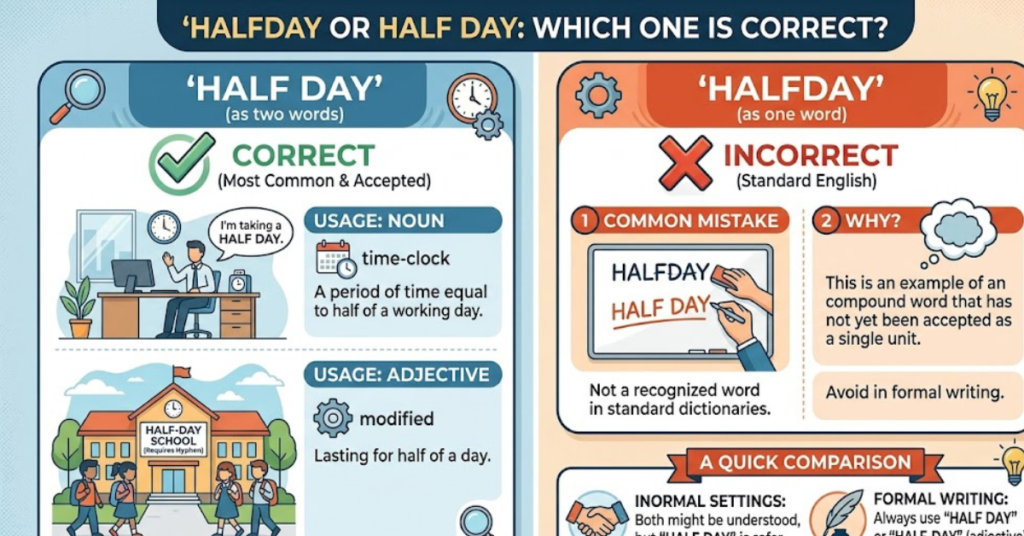
“Half day” (two words) is the correct and widely accepted form.
“Halfday” (one word) is generally incorrect in standard English.
Most dictionaries and style guides recognize half day as a noun phrase, not a compound word. That’s why you’ll see it written separately in formal and informal contexts.
Understanding Halfday or Half Day Meaning
The phrase half day refers to a period that is roughly half of a standard day. The exact length depends on context.
Common meanings include:
- Workplace context: Half of a typical work shift (e.g., 4 hours out of 8)
- School context: A shortened academic day
- General use: Any activity lasting half a day
Example sentences:
- I’m taking a half day off tomorrow.
- The office will operate for a half day due to maintenance.
- Students were dismissed after a half day of classes.
Why “Halfday” Is Often Mistaken as Correct
You might see “halfday” used in casual writing, but that doesn’t make it correct. Here’s why the confusion happens:
1. Influence of Compound Words
English includes many closed compounds like:
- Birthday
- Weekend
- Afternoon
This makes people assume halfday should follow the same pattern.
2. Informal or Internal Usage
Some companies or apps may use “halfday” as shorthand (e.g., in HR systems), but this is not grammatically standard.
3. Typing Habits
Fast typing or autocorrect can merge the words unintentionally.
When to Use “Half Day” Correctly
To avoid mistakes, use half day in these situations:
As a noun (most common)
- I requested a half day leave.
- She worked a half day on Friday.
In professional writing
- Emails
- Reports
- Leave applications
In formal documents
- Contracts
- HR policies
- Academic writing
Should You Ever Use “Halfday”?
In standard English, no—you should avoid it.
However, there are rare exceptions:
- Brand names or internal tools (e.g., software labels)
- Creative writing where stylistic choices apply
Even then, it’s best to stick with half day unless there’s a specific reason not to.
Quick Comparison Table
| Form | Correct? | Usage Context |
| Half day | Yes | Formal and informal writing |
| Halfday | No | Avoid in standard English |
Related Terms and Variations
To expand your understanding, here are a few related expressions:
- Half-day leave (hyphenated as an adjective)
- Example: I applied for a half-day leave.
- Midday (a true compound word)
- Example: We’ll meet at midday.
- Part-time day
- A less common alternative depending on context
Common Mistakes to Avoid
Here are a few errors people often make:
- Writing: I took a halfday off
- Correct: I took a half day off
- Writing: Halfday leave approved
- Correct: Half-day leave approved
- Mixing formats inconsistently
- Stick to one correct form: half day
FAQs
1. Is “halfday” ever correct?
No, “halfday” is not considered correct in standard English. Always use “half day.”
2. What is the correct spelling: halfday or half day?
The correct spelling is half day (two words).
3. How do you use “half day” in a sentence?
Example: I will be working a half day on Monday due to an appointment.
4. Is “half-day” with a hyphen correct?
Yes, when used as an adjective before a noun:
- Example: She requested a half-day leave.
5. What does half day mean in work?
It typically means working for half the usual number of hours, often around 4 hours in an 8-hour workday.
Conclusion
When it comes to halfday or half day, the rule is simple: stick with half day. It’s the correct, widely accepted form across professional, academic, and everyday writing. While “halfday” may appear occasionally, it’s best avoided if you want your writing to look clean and credible.
Next time you’re drafting an email or filling out a leave request, you’ll know exactly which version to use. Small details like this can make a big difference in how your writing is perceived—so it’s worth getting them right.
If you’re interested in improving your grammar further, keep exploring commonly confused words and sharpen your writing skills step by step.