
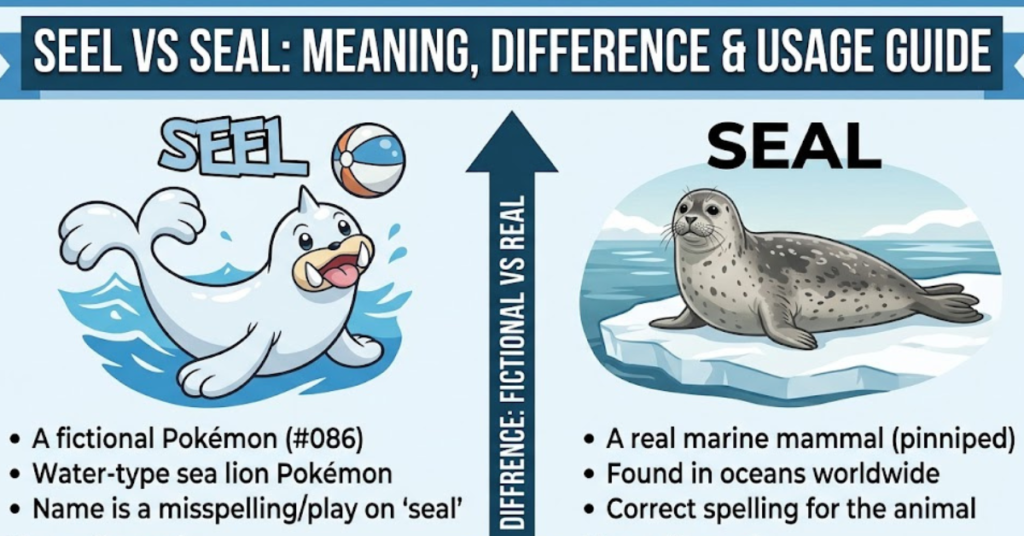

Ever paused mid-sentence wondering whether to write seel or seal? You’re not alone. The confusion around seel vs seal is more common than you might think, especially since one is a standard English word and the other is rarely used or outdated.
In this guide, we’ll break down the seel vs seal meaning, highlight the seel vs seal difference, and show you exactly when (and if) to use each one—without overcomplicating things.
Seel vs Seal: What’s the Difference?
Let’s get straight to the point:
- Seal is a correct and widely used English word.
- Seel is either an archaic term or a misspelling in modern usage.
That’s the core of the seel vs seal difference. But to really understand it, we need to look at each word individually.
What Does “Seal” Mean?
Common Meanings of “Seal”
“Seal” is a versatile word with several meanings depending on context:
- To close something tightly
- Example: Please seal the envelope before sending it.
- An official stamp or mark
- Example: The document has the company seal.
- A marine animal
- Example: We saw a seal at the beach.
- To finalize or confirm something
- Example: They sealed the deal with a handshake.
Why “Seal” Is So Common
“Seal” is part of everyday English. Whether you’re talking about packaging, agreements, or animals, it’s a word you’ll see and use often.
What Does “Seel” Mean?
Now here’s where things get interesting.
The Meaning of “Seel”
“Seel” is an old or archaic word that historically meant:
- To close or sew up the eyes of a falcon (used in falconry)
- To blind or obscure vision (figuratively)
Example (historical usage):
The falconer would seel the bird’s eyes during training.
Why You Rarely See “Seel”
In modern English, “seel” is almost never used. If you come across it, it’s usually in:
- Old literature
- Historical texts
- Specialized contexts like falconry
For everyday writing, “seel” is usually a typo for “seal.”
Seel vs Seal Meaning Explained Simply
To make things crystal clear:
- Seal = Common, modern word with multiple meanings
- Seel = Rare, outdated term with a very specific historical meaning
So when comparing seel vs seal meaning, the practical choice in almost every situation is “seal.”
When Should You Use “Seal”?
Use “seal” in almost all modern contexts, such as:
- Closing packages or containers
- Official approvals or stamps
- Agreements and deals
- Referring to the animal
Quick Examples
- Seal the jar tightly.
- The contract needs a seal.
- A seal swam near the shore.
When (If Ever) Should You Use “Seel”?
Only use “seel” if:
- You’re writing historical or literary content
- You’re referencing falconry terminology
- You intentionally want an archaic tone
Otherwise, it’s best avoided.
Common Mistakes to Avoid
Here are a few frequent errors related to seel vs seal difference:
- Writing seel instead of seal in everyday sentences
- Assuming both words are interchangeable
- Using seel in formal or professional writing
Pro Tip
If you’re unsure, go with seal—it’s correct 99% of the time.
Seel vs Seal in Everyday Writing
In modern communication—emails, blogs, academic writing, or social media—“seal” is the only appropriate choice.
Using “seel” may confuse readers or make your writing look like it contains a typo.
FAQs About Seel vs Seal
1. Is “seel” a real word?
Yes, but it’s archaic and rarely used today.
2. What is the main difference between seel and seal?
The seel vs seal difference is that “seal” is modern and widely used, while “seel” is outdated and limited to historical contexts.
3. Can I use “seel” instead of “seal”?
No, not in modern English. It would usually be considered incorrect.
4. Why do people confuse seel and seal?
They sound similar and look alike, leading to spelling mistakes.
5. Which one should I use in writing?
Always use “seal” unless you have a very specific historical reason to use “seel.”
Conclusion
Understanding seel vs seal doesn’t have to be complicated. The key takeaway is simple:
- Seal is the correct, modern word you should use in almost every situation.
- Seel is outdated and rarely relevant today.
By keeping this distinction in mind, you’ll avoid common mistakes and write with more clarity and confidence. If you’re ever in doubt, stick with “seal”—it’s the safe and correct choice.
Want to sharpen your grammar even further? Keep exploring commonly confused words and build a stronger, more polished writing style step by step.