
Ever paused mid-sentence and wondered whether it’s dysregulation or disregulation? You’re not alone. The confusion around dysregulation vs disregulation is surprisingly common, especially since both words sound like they could be correct.
Here’s the short answer: one is widely accepted and used in science and psychology, while the other is generally considered a misspelling. But there’s more to the story. In this article, we’ll break down what each term means (or doesn’t), where they come from, and how to use the correct one with confidence.
Dysregulation vs Disregulation: The Core Difference
What Is Dysregulation?
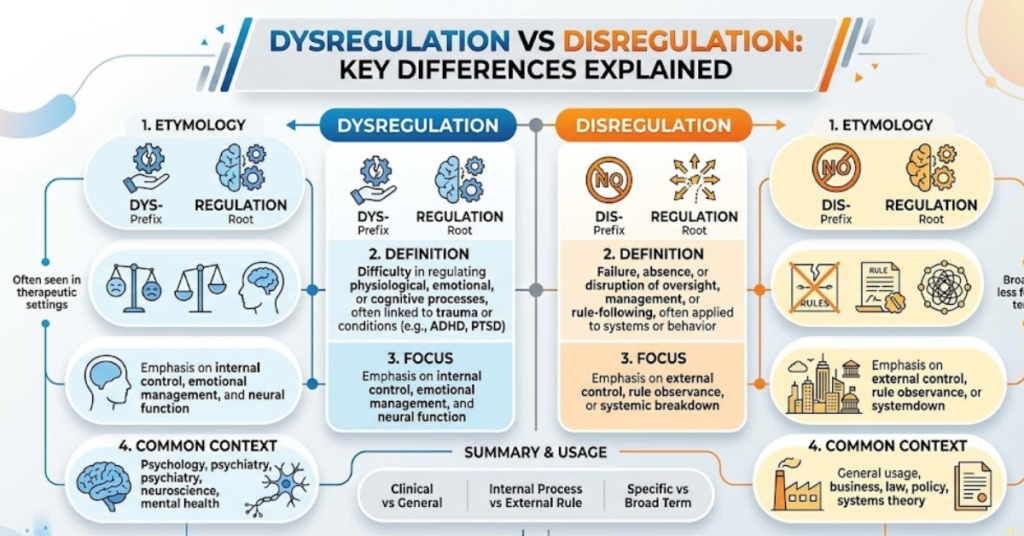
Dysregulation is a legitimate and widely used term, especially in medical and psychological contexts. It refers to an impairment in the ability to regulate emotional, physiological, or behavioral processes.
In simpler terms, it’s when something in the body or mind isn’t properly controlled or balanced.
Common examples include:
- Emotional dysregulation (difficulty managing emotions)
- Hormonal dysregulation (imbalanced hormone levels)
- Nervous system dysregulation (issues with stress responses)
The prefix “dys-” comes from Greek and means bad, difficult, or impaired, which gives the word its meaning of impaired regulation.
Is Disregulation a Real Word?
Technically, “disregulation” is not recognized as a standard or correct term in most dictionaries or academic fields. It occasionally appears in informal writing, but it’s generally considered a misspelling or misunderstanding of dysregulation.
Why the confusion?
- The prefix “dis-” usually means not or opposite of
- People assume “disregulation” means lack of regulation
- However, English doesn’t formally adopt this version in this context
So, while it might seem logical, it’s not the correct term to use in professional or academic writing.
Why Dysregulation Matters in Psychology and Health
Dysregulation is a key concept in several fields, especially mental health. Understanding it can help explain a wide range of human experiences.
Emotional Dysregulation
This is one of the most commonly discussed forms. It refers to difficulty managing emotional responses.
Signs may include:
- Intense mood swings
- Overreacting to minor situations
- Difficulty calming down after stress
It’s often linked to conditions like anxiety, depression, and trauma-related disorders.
Physiological Dysregulation
This involves the body’s internal systems not functioning properly.
Examples include:
- Sleep cycle disruptions
- Appetite control issues
- Stress hormone imbalance
Behavioral Dysregulation
This type affects actions and decision-making.
You might notice:
- Impulsivity
- Trouble focusing
- Difficulty following routines
Common Mistakes People Make
When comparing dysregulation vs disregulation, the confusion usually comes down to spelling and prefix misunderstanding.
1. Assuming Both Are Correct
Only dysregulation is accepted in formal usage.
2. Mixing Up Prefixes
- Dys- = impaired or abnormal
- Dis- = not or opposite
They are not interchangeable.
3. Using Disregulation in Academic Writing
This can reduce credibility, especially in research or professional contexts.
Quick Comparison Table
| Feature | Dysregulation | Disregulation |
| Correct spelling | Yes | No |
| Meaning | Impaired regulation | Not officially defined |
| Common usage | Psychology, medicine, biology | Informal or mistaken usage |
| Accepted in academia | Yes | No |
How to Remember the Difference
A simple trick:
- Think of “dysfunction” → something not working properly
- Now apply that to dysregulation → regulation not working properly
That connection makes it easier to recall the correct term.
When Should You Use Dysregulation?
Use dysregulation when describing:
- Emotional instability
- Biological imbalances
- Irregular behavioral patterns
Avoid using disregulation entirely unless you’re intentionally discussing the mistake itself.
FAQs
1. Is disregulation ever correct?
No, disregulation is not considered a correct or standard English word in formal contexts.
2. Why do people confuse dysregulation vs disregulation?
Because the prefixes “dys-” and “dis-” sound similar and both suggest something negative, leading to frequent mix-ups.
3. Is dysregulation only used in psychology?
No. While common in psychology, it’s also used in medicine, neuroscience, and biology.
4. What’s an example of dysregulation in daily life?
Struggling to control anger during minor disagreements is a simple example of emotional dysregulation.
5. Can dysregulation be treated?
Yes. Depending on the type, it can often be managed through therapy, lifestyle changes, or medical treatment.
Conclusion
Understanding the difference between dysregulation vs disregulation is simpler than it first appears. One is a well-established term used across science and mental health, while the other is largely a misspelling that slips in due to confusion over prefixes.
If you want to communicate clearly and professionally, stick with dysregulation. It’s accurate, widely recognized, and conveys exactly what you mean.
Want to sharpen your language even more? Keep exploring commonly confused words—you’ll be surprised how much clarity it brings to your writing.