
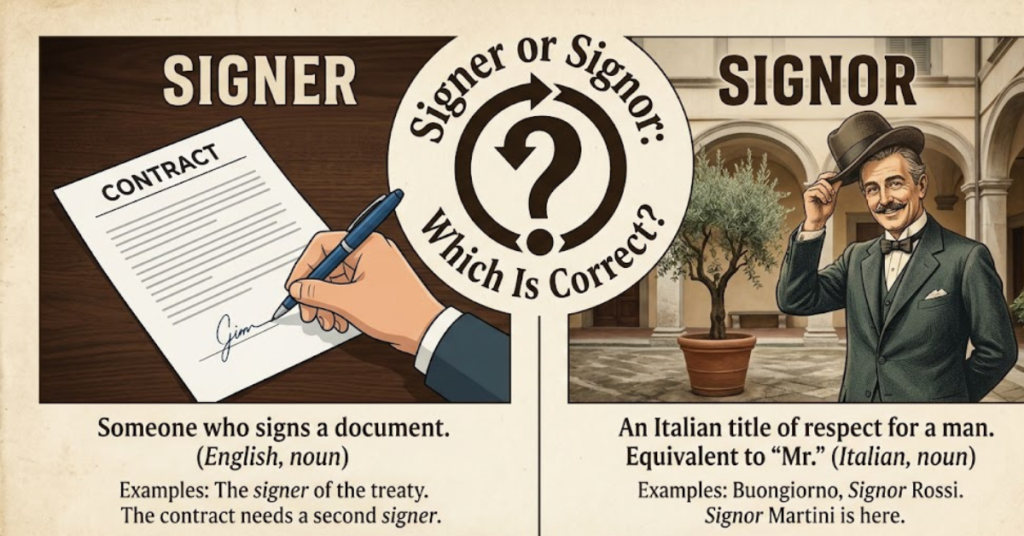

Ever paused mid-sentence wondering signer or signor—which one is actually correct? You’re not alone. It’s a common mix-up, especially in formal contexts like banking, contracts, and official documents. While the two words look similar, they mean completely different things.
In this guide, we’ll break down the difference between signer or signor, explain when to use each, and clear up confusion around phrases like authorized signer or signor and bank account signer or signor. By the end, you’ll never second-guess yourself again.
Signer or Signor Meaning: What’s the Difference?
Let’s start with the basics.
What Does “Signer” Mean?
A signer is a person who signs a document. Simple as that.
It’s commonly used in legal, financial, and business contexts, such as:
- Contracts
- Bank accounts
- Agreements
- Checks
For example:
- “The contract requires two signers.”
- “She is an authorized signer on the account.”
What Does “Signor” Mean?
Signor (pronounced seen-yor) is an Italian word meaning “Mr.” or “Sir.” It’s a title of respect, similar to “Mister” in English.
For example:
- “Signor Rossi will see you now.”
Key takeaway:
- Signer = someone who signs
- Signor = a respectful Italian title
Is It Signer or Signor in Professional Use?
If you’re dealing with legal, financial, or official documents, the correct word is almost always signer.
Common Scenarios
Here’s how it breaks down:
- Banking: bank account signer or signor → signer
- Contracts: contract signer or signor → signer
- Checks: check signer or signor → signer
- Authorization: authorized signer or signor → signer
Using signor in these contexts would be incorrect unless you’re literally referring to an Italian person with that title.
Authorized Signer or Signor: Which Is Correct?
This is one of the most searched variations—and the answer is clear.
Correct: authorized signer
Incorrect: authorized signor
An authorized signer is someone officially permitted to sign documents on behalf of a company, organization, or individual.
Examples:
- “Only an authorized signer can approve this transaction.”
- “He was added as an authorized signer to the business account.”
What Should You Use?
When it comes to banking, always use signer.
A bank account signer is someone who has permission to:
- Access the account
- Sign checks
- Approve transactions
Example:
- “She is the primary signer on the account.”
Using signor here would be incorrect and could even create confusion in formal paperwork.
Signer or Signor or Signee: Don’t Mix Them Up
Here’s where things get slightly more nuanced.
Key Differences:
- Signer: the person who signs a document
- Signee: the person who is being signed to or receives the document
- Signor: an Italian title (unrelated to signing)
Example:
- “The signer completed the agreement.”
- “The signee accepted the terms.”
Tip: In most cases, you’ll use signer, not signee or signor.
When to Use Signer or Signor
Use Signer When:
- Referring to someone signing a document
- Talking about legal or financial roles
- Mentioning banking or contracts
Use Signor When:
- Addressing an Italian man formally
- Writing in Italian or referencing Italian culture
Which Is Correct
Let’s settle it clearly:
- In business, legal, and banking contexts → Signer
- In Italian language or cultural contexts → Signor
If you’re ever unsure, ask yourself:
“Am I talking about someone signing something?”
If yes → go with signer.
Common Mistakes to Avoid
Here are a few frequent errors people make:
- Writing “authorized signor” instead of “authorized signer”
- Using “signor” in contracts or bank forms
- Confusing “signee” with “signer”
Quick Fix:
Stick with signer for anything involving documents or signatures.
FAQs
1. Is it signer or signor on a bank account?
It’s signer. A bank account signer is someone authorized to manage and sign on the account.
2. What does signer or signor mean?
A signer signs documents, while signor is an Italian title meaning “Mr.”
3. Is it authorized signer or signor?
The correct term is authorized signer.
4. Can signor ever be used in business documents?
Only if you’re addressing someone with that title. Otherwise, use signer.
5. What’s the difference between signer and signee?
A signer signs the document; a signee is the person receiving or being granted something.
Conclusion
The confusion around signer or signor is understandable—but once you know the difference, it’s easy to get right. In nearly all professional, legal, and financial contexts, signer is the correct choice. Signor, on the other hand, belongs to the Italian language and has nothing to do with signing documents.
If you remember just one thing:
Documents = signer
Italian titles = signor
Now that you’ve got it clear, you can write with confidence—whether you’re filling out a bank form or drafting a contract.