

Ever paused mid-sentence wondering whether to write headcount or head count? You’re not alone. This small detail trips up writers, HR professionals, and business leaders more often than you’d expect. While it may seem minor, using the correct form can make your writing look polished and professional.
In this guide, we’ll break down the headcount or head count meaning, explain which version is correct, and clarify headcount or head count AP style rules. By the end, you’ll know exactly when—and how—to use it confidently.
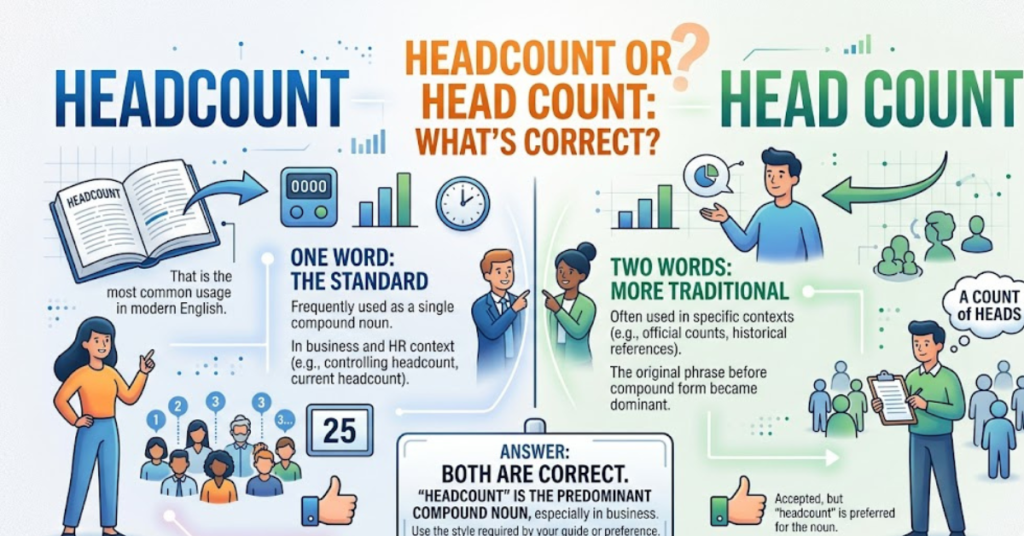
Headcount or Head Count: What’s the Difference?
At its core, both forms refer to the same idea: the total number of people in a group, usually employees in a company.
Headcount (One Word)
- Most commonly used in modern business and HR contexts
- Functions as a noun
- Refers to the total number of employees
Example:
“Our company’s headcount increased by 20% this year.”
Head Count (Two Words)
- Less common in business writing
- Often used in a more literal or informal sense
- Can refer to physically counting people
Example:
“The teacher did a quick head count before leaving the classroom.”
In short:
- Use headcount in professional, corporate, and HR writing
- Use head count when referring to the act of counting people physically
Headcount or Head Count Meaning in Business Context
In business environments, headcount has a more specific and strategic meaning. It’s not just about numbers—it’s about workforce planning and resource management.
What Headcount Includes:
- Full-time employees
- Part-time workers
- Contract staff (depending on context)
Why It Matters:
Organizations rely on headcount data to:
- Plan budgets and salaries
- Allocate resources
- Track company growth
- Manage hiring and layoffs
Example:
“Reducing headcount is part of the company’s cost-cutting strategy.”
Is It Headcount or Head Count in AP Style?
If you’re following Associated Press (AP) style, the correct usage is:
Headcount (one word)
AP style generally favors compound words when they are widely accepted and commonly used in professional contexts. Since “headcount” has become standard in business and journalism, it is preferred.
AP Style Tip:
- Always use headcount when referring to employee numbers
- Avoid “head count” unless describing a literal counting action
When Should You Use Headcount?
Here are some common situations where headcount is the right choice:
In HR and Business Reports
- “The company’s headcount reached 500 employees.”
Financial Planning
- “We need to adjust headcount to meet budget targets.”
Project Management
- “The project requires a headcount of at least 10 developers.”
Common Mistakes to Avoid
Even experienced writers slip up. Here are a few pitfalls to watch for:
- Using “head count” in formal business writing
- Switching between both forms inconsistently
- Misusing it as a verb (“We will headcount the team”)
Quick Rule to Remember:
If you’re talking about employees or workforce size, stick with headcount.
Related Terms
To better understand the concept, here are some related terms often used alongside headcount:
- Workforce size
- Employee count
- Staffing levels
- Personnel numbers
- Team size
These terms can help diversify your writing while maintaining clarity.
FAQs
1. Is it headcount or head count?
In most professional and business contexts, headcount (one word) is correct.
2. What is the meaning of headcount?
It refers to the total number of people in a group, typically employees within an organization.
3. Which form is correct in AP style?
AP style recommends using headcount as a single word.
4. Can head count ever be correct?
Yes, but only when referring to the literal act of counting people physically.
5. Is headcount formal or informal?
It’s considered formal and widely used in business, HR, and corporate communication.
Conclusion
So, is it headcount or head count? The answer is simple once you understand the context. In nearly all professional settings, headcount is the correct and preferred choice—especially in business writing and AP style.
Remember:
- Use headcount for workforce-related discussions
- Reserve head count for literal counting situations
Getting this right may seem like a small detail, but it can make a big difference in how polished your writing appears. If you’re aiming for clarity and professionalism, stick with what modern usage—and style guides—recommend.
Ready to sharpen your writing further? Explore more grammar guides and take your communication skills to the next level.