
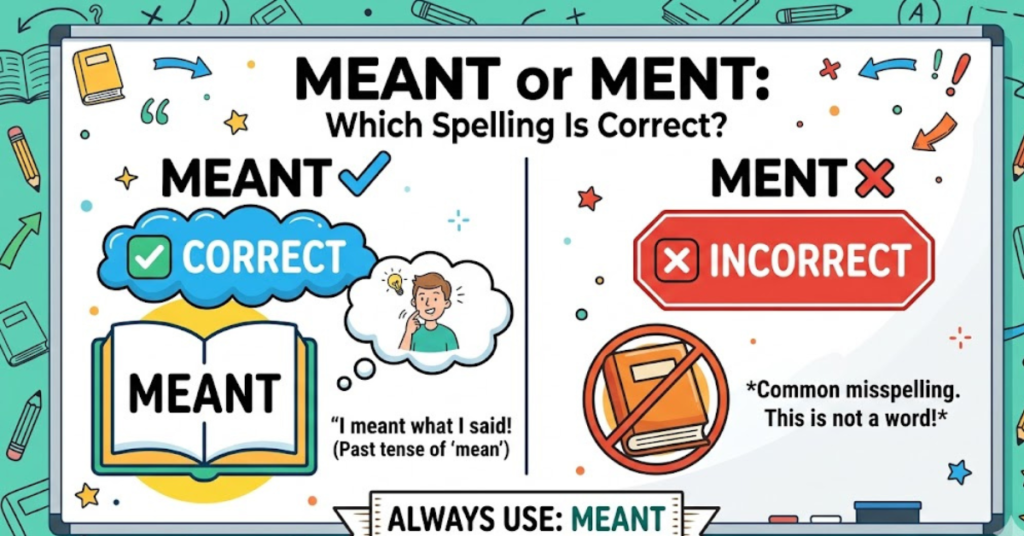

Ever paused mid-sentence wondering, “Is it meant or ment?” You’re not alone. This common spelling confusion trips up students, writers, and even fluent English speakers. The good news? It’s an easy fix once you understand the rule.
In this guide, we’ll break down meant or ment, explain the correct usage, and show you how to remember it for good. Whether you’re writing an email or a school paper, you’ll never second-guess yourself again.
Which One Is Correct?
Let’s clear it up right away:
“Meant” is correct
“Ment” is incorrect (not a standard English word)
If you’ve been wondering “is it meant or ment?”, the answer is simple: always use “meant.”
What Does “Meant” Mean?
The word “meant” is the past tense and past participle of the verb mean.
Definition:
- To intend or express something
- To signify or represent an idea
Examples:
- I meant to call you yesterday.
- What did you mean by that?
- She never meant to hurt anyone.
So when people ask about meant or ment meaning, they’re really asking about “meant”—because “ment” has no recognized meaning in standard English.
Why Do People Write “Ment”?
The confusion around spell meant or ment usually comes from pronunciation.
Here’s why it happens:
- “Meant” is pronounced like “ment”
- English spelling isn’t always phonetic
- Similar-sounding words create confusion
Think of it like:
- Went (not “wentt”)
- Sent (not “sentt”)
English loves silent letters—and “meant” is one of those tricky cases.
How to Remember the Correct Spelling
If you struggle with how to spell meant or ment, try these quick tricks:
1. Connect It to “Mean”
“Meant” comes from “mean”—so keep the “ea”:
- Mean → Meant
2. Think of Similar Words
- Dream → Dreamt
- Lean → Leant
They follow a similar pattern.
3. Use a Memory Phrase
“I meant what I mean.”
This reinforces the correct spelling naturally.
In a Sentence
Seeing real examples makes it easier to remember.
Correct Usage:
- I meant to finish my homework earlier.
- He meant every word he said.
- This gift is meant for you.
Incorrect Usage:
- I ment to call you.
- She ment no harm.
When practicing meant or ment in a sentence, always double-check for that “ea.”
Common Grammar Questions
Is It “I Meant” or “I Ment”?
Always “I meant.”
Grammar Rule
- “Meant” = correct past tense of mean
- “Ment” = incorrect spelling
Mean, Meant, or Ment?
- Mean (present)
- Meant (past)
- Ment ( not a word)
Spelling Tips
If you often search how do you spell meant or ment, here’s a quick checklist:
- Does it come from “mean”? → Use meant
- Is it past tense? → Use meant
- Unsure? → “Ment” is never correct
Why This Matters in Writing
Spelling errors like these can :
- Reduce credibility
- Confuse readers
- Impact academic or professional work
Even though it’s a small mistake, it can make a big difference in how your writing is perceived.
Read also <<< Pannel or Panel: Correct Spelling & Meaning Guide
FAQs
1. Is “ment” ever a correct word?
No. “Ment” is not a standard English word. It’s always a misspelling of “meant.”
2. Why does “meant” sound like “ment”?
English pronunciation doesn’t always match spelling. “Meant” simply has a silent vowel combination.
3. How do I stop confusing meant or ment?
Practice writing sentences and remember the root word “mean.”
4. Is this a common mistake?
Yes, especially among learners and fast typists. It’s widely searched online, including discussions like “meant or ment reddit.”
5. Can spell check fix this?
Most tools will flag “ment” as incorrect, but it’s still good to know the rule yourself.
Conclusion
So, when it comes to meant or ment, the answer is clear: “meant” is the only correct spelling. It’s the past tense of “mean” and the version you should always use in writing.
If you’ve ever hesitated or typed the wrong one, don’t worry—it’s a common mistake. Now that you understand the rule, you can write with confidence and avoid this slip entirely.
Want to sharpen your grammar even more? Keep exploring similar word pairs and build your writing skills step by step.