
Ever paused mid-sentence wondering whether to write scraped or scrapped? You’re not alone. The confusion around scraped vs scrapped meaning is incredibly common, and using the wrong one can completely change what you’re trying to say.
These two words may look similar, but their meanings are worlds apart. In this guide, we’ll break things down in a simple, no-confusion way—so you can use each word correctly and confidently every time.
Scraped vs Scrapped Meaning: The Core Difference
Let’s get straight to the point.
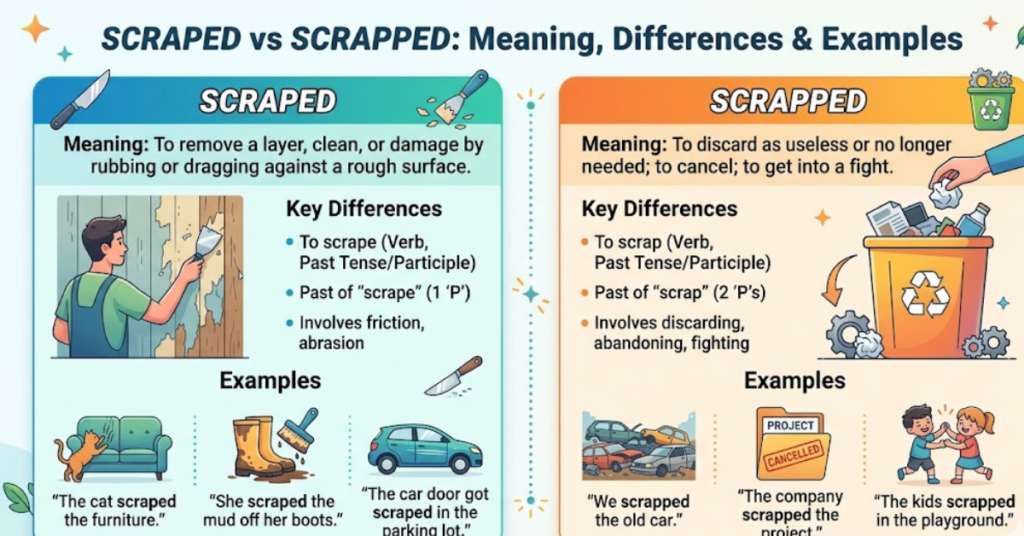
- Scraped → means to remove or gather something by rubbing or dragging across a surface
- Scrapped → means to discard, cancel, or get rid of something entirely
That single extra “p” makes a big difference.
What Does “Scraped” Mean?
Definition of Scraped
“Scraped” is the past tense of scrape. It usually involves physical action or collecting something from a surface.
Common Uses of Scraped
You’ll often see “scraped” used in situations like:
- Removing something from a surface
- Light injury (like skin damage)
- Collecting data or resources
Examples of Scraped in Sentences
- She scraped her knee while playing outside.
- He scraped the paint off the wall.
- The company scraped data from multiple websites.
Related Keywords (LSI)
- scratched
- removed
- collected
- gathered
What Does “Scrapped” Mean?
Definition of Scrapped
“Scrapped” comes from scrap, meaning to throw away, cancel, or abandon something.
Common Uses of Scrapped
This word is typically used in decision-making or planning contexts:
- Canceling projects
- Discarding items
- Abandoning ideas
Examples of Scrapped in Sentences
- The company scrapped its expansion plans.
- They scrapped the old car after the accident.
- The idea was scrapped due to budget issues.
Related Keywords (LSI)
- canceled
- abandoned
- discarded
- eliminated
Key Differences Between Scraped and Scrapped
Here’s a quick comparison to lock it in:
| Feature | Scraped | Scrapped |
| Meaning | Removed or collected by friction | Discarded or canceled |
| Context | Physical action or data collection | Decisions or plans |
| Example | Scraped mud off shoes | Scrapped the project |
| Memory Tip | “Scrape = surface” | “Scrap = trash” |
Easy Trick to Remember the Difference
If you mix them up often, try this:
- Scraped (one “p”) → Think of a surface action
- Scrapped (two “p’s”) → Think of putting something in the trash pile
A simple visual:
More “p’s” = more final → completely gone.
Common Mistakes to Avoid
Even experienced writers slip up here. Watch out for these:
- “The plan was scraped” (Incorrect if you mean canceled)
- “The plan was scrapped”
- “He scrapped mud off his shoes”
- “He scraped mud off his shoes”
When to Use Each Word (Quick Guide)
Use scraped when you mean:
- Removing something physically
- Collecting data
- Light injury
Use scrapped when you mean:
- Canceling a plan
- Throwing something away
- Abandoning an idea
FAQs
1. What is the main difference between scraped and scrapped?
The key difference in scraped vs scrapped meaning is that “scraped” involves removing or collecting, while “scrapped” means discarding or canceling.
2. Is “scraped” ever used for canceling something?
No, “scraped” is not used for canceling. The correct word in that context is “scrapped.”
3. Can both words be used in business writing?
Yes, but in different contexts:
- “Scraped” for data collection
- “Scrapped” for canceled plans or projects
4. Why do people confuse scraped and scrapped?
They sound similar and differ by only one letter, making them easy to mix up in writing.
5. How can I remember the correct usage?
Think:
- Scraped = surface action
- Scrapped = trash or cancellation
Conclusion
Understanding the difference between these two words is simpler than it first seems. Once you grasp the core idea behind scraped vs scrapped meaning, it becomes second nature to choose the right one.
Just remember:
- Scraped is about removing or collecting
- Scrapped is about discarding or canceling
Mastering small distinctions like this can make your writing clearer, sharper, and more professional. If you want to improve further, keep exploring similar commonly confused words—they’re small tweaks that make a big impact.