
Ever typed “steller vs stellar” and paused, wondering which one is actually correct? You’re not alone. It’s a surprisingly common confusion, especially because both words look nearly identical—and one of them even sounds right in certain contexts.
In this guide, we’ll break down the difference between steller vs stellar, explain which one is correct (most of the time), and show you how to use each word confidently. By the end, you won’t second-guess yourself again.
What Does “Stellar” Mean?
Let’s start with the word you’ll use most often.
“Stellar” is a real and widely accepted English word. It comes from the Latin word stella, meaning star. Over time, its meaning expanded beyond astronomy.
Common meanings of “stellar”:
- Related to stars (literal meaning)
- Outstanding or excellent (figurative meaning)
Examples:
- She gave a stellar performance in the presentation.
- Astronomers study stellar formations in distant galaxies.
Synonyms of “stellar”:
- Outstanding
- Exceptional
- Brilliant
- (in Urdu context, meaning excellent)
In everyday language, “stellar” is often used to describe something impressive or top-quality.
What Does “Steller” Mean?
Here’s where things get interesting.
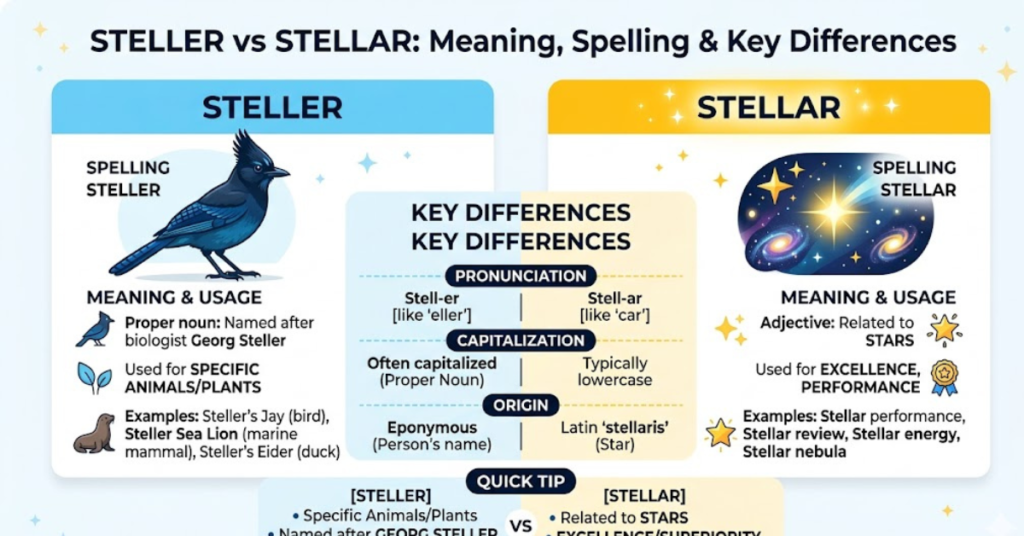
“Steller” is not a standard English word in most contexts. In fact, it’s usually just a misspelling of “stellar.”
However, there is one exception.
Rare usage of “Steller”:
- It appears as a proper noun, mainly in names.
For example:
- Steller’s sea eagle (a species of bird)
- Named after the German naturalist Georg Wilhelm Steller
So while “steller” exists in very specific scientific or historical names, it is not used as a general adjective.
Steller vs Stellar: The Key Difference
Let’s simplify it:
| Word | Correct Usage | Meaning | Common Use |
| Stellar | Yes | Excellent / star-related | Everyday language |
| Steller | Usually no | Proper name only | Rare, specific cases |
Quick takeaway:
- Use stellar when describing something amazing or star-related
- Avoid steller unless referring to a specific name or species
Why Do People Confuse “Steller” and “Stellar”?
This confusion happens for a few simple reasons:
1. Similar spelling
Both words differ by just one letter, making typos easy.
2. Pronunciation overlap
When spoken quickly, they can sound nearly identical.
3. Autocorrect mistakes
Sometimes typing errors slip through unnoticed.
When Should You Use “Stellar”?
Use “stellar” in everyday writing when you want to:
- Praise someone’s performance
- Describe something high-quality
- Talk about astronomy or space
Example sentences:
- That was a stellar idea!
- The team delivered stellar results this quarter.
- Scientists observed stellar explosions.
When Is “Steller” Acceptable?
Only use “steller” in very specific contexts:
Proper noun examples:
- Steller’s sea cow
- Steller’s jay
If you’re not referring to a named species or person, you probably want stellar instead.
Common Mistakes to Avoid
Here are a few mistakes people often make:
- she did a steller job → She did a stellar job
- This is a steller performance → This is a stellar performance
Quick tip:
If you’re unsure, go with stellar—it’s almost always the correct choice.
FAQs
1. Is “steller” ever correct?
Yes, but only as a proper noun, such as in animal names like Steller’s sea eagle. Otherwise, it’s usually incorrect.
2. Which is correct: steller or stellar?
Stellar is correct in almost all general writing situations.
3. What does “stellar performance” mean?
It means an outstanding or excellent performance.
4. Why do people misspell stellar as steller?
Because of similar pronunciation and typing errors.
5. Can I use “steller” in formal writing?
Only if you’re referring to a specific name. Otherwise, avoid it.
Conclusion
Understanding the difference between steller vs stellar is simpler than it first appears. In most cases, “stellar” is the correct and widely accepted word, used to describe excellence or anything related to stars. “Steller,” on the other hand, is limited to rare proper nouns.
If you remember just one thing, make it this:
When in doubt, choose stellar.
Now that you’ve got it down, you can write with confidence—and maybe even deliver a stellar piece of content yourself.