
Ever paused mid-text wondering whether to write boujee or bougie? You’re not alone. The debate around boujee vs bougie has taken over social media, pop culture, and everyday conversations. While both words sound the same, their meanings and usage can differ depending on context.
In this guide, you’ll learn the real difference, the correct spelling, and how to use each term confidently—without second-guessing yourself.
What Does “Bougie” Mean?
Let’s start with the original term.
Bougie comes from the word bourgeois, a French term historically used to describe the middle or upper-middle class—often associated with materialism or conventional tastes.
Modern Usage
Today, bougie has a more casual and flexible meaning. It’s often used to describe someone or something that feels:
- Fancy or upscale
- Slightly pretentious
- Focused on luxury or appearances
Example:
- “She ordered sparkling water and truffle fries—so bougie.”
Boujie Definition (Alternate Spelling)
You might also see boujie definition searches online. “Boujie” is simply a misspelling or variation of bougie, commonly used in informal writing or social media.
What Does “Boujee” Mean?
Now, let’s talk about boujee.
This version gained popularity through pop culture, especially in music and online slang. It carries a slightly different vibe than bougie.
Modern Meaning of Boujee
Boujee often describes someone who:
- Enjoys luxury but stays relatable
- Mixes high-end taste with everyday roots
- Embraces a flashy or trendy lifestyle
Example:
- “They’re boujee but still eat street food.”
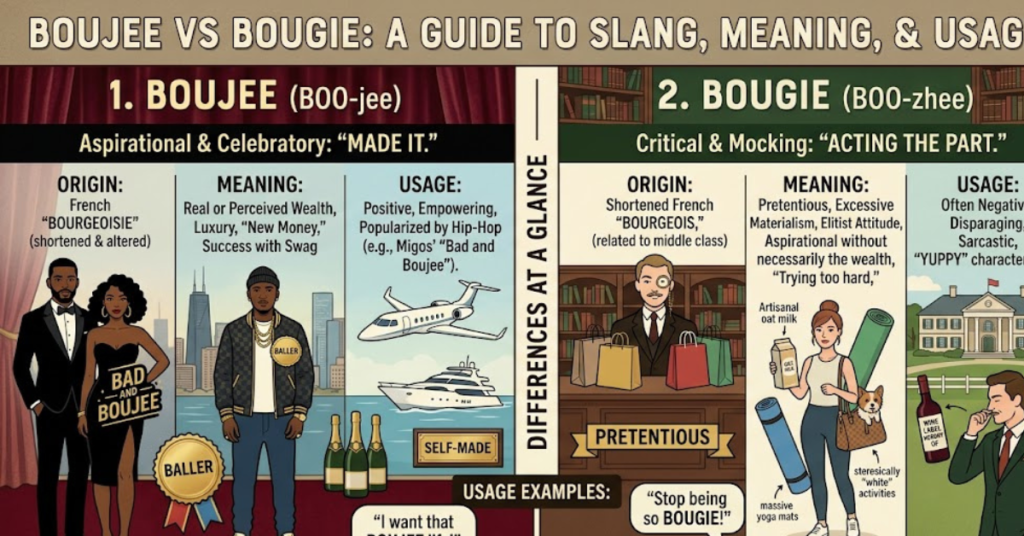
Boujee vs Bougie: Key Differences
Here’s a clear breakdown of boujee vs bougie:
| Feature | Bougie | Boujee |
| Origin | From bourgeois | Slang/pop culture adaptation |
| Tone | Slightly critical or sarcastic | More playful or trendy |
| Meaning | Pretentious or upscale | Stylish with a mix of luxury |
| Usage | More traditional slang | Social media & music culture |
Quick Tip:
If you’re aiming for correctness, bougie is the safer choice. If you’re going for vibe and style, boujee works too.
How Do You Spell Bougie Correctly?
If you’re asking how do you spell bougie, here’s the straightforward answer:
- Correct: Bougie
- Informal/Slang: Boujee
- Common mistake: Boujie
How to Spell Bougie Easily
Think of it this way:
- Bougie → closer to its French root (bourgeois)
- Pronounced: boo-zhee
A simple trick:
If it looks slightly French, you’re probably spelling it right.
When Should You Use Bougie or Boujee?
Choosing between the two depends on your context.
Use Bougie when:
- Writing professionally or semi-formally
- Describing someone as pretentious
- You want linguistic accuracy
Use Boujee when:
- Posting on social media
- Writing casually or creatively
- Referring to modern slang or pop culture
Why People Confuse Boujee vs Bougie
There are a few reasons this mix-up happens so often:
- Same pronunciation – Both sound identical
- Internet influence – Slang evolves quickly online
- Spelling flexibility – Informal writing allows variation
As a result, searches like how to spell bougie or boujie meaning have become increasingly common.
Common Examples in Everyday Language
Here’s how both terms show up in real conversations:
- “That café is so bougie—everything is organic.”
- “He’s boujee now, flying business class everywhere.”
- “Don’t act bougie just because you got a promotion.”
Notice how tone and context slightly shift the meaning.
FAQs
1. Is “boujee” a real word?
Yes, but it’s informal slang. It’s widely accepted in pop culture but not traditionally correct.
2. What is the correct spelling: bougie or boujee?
Bougie is the correct and original spelling. Boujee is a modern variation.
3. What does boujie meaning refer to?
“Boujie” is usually a misspelling of bougie and carries the same meaning.
4. Can I use bougie in formal writing?
You can, but use it carefully. It’s still considered informal.
5. Why is boujee so popular?
Its popularity comes from music, social media, and its association with a trendy lifestyle.
Conclusion
Understanding boujee vs bougie isn’t just about spelling—it’s about tone, context, and cultural nuance. Bougie leans toward tradition and subtle critique, while boujee reflects modern slang and a more playful, aspirational vibe.
If you want accuracy, stick with bougie. If you’re writing casually or channeling pop culture energy, boujee fits right in.
Now that you know the difference, you can use both terms with confidence—and maybe even sound a little more stylish doing it.