
Ever typed “to bad” and wondered if it looked a little off? You’re not alone. The confusion around to bad or too bad is one of those small but surprisingly common grammar mistakes that can slip into everyday writing. The good news? It’s easy to fix once you understand the difference.
In this guide, we’ll break down and explain the correct usage, and give you clear examples so you never second-guess yourself again.
Too Bad vs To Bad: What’s the Difference?
Let’s get straight to the point:
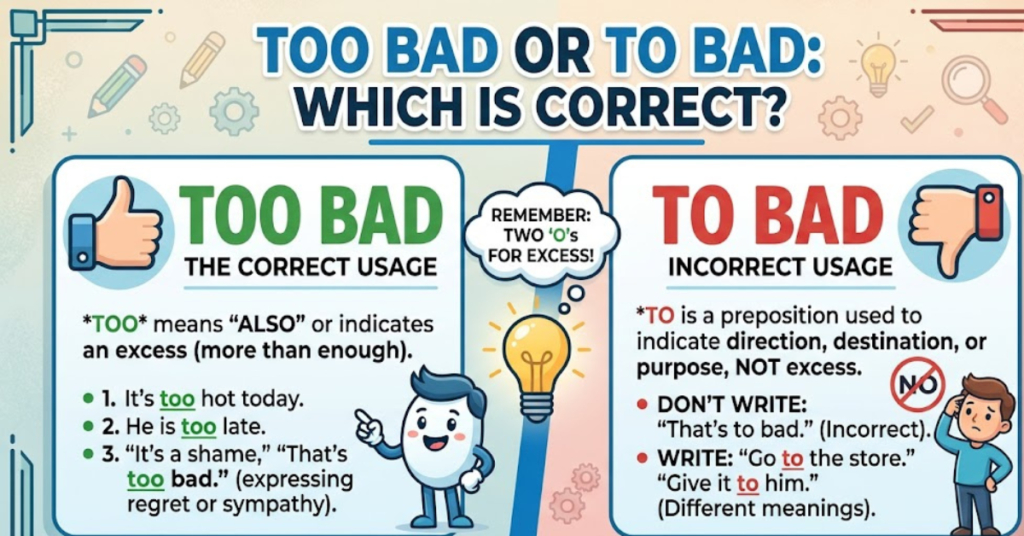
- “Too bad” is correct in almost all cases
- “To bad” is almost always incorrect
Why “Too Bad” Is Correct
“Too” is an adverb that can mean:
- Excessively (e.g., too hot, too cold)
- Also (e.g., me too)
- Or part of expressions like “too bad”, meaning unfortunate or regrettable
Examples:
- That’s too bad you missed the event.
- It’s too bad we can’t go today.
In these cases, “too bad” expresses disappointment or sympathy.
Why “To Bad” Is Usually Wrong
“To” is a preposition or part of an infinitive verb (e.g., to go, to eat). It doesn’t naturally pair with “bad” in the same way.
Incorrect:
- That’s to bad you missed it
There are rare cases where “to bad” might appear in a longer sentence, but not as a phrase meaning “unfortunate.”
Example (rare and different meaning):
- He went from good to bad behavior.
Here, “to” shows direction or change—not the same as “too bad.”
Is It Too Bad or To Bad? (Quick Rule)
If you’re expressing regret, disappointment, or sympathy, the correct phrase is always:
Too bad
A quick trick:
- Replace “too” with “very”
If the sentence still makes sense, you’re using it correctly.
Example:
- That’s very bad → That’s too bad
Common Situations Where “Too Bad” Is Used
You’ll often see or hear “too bad” in everyday conversations. Here are the most common contexts:
1. Expressing Sympathy
- That’s too bad about your exam results.
2. Showing Mild Disappointment
- It’s too bad we couldn’t meet.
3. Casual or Slightly Dismissive Tone
- You missed it? Too bad.
To Bad or Too Bad Grammar Explained
Understanding grammar comes down to knowing the role of “too.”
Key Grammar Points:
- “Too” = adverb (means excessively or unfortunately)
- “To” = preposition or part of a verb
When paired with “bad” to express emotion or judgment, only “too” works correctly.
Easy Ways to Remember the Difference
Here are a few simple memory tricks:
- Too = extra “o” = extra meaning (excess or emotion)
- If you’re expressing a feeling → use too bad
- If “to” doesn’t show direction or purpose → it’s likely wrong
Examples: Correct vs Incorrect Usage
Correct:
- It’s too bad you couldn’t come.
- That’s too bad for them.
Incorrect:
- It’s to bad you couldn’t come
- That’s to bad for them
FAQs
1. Is it “too bad” or “to bad”?
The correct phrase is too bad when expressing disappointment or sympathy.
2. Can “to bad” ever be correct?
Yes, but only in a different context, such as showing direction (e.g., “from good to bad”). It’s not used to express regret.
3. Why do people confuse?
Because “to” and “too” sound the same in spoken English, making them easy to mix up in writing.
4. What does “too bad” mean?
It means something is unfortunate, disappointing, or regrettable.
5. How can I avoid this mistake?
Use the “very” test. If “very bad” fits, then too bad is correct.
Conclusion
When it comes to to bad or too bad, the rule is refreshingly simple:
Use “too bad” when expressing disappointment or sympathy.
The confusion is common, but once you understand the role of “too” as an adverb, the mistake becomes easy to avoid. Keep the quick memory tricks in mind, and you’ll write with more confidence and clarity.
If you’re working on improving your grammar, this small fix can make a big difference in how polished your writing feels.