
Ever paused mid-sentence wondering, “Is it yesterdays or yesterday’s?” You’re definitely not alone. This small grammar detail trips up even confident writers because it involves one of the trickiest parts of English: apostrophes.
In this guide, we’ll break down yesterdays or yesterday’s, explain which is correct, and show you exactly how to use each form in real-life writing. By the end, you’ll never second-guess yourself again.
Yesterdays or Yesterday’s: Which Is Correct?
Let’s clear it up right away:
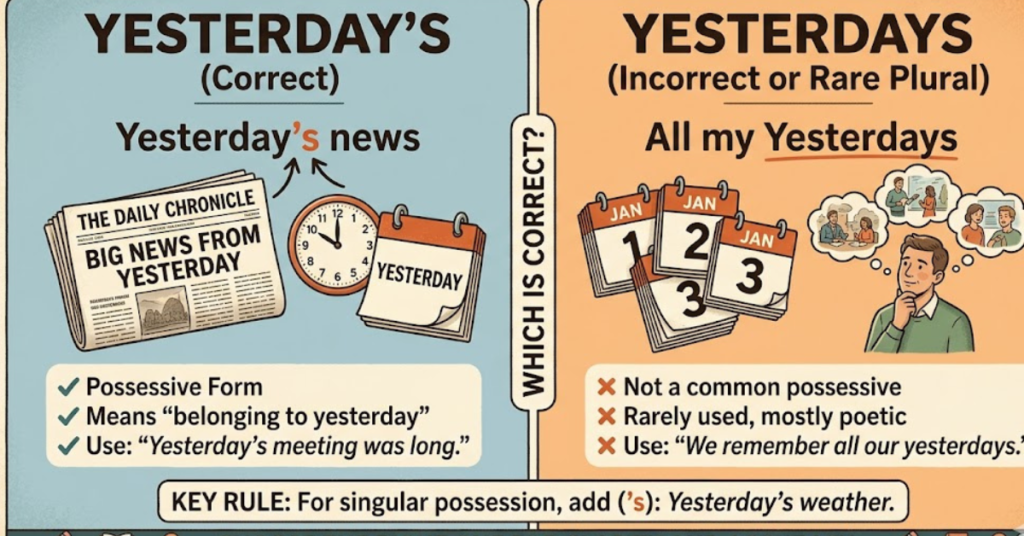
- “Yesterday’s” (with an apostrophe) is usually correct
- “Yesterdays” (without an apostrophe) is rarely used and often incorrect
The confusion comes down to possession vs. pluralization.
Understanding Yesterday’s (With Apostrophe)
What Does “Yesterday’s” Mean?
“Yesterday’s” is the possessive form of yesterday. It shows that something belongs to or is associated with yesterday.
Examples:
- Yesterday’s weather was beautiful.
- I reviewed yesterday’s notes before the test.
- Did you attend yesterday’s meeting?
In all these cases, something is linked to yesterday, so the apostrophe is necessary.
When (If Ever) Is “Yesterdays” Correct?
Is “Yesterdays” Ever Used?
Technically, “yesterdays” is the plural form of yesterday, but it’s rarely used in everyday English.
You might see it in more poetic or literary contexts, such as:
- “We often dwell on our yesterdays.”
Here, “yesterdays” refers to multiple past days or memories, not possession.
Key Takeaway:
- Use “yesterday’s” for almost all practical writing
- Use “yesterdays” only when talking about multiple past days (rare)
Yesterdays or Yesterday’s Meaning Explained
To simplify:
- Yesterday’s = belonging to yesterday
- Yesterdays = more than one past day (rare usage)
If you’re writing something like yesterdays or yesterday’s meeting, the correct choice is:
Yesterday’s meeting
Because the meeting happened on or belongs to yesterday.
Common Grammar Mistakes to Avoid
When dealing with yesterdays or yesterday’s grammar, watch out for these common errors:
1. Forgetting the Apostrophe
Yesterdays news was shocking
Yesterday’s news was shocking
2. Using Plural Instead of Possessive
I missed yesterdays class
I missed yesterday’s class
3. Overthinking It
If something is tied to a specific day, it’s almost always possessive.
Quick Rule to Remember
If you can rephrase the sentence as:
“the [something] of yesterday”
Then “yesterday’s” is correct.
Example:
- Yesterday’s results = the results of yesterday
Real-Life Examples for Clarity
Here are more examples to reinforce the correct usage:
- Yesterday’s game was intense.
- I forgot to submit yesterday’s assignment.
- Let’s discuss yesterday’s events.
Notice how all of these show ownership or connection.
Why This Grammar Rule Matters
Getting yesterdays or yesterday’s which is correct right improves:
- Writing clarity
- Professional communication
- Academic accuracy
Even small grammar details can make a big difference in how your writing is perceived.
FAQs
1. Is it yesterdays or yesterday’s?
The correct form in most cases is yesterday’s, because it shows possession.
2. Can I ever use “yesterdays”?
Yes, but it’s rare. It’s only used when referring to multiple past days or memories, usually in a poetic sense.
3. How do I write yesterdays or yesterday’s meeting?
The correct phrase is yesterday’s meeting.
4. Why does “yesterday” need an apostrophe?
The apostrophe shows that something belongs to or is associated with yesterday.
5. What’s the easiest way to remember this rule?
If you mean something from yesterday, use yesterday’s.
Conclusion
So, when it comes to yesterdays or yesterday’s, the answer is simple:
“Yesterday’s” is almost always the correct choice.
Use it whenever you’re describing something connected to a specific day. Save “yesterdays” for rare, poetic situations.
Mastering small grammar rules like this adds polish to your writing and builds confidence. If you want to keep improving, explore other tricky apostrophe rules—you’ll be surprised how much impact they have.